Tuesday, September 02, 2003

Reversing a Destruction

Photos and story by Ong Ju Lin

The idyllic fishing village of Leam Markham in Trang Province, Southern Thailand, is a classic example of how restoration of coastal mangrove forests can bring a new wave of prosperity to poverty-stricken fisherfolk, writes Ong Ju Lin.
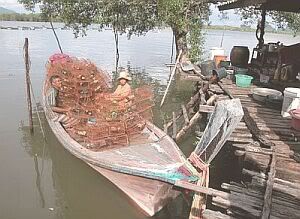

The fishing village of Lean Markham in Trang province is cradled in a lush mangrove forest on the coast of southern Thailand, off the Andaman Sea.


BU NUANSI came home tired but smiling. Wiping his furrowed brows, he pulled out a stool and gestured to us to sit with him. A cat lying nearby stretched itself and sauntered off. The sweet aroma of fried cempedak, served for tea, was invigorating on that hot, humid afternoon.

The good news that the village elder, popularly known as Pak Bu, bore that day was like the clear blue sky – a respite from the monsoon rains.

Pak Bu sat down and looked at us with a confident smile etched on his lined face. “This time, it will be different. We will win.”

Pak Bu, 67, turned conservationist when he realised the only way for his people to eat and live well was to organise themselves to fight for their rights and to protect the environment. He had relinquished his post as village imam (Islamic religious head) to focus on environmental protection and community development.

Pak Bu and his men had just returned from the Muang District police station after having their statements recorded. The day before, he and 10 villagers escorted by policemen had gone out in three boats to arrest a recalcitrant fishing trawler which had eluded them for six years.

They gave chase and surrounded the boat. The four men on board surrendered. The fishing trawler had been infiltrating the 3km coastal conservation zone, dredging the seabed and destroying traditional fishing gear for years. Their faster Apollo boat always managed to evade the smaller fishing boats belonging to subsistence-based fisherfolk.

“Reporters interviewed me this morning. When our story is published it will become a hot issue. The owner of the trawler wanted to settle the matter by paying us off but the whole village refused. The four men are now in police lock-up,” said Pak Bu.

Until recently, such initiative and group action were unheard of in this quiet Muslim community in a Buddhist majority country. For years, they were victims of commercial trawlers, destructive fishing practices and middlemen. Their complains fell on deaf ears as they believed, rich owners of commercial trawlers were in league with corrupt government officials.

Weak enforcement saw big trawlers flouting sea laws. Their huge gaping trawler nets scraped the seabed, crunching up coral reefs and hauling in fries before they had time to grow. Depleted catches forced some fishermen to resort to dynamite fishing and cyanide poisoning which further degraded the marine ecosystem.

Soon the men were returning from sea with empty nets. To help support their families, the women worked for meagre wages in factories, leaving behind malnourished children under the care of the elderly. Impoverished and helpless, the community fell into debt to middlemen.

Many turned to chopping down mangrove wood for charcoal factories to eke out a living. Over the last two and a half decades, more than 50% of the vast mangrove forests along Thailand’s 2,560km-coastline had been destroyed by charcoal companies and tiger prawn aquaculture. The degraded mangroves resulted in even smaller catches and the people were unable to break free from the cycle of poverty.

It was at that low point that Yadfon (Raindrop) Association established contact with this remote village, accessible then only by boat. “When we first came here 19 years ago, there were so many problems we didn’t know where to start. But we were determined to help out, so we stayed on and slowly learned from the villagers and gained their trust,” said Pisit Charnsnoh, 57, who co-founded the organisation with his wife, Luong.
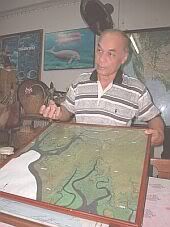

Pisit Chansnoh with a map of the river basin.

“Yadfon creates a learning process. We are not standing in front and teaching. We give equal respect and learn from each other to create something new,” said Pisit, a graduate in animal husbandry.

Their early work includes digging wells to supply clean drinking water, setting up revolving funds for the poor to buy fishing gear and engines for their boats, and rearing of groupers which was very profitable at that time.

In 1986, Yadfon and Pak Bu helped the villagers to create a 95ha community mangrove forest which covered Leam Markham and the neighbouring villages. It was the first of its kind in Thailand. The restoration results were dramatic. From 1991 to 1994, there was a 40% increase in total catch, resulting in increased income levels in the local villages. The success of the community forest caught the attention of the government which gave its tacit support.

Three years ago, charcoal concession was abolished as a result of Yadfon’s work and years of lobbying by environmental groups.

Today, there are nine community managed forests modelled after Leam Markham. The grassroot effort inspired the first-ever popularly-written Community Forest Act which is currently awaiting parliamentary sanction. The Act mandates that villagers are allowed to live and harvest from the forest if they can properly manage the forest in a sustainable manner.

During our trip, we were also taken on a mangrove tour in a fishing boat by Meliwan Menpoh, 36, head of the Leam Markham Women’s Cooperative. She had helped to replant the mangroves and was proud to show us the results of her village’s collective effort.
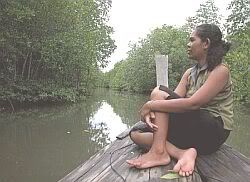

Meliwan Menpoh showing us the mangroves she helped to replant.

At the periphery, two signboards bore the words “Community Mangrove Forest”. As we glided along the canal flanked by verdant mangrove trees, Meliwan pointed out several species whose leaves, roots or barks have medicinal values.

Since the mangroves grew back, the fish, crabs and shellfish have returned, said Meliwan. Their nets are full. The children no longer go hungry.

In the neighbouring village of Tung Tase, the women took us on the 750m mangrove boardwalk sponsored by the Queen of Thailand. With dexterity, they descended the swampy earth and walked with ease among the gnarled roots. One of them bent down and plucked out a clam from the mud. Then another, and another. Soon her hands were full. Scanning the rich black mass, I could not even spot one measly clam, while she was already returning the ones she picked back to the exact spots she found them.

The mangrove forest is like a “supermarket” to the villagers. The only difference is that the items are free for all.

Back at the women’s co-op, we had curried clams and bamboo shoots. In fact, everything that was laid on the mat was locally harvested. Globalisation has yet to make its mark here.

Part of Yadfon’s work is empowering the women to play an essential role in environmental protection and community building. In almost all the communities that Yadfon has touched, there is a women’s co-op to generate funds to supplement the family income or tide the family over during the monsoon months when the men cannot go out to sea.

In Leam Markham, the women also weave baskets, purses and spectacle cases from pandanus (mengkuang) leaves. The plant grows in abundance in the area.

Further south from Leam Markham in Thambon village, the sale of handicraft has become the main source of income during the monsoons. When the men could not go out to sea, they would take over the women’s traditional role.

Buya Yaji, 46, is proud that her husband has taken to weaving baskets and purses, and can make them more skilfully then she could, although not as fast.

Luong, who helped set up the co-op in 1986, said that weaving has given the elderly a productive activity and a way to contribute to the family income.

A Thammasat University graduate, Luong shares a warm intimacy with the womenfolk. Almost 30 years ago, as a young activist, she had helped the villagers to get a piece of land to build a school. Many of the women in the co-op were educated there. When she returned to the village in 1985, it was a reunion of sorts and the community was open to Yadfon’s community development work.

Leam Markham’s model of sustainability has been repeated in 40 other coastal communities in Trang province and it is now spreading inland. It is Pisit’s dream to see the conservation of the whole watershed area, and the communities living sustainably along the length of the river.
Yadfon Association president Pisit Charnsoh explaining the importance of conserving the Trang wetlands in its entirety.

Upriver, it is not the protection of mangroves or seagrass, but the conservation of the sago ecosystem which is dominant in brackish wetlands. A Centre of Sago Learning has been set up to teach children about the importance of sago as a food source, as material for roof thatch and forest covering for water catchments.

Yadfon’s work has not gone unnoticed. Last year, Pisit won the prestigious Goldman Environmental Prize and US$125,000 (RM$475,000) for his work in improving the conditions of poor fishing communities in Trang.

With their four children all grown, Pisit and Luong want to spend more time cultivating their half hectare of land, now overgrown with weeds but bountiful with rambutans, mangosteens and durians.

“We’re so busy, we never have time to live in our dream house in the village,” said Luong. Both are past retirement age but carry on with the same fervour that they had when they first returned to Trang.

But their work is not over. Ultimately, they want to see communities becoming guardians of the entire watershed ecosystem. Asked what drives him, Pisit said it is his vision to see man co-existing peacefully with nature.

published in The Star Malaysia, September 2, 2003 (www.thestar.com.my)

Monday, May 05, 2003

Pill of hope for HIV+ people

by Ong Ju Lin

The fate of the V1 Immunitor, which is currently being taken by 60,000 HIV+ people in Thailand and some 5,000 abroad with some hopeful results, is in the hands of the Thai health authorities who continue to dismiss it as a potential therapy in a land stricken with AIDS infecting one million people. Last week, the Thai Food and Drug Administration sought to have its manufacturing and sales licence revoked, claiming V1 to be a sub-standard product and accusing its manufacturers of misleading the public.


THEY came clutching at straws. Emaciated and weakened, many with skin lesions and fungal infections, their bodies bore the assault of a disease that had claimed over 28 million lives.

In scores, they came, some being carried on stretchers, to the Bangpakong clinic located in Chachoengsao province in the outskirts of Bangkok. The antidote - the V1 Immunitor, an experimental therapeutic vaccine in the form of pink pills, touted to be the first of its kind in the 20-year war against the AIDS epidemic.

I went to Bangkok to see for myself people living with AIDS who have taken V1. I wanted to investigate if indeed the claims of the first effective AIDS vaccine were true or if the opponents of the controversial V1 were right – that V1 was “useless” as the then Centre of Communicable Diseases director-general Dr Samsong Rakpao had said, and a scam as asserted by AIDS NGOs in Thailand.

I met Sirpai Poontavee, 31, from Prachinbun district and her eight-year-old daughter, at the V1 Immunitor clinic. They had come in a taxi to get their monthly supply of the oral vaccine. The clinic, across the road from the V1 manufacturing plant, is located in a bleak, sun-scorched industrial park dotted with characterless white buildings.

The odour of burnt cocoa from a nearby chocolate factory wafted into the clinic as patients took turns standing on the weighing machine to have their weight charted and their medical histories recorded.

A mother of two, Sirpai discovered her HIV-positive status five years ago. A housewife then, she was infected by her husband through sexual transmission. Speaking through a translator, she said she started having AIDS symptoms about the time when her husband died of AIDS two years ago. Her two daughters were also infected but she was too poor to afford antiviral drugs, the standard treatment for AIDS.


Sirpai Poontawee and her eight-year-old daughter Priyanod Muangthai at the V1 Immunitor clinic in Bangpakong.

“My health deteriorated. I felt feverish. I had oral thrush and fungal infections which caused red spots all over my legs. I became so thin and I looked like a sick person, sick with AIDS and I was ashamed to be seen. I felt like there was no future for us.”

Sirpai started taking V1 pills two years ago after being told of V1 by her friends.
“My children used to have skin disease. They were weak and they were sick all the time. I worried for them. But now they have normal lives. They go to school like normal kids. Look at my skin now and the colour on my face. My friends don’t even believe I have AIDS,” said Sirpai, holding her eldest daughter, Priyanod Muangthai, 8. Both were a picture of health.

Sirpai continues to take one pill a day, and fed the same amount to both her children.

Another patient, Anan Ketnork, was near death when he took V1 and has resumed normal activities since. A wiry young man in his late 20s, Anan could not walk when he came to the V1 free distribution at the First Provincial Police Headquarters in Bangkok in 1999. The event attracted broad media coverage. Displaying symptoms of full-blown AIDS, Anan was dazed and disoriented when he was wheeled into the police station that day. Images of his emaciated frame slumped on the wheel chair were splashed in the newspapers and aired on prime time news the following day.

“I was told by the doctor that I had fungus in my brain. I took herbal medications and after that I couldn’t eat or swallow or get up and I had this constant terrible headache. I also lost a lot of weight. I felt like I was dying,” he said.

Anan, who used to work in a furniture factory, said he was infected by his wife who had received several blood transfusions as a result of massive blood loss from a miscarriage she had in 1998. Although infected earlier than Anan, his wife had not shown AIDS symptoms so the responsibility of caring for the family fell on her.

“I was never unfaithful to my wife so we think it was the blood transfusion. At the time when I was sick, my wife was earning 90 baht (about RM9) a day shelling oysters. She had to borrow money to pay for my medication and support the family,” he recounted.

Anan said he was given 14 free tablets and after taking them for a mere one week, he started to regain his strength. He was able to sit up unassisted, feed himself and his appetite returned, he said. He continued taking them and was able to do light work around the house after two months.

“I still could not ride my motorbike or run, but I gained 11kg, from 41kg to 52kg. My headaches stopped. I am still taking V1 and I can work like a normal healthy person. I ride my motorcycle now to pick up the tablets from Chonburi,” he said.

Sirpai and Anan are among thousands of people who have benefited from the vaccine developed by home-grown Thai pharmacologist Vitchai Jirathitikal, a graduate of Mahidol University.

The second son of a family of pharmacist, Vitchai had gone against his father’s wish to work on HIV, joining scientists throughout the world in the race to find a cure for the AIDS epidemic.

Working in his family’s lab at Bangpakong, Vitchai developed the V1, V2, V3, and V4 for different ailments by using a “new technology” that involves crystallising heat-inactivated antigens (viral, bacterial or fungal) in magnesium chloride, and packaging it in a pill coat that resisted the stomach’s digestive action.


Vitchai Jirathitikal (right) with a patient at the Bangkapong V1 clinic.

“The goal is to find a medicine that does not give bad side effects. Other drugs that have been developed to fight AIDS cause damage to the liver, heart and the kidneys. It weakens the immune system and the patients look even sicker. How can you fight the virus when you are sick?”

Vitchai said V1 had been tested for acute toxicity in mice and it was found that only if a dose equivalent to 2kg of V1, or 2,200 pills a day, was taken by a 70kg human could V1 result in harm. Even ordinary table salt can cause harm if 2kg of salt is consumed in a day, he said.

Other than having minimal side effects, he pointed out that V1 is affordable and its administration simple – just pop the pill – compared to conventional vaccine, which has to be injected.

But he insisted that he never claimed V1 was a cure for AIDS. “I am not saying V1 is a miracle drug. What it does is to boost the immune system to fight the virus. It is giving hope to people.”

A grim reality

In Thailand, with one million people infected by the virus (one in 60 people in a nation of 63.6 million) and close to 300,000 killed by the disease, managing AIDS is a grim reality.

Last year, with some 29,000 new infections, AIDS has become the leading cause of death. However, only 5% of the one million infected people had access to antiretroviral drugs which cost between 10,000 baht and 30,000 baht (RM1,000 and RM3,000) a month.

This in contrast to a month’s supply of V1 pills which costs 900 baht (RM90), far lower then even generic antivirals, which are sold at a subsidised rate by the Government Pharmaceutical Organisation of Thailand at 1,800 baht (RM180), a price still beyond the reach of most people living with HIV/AIDS in Thailand.

Currently, the Thai government provides subsidised antiretroviral treatment for 10,000 patients. But with a whopping 9.2bil baht (RM920mil) aid from the Global Fund for AIDS, Tuberculosis and Malaria approved this year, the Public Health Ministry announced that free medical aid would be extended to cover all those living with AIDS by 2007.

Even then, with the infection rate of 29,000 new cases a year and 55,000 AIDS-related deaths last year, the scenario on the ground is still bleak. Antiretroviral drugs have high toxicity, causing severe side-effects, and patients invariably develop resistance to it after two years. As a routine, hospitals send patients with terminal, full-blown AIDS to Buddhist temples to die.

Hope amidst controversy

When the V1 pill caught the attention of the media in 2001, it received mixed reactions from various quarters. The free distribution campaign to promote V1 was viewed with suspicion by AIDS organisations and public health officials. They had accused the promoters of V1 of raising false hope and regarded the free distribution as a publicity stunt on an unproven drug which only had a food supplement permit.

Shortly after the distribution campaign, including large stadium handouts in Bangkok, the V1, which had earlier received its food supplement permit on Oct 15, 1999, from the Thai Food Drug Administration (FDA), was deregistered on June 5, 2001.

But patients who have been taking V1 came out in full force in a demonstration to demand for the permit to be reinstated. A week later, the permit was reissued. A day before the permit was reissued on July 13, 2001, the Bangkok Post reported that Prime Minister Thaksin Shinawatra gave his full backing for research on V1 pills.

Thaksin was quoted to have said that some officials were adhering too closely to international rules that were preventing Thai researchers from experimenting with AIDS vaccines. “We should give Thai people opportunities to develop a vaccine,” he said.

The free distributions had the patronage of the Salang Bunnag Foundation, which is headed by a controversial figure in Thai politics. Police General Salang’s involvement with V1 turned AIDS activists and the foreign press against V1.

He was remembered as the man who commanded the police and paramilitary in the Thammasat University massacre of pro-democracy supporters in 1987. In 1996, he ordered the execution of six drug dealers in his custody, which was caught on film.

Although V1 manufacturers had cut off ties with Salang since 2001, the damage had been done. With the bad press and attacks by powerful NGOs, some high-level public health officials had joined the crowd in denouncing V1. They claimed that cases of patients getting better were mere anecdotal evidence.

Scientific evidence

Since then, V1 has undergone clinical trials and research into its safety and efficacy. Outside of Thailand, it is gradually gaining recognition in the scientific fraternity.

With publications in the Electronic Journal of Biotechnology, and peer-reviewed journals such as HIV Clinical Trials and Vaccine, a leading international journal in the field, the V1 has received attention from countries hardest hit by AIDS. Eleven countries in Africa are currently testing the V1, with 10 more countries having plans in the pipeline.

V1 Immunitor scientific director Dr Aldar Bourinbaiar said the results of V1’s efficacy as a potential therapeutic and preventive vaccine far surpassed any drugs or vaccine that have been developed since HIV was discovered two decades ago.

Dr Bourinbaiar is one of the pioneer researchers in AIDS drug and immunology and has a total of over 20 years of experience in patenting work and working in multinational pharmaceutical companies and top labs in the world. He has six patents and over 100 publications, including five books to his name in AIDS research.

“We are seeing an 85% efficacy rate. That has never been seen in any AIDS drug or vaccine,” he said. In a paper, published in HIV Clinical Trials (Thomas Land Publishers Inc, 2002), 40 patients tracked in a six-month survey experienced an average weight gain of 2.2kg. They also registered a mean increase of 18% and 16%, respectively, in their absolute CD4 and CD8 cells, a measurement of white blood cells responsible for warding off infections.

For end-stage patient survival rate, V1 has kept alive 56.6% of the patients, while those who did not take V1 were all dead within nine weeks. The research on 117 terminally ill patients at the Wat Phra Baht Nam Phu, the largest Buddhist temple in Thailand that cares for dying AIDS patients, was published in HIV Clinical Trials last year.

“If you are a terminal AIDS patient, and you took V1, instead of being dead within two months, you have a more than 50% chance of surviving past two months. Your chance of being alive is still in the 15% range even after one year.

“No antiviral drug in the world today can match that effect. The most advanced antiviral combination therapy in full-blown AIDS patients showed that 16% of treated patients had died versus 23% of patients who were untreated and placed on placebo. That means the difference attributable to antiviral drugs was only 7%, whereas in the V1 study, which dealt with much sicker patients, the difference was between zero and 56.6% survival,” said Dr Bourinbaiar.

Independent researcher Dr Orupan Metadilogkul, who was the prime investigator in the research, said one or two of the patients from the study managed to stay alive, got out of the temple and had been living normal lives.

“One still visits me, and that’s after two years from the study,” said Dr Orupan, an epidemiologist, who is also the president of the Occupational and Environmental Medicine Association of Thailand.

Dr Orupan is currently under investigation by the Public Health Ministry for publishing a paper on 22 cases of AIDS patients who had become HIV-negative after taking V1 between two weeks and 14 months.

Her paper has been lambasted by the ministry’s permanent secretary-general Dr Vallop Thaineau as poorly done research, and he accused her of misleading the public into believing that V1 was a cure for AIDS. Dr Orupan had responded by suing him for libel.

A conspiracy?

Last October, a senior medical technologist was found hanged after being blamed by her superiors for making an error in a particular HIV blood test of a patient who was taking V1. Police said they suspected the alleged suicide as a result of issues related to work at the state-run Lerdsin Hospital, where she was working.

Sureeporn Limpasupalerk, 52, had found that the blood test of a HIV-infected person, named Amnuay Phawachalermsak, had become negative after taking the V1 pills. Her report was picked up by the press and made headlines. Seureeporn was questioned by the hospital board after an inquiry by the Ministry of Public Health over her test report, reported The Nation (Nov 3, 2002).

A Thai language paper, the Thai Post quoted a close friend of Sureeporn saying that she had been asked by her to keep some copies of the patient’s test results and fight for fairness for her if she was to be put under further investigation.

The paper quoted her friend as saying that the copies she had in hand were those of the original results, which had mysteriously disappeared from the hospital a month after Sureeporn was questioned in August.

At the behest of patients who have been taking V1 and Dr Orupan, the Public Health Ministry ordered a fact-finding committee to be set up to look into the alleged suicide but the case is as good as closed. Nothing concluded, half a year later.

Over the months, independent doctors who had been volunteering at the Bangpakong Clinic have withdrawn their support for the V1, alleging that they had been pressured by their superiors to drop out or have their medical licence revoked.

One of them is a former World Health Organisation (WHO) consultant, who refused to have his name published for fear of repercussions. He was volunteering his Saturdays to see patients at the V1 clinic until the past March.

He said: “In my 20 years of research into vaccines, I have never seen anything like that. This is the first time I have encountered such a vaccine that had such a positive impact on AIDS patients. It is better than any AZTs because for AZTs you have to take more and more, you suffer the side effects and then you develop resistance.

“But with V1, I see the patients getting well and returning to normal life. Instead of dying, they go back to work. This is not by chance. This is because of the product.”

He blamed the resistance to accepting V1 on the chauvinism in mainstream science that is Western-based. It locks the mind into a certain way of thinking, he asserted.

Asked why he refused to stand by his words publicly, he said: “As a government officer, we survive under a big conflict. I am not as strong as Dr Orupan.”

While the V1 continued to be maligned in Thailand, ironically, it has received better acceptance abroad. So far, according to Dr Bourinbaiar, open label clinical tests are being conducted by independent doctors in 35 countries, including 11 in Africa.

More needs to be done, he said, but neither the Thai government nor international AIDS funders have been forthcoming. As a result, V1 research has been criticised for the small number of subjects involved.

Said Dr Bourinbaiar: “Multinationals put in billions to develop and promote a drug. For V1, Vitchai has managed to develop it with half a million. This is an exciting discovery that has laid enough groundwork for more support to come in."


Published in The Star, May 5, 2003 (www.thestar.com.my)

Unwelcome Treatment for V-1

Thai authorities want V1 banned, citing false claims by the drug manufacturer and dubious results, writes Ong Ju Lin.

FOR the second time, the Thai National Food Commission intends to pull the plug on the controversial V1 Immunitor, touted by its makers as a vaccine for AIDS. Two years ago, it withdrew its food supplement permit but reissued it a week later after a demonstration by 300 patients who were taking V1 at its manufacturing plant in Bangpakong, Chachoengsao province.

This time, the commission seemed determined to put V1 manufacturers out of business. Thai Food and Drug Administration secretary-general Dr Supachai Khunaratanaphruk said the manufacturers could face a maximum penalty of a 30,000 baht (about RM3,000) fine and three years in prison for making false claims.

He said the FDA has decided to revoke the manufacturing and sales licences of the V1, V2, V3 and V4 Immunitors as they were “sub-standard products whose effectiveness as a cure for HIV/AIDS had been exaggerated”.

The manufacturers have been given 15 days to answer to the charges – that V1 manufacturers have misled the public with its claims that V1 is a cure for AIDS, that the manufacturing plant in Bangpakong was operating without a valid FDA licence, and that the food supplement failed to meet the Thai-language requirements on its packaging.

“The commission’s decision was made in the interest of consumers. This food additive does not possess the benefits or qualities that have been advertised,” Dr Supachai was quoted by the Bangkok Post on April 25.

V1 manufacturers, however, are not going down without a fight. V1 maker Vitchai Jirathitikal said V1 has never claimed that it was a cure for AIDS, or put out an advertisement to promote V1.

“The alleged advertisement is an interview that was conducted by a reporter from a local Thai paper. The final printed story is false and does not reflect my viewpoint.

“There is a fine distinction between ‘cure’ and ‘treatment’ but in the Thai language there is none. We have always said that more research is needed but what we have found is that blood tests of some patients have shown that the virus is no longer detectable in the blood,” he said.

Vitchai also defended the company saying that the V1 manufacturing plant in Bangpakong Industrial park, Chachoengsao province, has been inspected by the FDA and found to be suitable for manufacturing V products.

The factory layout blueprint has been approved and the company has an approval letter from the FDA indicating that the good manufacturing practice (GMP) licence will be issued shortly, he said.

He said it was strange that the commission to investigate the V1 has not even questioned any of the V1 manufacturers or independent scientists currently researching V1 before announcing the decision to revoke the licences. This, despite the fact that numerous clinical trials of V1, research into its efficacy and safety in AIDS patients, and studies on its potential as a therapeutic and prophylactic (preventive) vaccine have been published in peer-reviewed international journals such as Vaccine, HIV Clinical Trials and Electronic Journal of Biotechnology.

“The only study that was ever done by the government on V1 was a half-hearted attempt to measure its efficacy conducted on 40 patients in June last year,” Vitchai said.

The study in June last year was a one-off blood test on patients who have been taking V1. There were no tests before and after to compare the changes in viral load count or changes experienced by patients after taking V1.

From that study, former Centre of Communicable Diseases director-general Dr Samsong Rakpao made a public announcement that V1 was “useless” when in fact the result of the study said something quite different. It found that V1 was safe and recommended for more research conforming to international standards in order to evaluate its efficacy.

A week later, Dr Samsong was reassigned to non-active duty for allegedly taking kickbacks on a government mosquito control programme.

Dr Supachai when contacted refused to comment on the studies that had been done on V1, saying that any statements given would have legal implications. He had earlier said that V1 only had a food supplement permit and did not contain any medicinal properties.

When asked if the commission had reviewed the studies published in peer reviewed journals, one of which was a study that showed that 56.6% of end stage AIDS patients who took V1 survived past two months when none did in the placebo group, Dr Vallop Thaineau, the chief public officer in the Public Health Ministry, said he was not convinced.

“Well, the journals can publish what they want, I personally don’t buy it. The ministry is worried that the people are losing time in taking this food supplement instead of the antivirals which is the standard treatment,” he said in a phone interview.

Earlier, he had publicly denounced the study, accusing Occupational and Environmental Medicine Association of Thailand president Dr Orupan Metadilogkul, who was the prime investigator in the research, of misleading people into believing that V1 could cure AIDS.

In a Thai daily, Dr Vallop, who is the Public Health Ministry permanent secretary, was reported to have said that Dr Orupan’s study would cause AIDS patients to die earlier as they would be lured into taking V1 instead of antivirals. Dr Orupan has taken him to task for this statement by suing him, along with 10 other top-level public officials and AIDS experts, for libel.


Dr. Orupan Metadilogkul checking on a mother and son who were no longer HIV positive after taking the V1 pill for more than a year.

“He (Vallop) said that I was cheating the public with my studies. He accused without basis that my studies were done poorly. I am still waiting for him to point out which part of my study was not done properly,” said Dr Orupan who won the International Award on Occupational Health and Safety from the American Public Health Association (APHA) in 2001, and the Debbie Cole Award from the Silicon Valley Toxics Coalition (in the United States) last year.

The feisty epidemiologist, who is well known in Thailand for leading group suits against multinationals for arsenic and lead poisoning, is now under investigation by a special committee headed by the ministry’s Centre of Disease Control for a paper she presented last year.

In her study, she detailed the results of 22 cases of serodeconversion, a medical term describing patients, who have been taking V1, whose blood tests had changed from a HIV-positive status to negative.

“I have been put under investigation for almost two months but I haven’t been called to answer any charges. In fact, I don’t even know what the charge is. They need to announce what they have found in their investigation because my professional reputation is at stake,” she said.

Head of the investigating committee of the Centre of Communicable Diseases Dr Charal Trimvuthipont, when contacted, could not provide any answers. “We will call her for investigation soon,” he said, without wanting to comment on the charges.

In the 22-case study which she presented in February last year, the viral load, CD4 and CD8 counts (lymphocyte cells showing immunity levels) and HIV status were recorded from patients who had been taking V1 from two weeks to 14 months.

The study showed that the blood of 22 patients – eight females and 14 males, age from two to 58 years old – had indeed turned negative for HIV. The patients also reported weight gain and are enjoying normal health.


Warakul, with husband Tares Sangsakul, is HIV-negative after taking V1. She has made a petition to the King of Thailand and the Thai Prime Minister in support of V1.

Dr Orupan insisted it was the government’s duty to do a mass clinical trial on the V1 since she has laid the groundwork with several promising results, including one on the efficacy of V1 on terminally ill AIDS patients.

“V1 is a product of the Thai people. The government has a duty to investigate the vaccine scientifically as Thailand is facing a pandemic with one million people infected with HIV,” she said. Instead, the government has opted to put in millions of dollars for the world’s largest HIV vaccine trial on a failed vaccine developed by a foreign multinational company, Dr Orupan pointed out.

Amidst criticism, Thailand announced last year at the Barcelona International AIDS Conference that it will conduct the biggest vaccine trial of the AIDSVAX vaccine involving 16,000 volunteers, although a trial of a similar “prime-boost” vaccine in the United States had been cancelled. The vaccine trial is the 11th one to be conducted in Thailand.

The interim results from a phase-two trial of this “prime-boost” vaccine, developed by pharmaceutical company VaxGen, that was conducted in the United States were so disappointing as to cause the US National Institutes of Health to abandon its plans for large-scale testing. But Dr Vallop, at the conference, had said that this “has in no way altered Thailand’s commitment” to forge ahead.

Said Dr Orupan: “I’m worried for the 16,000 Thai volunteers who will be used as guinea pigs on a vaccine that Americans won’t allow to be tested on themselves.”

V1 Immunitor scientific director Dr Aldar Bourinbaiar alleged that vested interests stood to lose if V1 was a success, among them drug firms and multinational pharmaceuticals that work closely with the government. During the stadium handouts of V1 pills in 2001, sales of antiretrovirals dropped as much as 50%, he said.

While drug firms sell anti-retroviral drugs costing 10,000 to 30,000 baht (about RM1,000 to RM3,000) a month, V1 only costs a fraction of the price at 900 baht (RM90) for a month’s supply.

He also said that the ministry’s working closely with multinational pharmaceutical company GlaxoSmithKline in AIDS research was a conflict of interest as it was a profit-making entity.

Recently, the government received grants from the Global Fund for AIDS, Tuberculosis and Malaria to buy antiretrovirals for AIDS and extend free treatment for AIDS patients amounting to 8.5bil baht (RM850mil) over five years. The ministry’s state enterprise headed by Dr Vallop, the Government Pharmaceutical Organisation (GPO) which sells subsidised antivirals, stand to benefit from the grants.

Meanwhile, former and current AIDS patients on V1 are taking matters into their own hands. Warakul Sangsakul, 32, one of the patients who had become HIV-negative after taking V1, has made a petition to the Thai Prime Minister and the King of Thailand in support of V1 and Dr Orupan’s study.

She is also in the process of collecting signatures of those infected people who, like her, had become HIV-negative after taking V1.

“I have come to support Dr Orupan and V1 because I am one of the patients who have become negative after taking V1,” she said when met at the palace while she was submitting her petition recently.

“Five years ago, when my husband and I started to get full-blown AIDS, we were very ill and we had contemplated suicide. We felt hopelessness because it is a disease without cure. But after taking V1, we can lead normal lives now.”

Last year, patients on V1 collected over 2,500 signatures to urge UN Secretary General Kofi Annan to make V1 part of a comprehensive AIDS prevention therapy programme initiated by the United Nations.

Last Tuesday, some 250 patients gathered in front of the Parliament building to make their voices heard, lead by Warakul’s husband, Tares Sangsakul, who is president of the V1 Patients Association.

The group, which claimed to have some 10,000 supporters, was set up last year to support and give voice to people living with HIV/AIDS who are taking V1 pills. “We want to urge the government to recognise V1 as a medicine to fight AIDS. If V1’s licence is revoked, the people of Thailand would stand to lose.

“There are one million infected people in Thailand and more than 55,000 who die every year from AIDS. I would not be standing here if it was not for V1,” said Tares.

Published in The Star on May 5, 2003 (www.thestar.com.my)

Monday, February 17, 2003

The Road to Polygamy


How would you like to get hitched in this town? Doesn’t look too romantic, huh? This is Pekan Siam, across the border from Padang Besar where rice retailing and polygamy peddling can go in the same shoplot, ONG JU LIN investigates.

JUST across the border of Padang Besar is a small rectangular town made up of rows of shop houses which survive on a steady diet of Malaysian tourists. In the day, the streets are subdued.

The hot, lazy afternoons see its residents milling away the hours in the shadows of ugly cement shop blocks under the blazing sun.

At night, the town comes alive with bright neon lights, blaring music, and loud, garish posters promising a “Thai paradise”, as one massage parlour advertises.

Like many border towns over on the Thailand side, Pekan Siam retained the comparative advantage of cheaper goods and laxer laws. Here, Thai rice, tour packages, full body massage and easy sex are offered side by side with instant marriages.

For as little as 2,000 baht (USD$50), a Muslim couple could get hitched with few questions asked.

“You don’t need a marriage course; you don’t need to seek the bride’s parents’ permission or to let your old wife know. All you need to know is how to lafaz (utter the intention to wed a woman),” said our Thai tour guide.

We were among a group of reporters who has just been taken over the border on a fact-finding tour sponsored by the Perlis state government. Following the fracas over Perlis’ loosening of conditions for polygamy, Mentri Besar Datuk Seri Shahidan Kassim invited the press to see for themselves the “cowboy marriages” that had lured Malaysian couples over the border.

Putting the blame of southern Thailand’s lack of law and enforcement as the source of the polygamy problems besetting his state, Shahidan had urged southern Thailand’s Islamic religious authorities to clamp down on these unauthorised Thai kadis whom he branded as “polygamy peddlers”.

Last year, Malaysian consul general to Songkhla Wan Jaafar Wan Mahamud revealed that out of 500 Malaysian men who go to Thailand to tie the knot, 102 were from Perlis. The figure is believed to be only a fraction of the actual number of illegal border marriages.

These clandestine marriages, which do not have the permission of Malaysia's syariah courts, are deemed illegal under the Islamic Family Act.

In Malaysia, Syariah Courts in most states place restrictions and conditions on the man before he is allowed to take a second (or third or fourth) wife.

The present wife is informed of her husband’s intention and is usually called as witness to testify to the husband’s capability as provider. Men wanting to escape that scrutiny, as well as for various other reasons only known to them, are the ones who would hide their polygamous marriage by contracting it in Thailand.

A host of problems have cropped out of these marriages – for example, when first wives get a whiff of their husband’s polygamous marriage and when a husband reneges on his responsibilities towards the first family, leading to break-ups and the creation of single mothers who depend on state-sponsored welfare organisations.

A new couple who has gotten hitched illegally would also run into a host of problems. Without the authorisation of the Malaysian Syariah Court, their Thai marriage certificate is not recognised and if they have a child, the child is technically stateless.

Perlis Mufti Datuk Mat Jahaya Hussin said that these problems are what prompted Perlis to loosen its polygamy conditions. In short, the justification for the removal of restrictions on polygamy is to level the playing field, so to speak, with Thailand

The rice shop owner entertaining queries from reporters about his side business: marriage service. For an additional charge, he can also arrange a honeymoon package with a local tour operator.

But the announcement that really got women’s groups incensed was Shahidan’s invitation to prospective couples to get hitched in Perlis instead of Thailand. Critics wonder if it had anything at all to do with “Visit Perlis Year” this year.

The price of a certificate

Back at Pekan Siam, a grocery store selling different strains of rice has been identified as the target. The façade gives no indication of its other service of the clandestine nature. At the entrance, a notice board bears the words “Perniagaan Muslim” (Muslim business) in Malay and Jawi (Arabic script).

Just the day before, state Wanita Umno assistant secretary Azizah Salleh who was also part of the fact-finding team, had posed as a potential bride of a Muharis Mokhtar, a party colleague. In her 50s, Azizah is about 20 years older than Muharis.

Relating her experience, Azizah said the shop owners, who acted as the brokers, led them into a room inside the shop before explaining the process of getting their surat nikah (marriage
certificate).

“They even served us tea and kuih (cakes). They looked a bit puzzled, perhaps because of our age difference, but never asked us anything about why we were getting married.
“All that was needed was our ICs so they could put our names down. The fee was RM200,” she said.

Determined to do our own investigations, we went into the shop pretending to buy rice. Then, we popped the question: “Do you offer marriage service here?”

“It can be done here,” the female shop assistant replied.

Right here?

“Yes, you could get married inside the shop or you could go to the ustaz’s home. It’s just around the corner,” she said.

This is the same ustaz (religious teacher) who is said to marry 100 couples a month.

“You can come back tomorrow because the ustaz is in Patani today. Anyway, the whole thing can be completed in half an hour,” she added.

Later, she was joined by the shop owner. This time, he said the service fee was RM300. Also, a honeymoon package can be arranged with a local tour operator, for an additional charge.

(Couples can also opt for an easier way, albeit with a higher fee. Agents at a certain taxi stand at Padang Besar can arrange a package deal for prospective couples, inclusive of transportation to the mosque and back across the border – all within a day.)

To say the least, getting married behind a rice store is hardly something memorable to be cherished. Couples who resort to such an undertaking must be desperate.

And they are. Later, during the roundtable dialogue between Shahidan and southern Thailand religious authorities, Yala Islamic Committee (fatwa ulama) secretary Basir Mahmud said there had been “not a few cases where there was already the seed inside the woman’s womb”.

“Sometimes, we feel pressured into marrying the couple as they will be spending the night together in Thailand before going home. Marrying them as husband and wife before such a situation occurs would prevent them from sinning,” he said.

In the dialogue, we were also told that any kadi not authorised by the Yala Islamic Committee had no right to solemnise marriages of foreign couples.

Songkhla province Islamic Committee president Abd Aziz Ismail said there were no sanctioned kadi in border areas such as Padang Besar (Pekan Siam) and Danok.

"If marriages were solemnised by these unauthorised persons, then they were conducted without the consent of the Songkhla religious authorities. In Songkhla, there are 25 kadis and their deputies who have been given tauliah (authority); in Yala, there are four. The lists (of authorised kadis) have been given to the Perlis Islamic Council.”

A marriage by an authorised kadi would cost a fixed rate of 3,000baht (RM300), of which a registration fee of 1,400baht (RM140) would be handed to the province Islamic Committee, he said.

During the session, a visibly angry Shahidan shouted: “Send your men to the border and attack all those polygamy peddlers. It is for your own good name and the image of Islam in Thailand that you must do this.”

But his outburst was mere histrionics. Thailand’s state religion is Buddhism, and there is no enforcement arm to ensure Islamic laws of the province are obeyed.

“We can’t get the police here to catch these culprits. Some (of these culprits) belong to syndicates. All we can do is to ask Malaysia to tell their people not to fall for these bogus kadis who are unable to issue the proper documents,” said Aziz.

In either case, whether Malaysians contracted their marriages through a sanctioned or unsanctioned kadi, the marriage is still illegal without the permission of the state Islamic Council in Malaysia.

Failure to obtain permission beforehand constitutes an offence and the man is liable to a fine of up to RM1,000 or six months' jail. But usually he only gets a slap on the wrist, with fines of about RM300 and no jail sentence. The marriage eventually gets registered.

Women's group Sisters in Islam (SIS) had argued that the penalty hardly serves as deterrent and it is no wonder the number of illegally contracted marriages keeps on rising. Its legal officer Nora Murat said since she started the free legal advice clinic last March, she has been receiving about 25 polygamy-related cases every week.

“Relaxing laws to match Thailand’s is not the answer. The solution is to make men respect the syariah courts and the laws. You can’t allow them to run off to the border to escape the law. Enforce the RM1,000 fine and six months' jail sentence and see the difference that can make,” she said.

In defending the move, Perlis Mufti Mat Jahaya said that hukum syarak (Islamic laws) had not stated the need for the first wife to be notified of her husband’s second marriage, and those who criticise are at risk of terlajak cakap (going overboard) in opposing what is embedded in Islam as the rights of men to polygamy.

SIS had been called syirik (blasphemous) by Shahidan for saying that polygamy is not a man’s right but a woman’s privilege practised in circumstances of war and strife.

SIS, in its information booklet on Islam and Polygamy, pointed out that while hukum syarak is silent on the necessity to inform the present wife, it was also silent on the need to register with the syariah courts, or to have a wali (father or male relative of the bride who gives her away, or in their absence, an authorised figure) or the administrative purposes that evolved along with the system of delivering justice.

Says Nora: “The spirit of the syarak is justice. There is no common decency, much less justice in allowing men to take another wife without at least informing his present wife. The Quran talks about love and tenderness in the partnership of husband and wife. It says: “You are each other’s garment.” Marriage is about trust, and it is against the spirit of the Quran when women are treated so unjustly.”

The following weeks would be a challenge to women, civil rights groups, and Women and Family Development Minister Datuk Sharizat Abdul Jalil, who has openly called the Perlis ruling a humiliation to women to make their voices heard.

The agreement to standardise syariah laws throughout the country has not touched on whether to relax or reinforce the conditions for polygamy, but it is learnt that the controversial and much-maligned Perlis ruling would be used as the yardstick.

Thursday, May 09, 2002

Legacy for sale

Amidst calls at the recent Penang Story International Conference for conserving historical living communities, some long-time residents of inner Georgetown have to pack up and leave what has been home to their families for the past hundred years, writes ONG JU LIN.

KHOO Chye Huat, 96, and her two sons watched from the patio of their clan home as the long line of dignitaries, accompanied by musicians clanging gongs and beating drums, streamed into the courtyard at the Khoo Kongsi, Cannon Square, Penang.

It did not quite matter that she and her family were not invited for the closing dinner of the Penang Story International Conference, even though they lived right where the dinner was held. They felt privileged that the Chief Minister, who was the guest of honour, had walked up Khoo’s home of 90 years to greet them before proceeding towards the VIP table.

Her son, Goh Chye Chin, 61, proudly showed me a photograph of Prime Minister Datuk Seri Dr Mahathir Mohamad shaking hands with his mother. They even caught a glimpse of China’s vice-president Hu Jintao who was whisked into the courtyard in a tinted Mercedes Benz.

Khoo was getting used to seeing tourists and VIPs “invading” the empty square to view the magnificent clan temple. Until about a year ago, the courtyard still had the semblance of a clan village, filled with the bustle of family, religious and clan activities.

Since the repeal of the Rent Control Act two years ago, the residents of the 24 clan-houses in the square, most of whom were Khoo clansmen, have been systematically evicted by the Leong San Tong Khoo Kongsi trustees to make way for a multi-million ringgit tourism development project.
The project will see the pre-war double storey-terrace houses surrounding the central square consisting of the temple and the stage being converted into souvenir shops and bed and breakfast motels.

Touted as the finest Chinese temple in the nation, the trustees forked out a whopping RM4mil for the restoration of what would be the Penang Hokkien heritage contribution to the world.

At the dinner address, even as Penang Heritage Trust (PHT) chairman Dr Choong Sim Poey spoke about the conference as perhaps “a turning point” that would make Penang recognised as a World Heritage Site, the remaining eight tenants, including Khoo, had received eviction notices to vacate by July 3, failing which they would be charged double rental.

“As Khoo clansmen, my family members have lived here for 102 years, and it has been my home since I was five. I am not used to living anywhere else,” said Chye Huat, displaying the eviction notice.

However, the irony of it all was lost to most of the congregation of academics and activists who had, for four days during the conference, talked about conserving Penang’s heritage, including the historical living communities of George Town, which constituted the cultural heritage.

Their passionate cries for conservation (people, not just buildings!) seemed as hollow as the surrounding clan houses in the square, now emptied of their inhabitants.

I asked Goh what he thought about the government’s effort to get Penang listed as a World Heritage Site. “I hope the government is not successful in getting Penang into the list so that we don’t have to move out. We were told by the Khoo Kongsi trustees that it is a government initiative and how can we go against the government?”

His view reveals what the so-called conservation effort meant to the “little people” of George Town’s inner city.

Goh was also worried that the old house would collapse on his family and if that happened “it would be hard for both parties (the trustees and his family as tenants).”

“To be fair, the trustees are also helping us look for a new home and have compensated my mother with RM5,000,” he said, not realising that the clan ethics stipulate the trustees must bear the responsibility of looking after their clansmen.

For the people, it is about having a roof over their heads. Goh does not mind staying elsewhere but, for Khoo, who has lived there all her life, no place is better than home. She has an emotional attachment to the community and the lifestyle she has always known.

But what is happening to the Khoo Kongsi, and in many places in historical George Town, is actually contrary to what heritage conservation is about.

On the same day, Unesco regional advisor for culture in Asia and the Pacific Richard Englehardt, said: “Heritage conservation has nothing to do with tourism. If you preserve it only to sell it, you will be better advised to develop an amusement park from scratch out of concrete. “The worst thing you can do is to take the people out and let them tinker with handicrafts for the entertainment of tourists.”

These are the basic dos and don’ts of heritage conservation, and if Penang is serious about its joint application with Malacca to the much-vaunted Unesco World Heritage inscription, it should heed that advice.

Sadly, it appears that Penang has moved in the wrong direction with the repeal of the Rent Control Act two years ago. At the rate tenants are either being evicted or forced to move out due to skyrocketing rentals, George Town might become, in the words of Save Ourselves secretary Ong Boon Keong, a “ghost town.”

According to Ong, a survey done by SOS last year showed that about 10% of the 8,000 pre-war houses were found to be vacant – only a year after the repeal.

Landlords are converting them to what they hoped would have more lucrative returns. Rows of pre-war houses have been converted into pubs, bars, restaurants and hotels – for instance, the renovated houses at Leith Street, Eight Row off Jalan MacAlister, and Chow Thye Road off Jalan Burmah. Others remain empty.

Some of the urban poor have been relocated to government housing for the poor out of the town centre like the River Road and Rifle Range flats. The less fortunate walk the streets while homeless trishaw riders sleep in their trishaws.

As the inner city is being emptied gradually, traditional traders such as goldsmiths, signboard carvers, joss-stick makers and carpenters are seeing their twilight years with their sons and daughters reluctant to pick up their skills and continue the trades.

Kampung Kolam assemblyman Lim Gim Soon, whose constituency has thousands of pre-war homes, said he fears that when the economy starts to pick up, there would be another mass displacement as landlords race to develop their properties.

It is little wonder that George Town has been listed as site number 50 of the world’s 100 most endangered sites by the World Monument Watch Fund.

The state government is fully aware of the threat of urban blight, but viewed it as a normal phenomenon affecting old towns prior to its rejuvenation – a theory that is subject to debate.

At the panel on World Heritage Nominations, Chief Minister Tan Sri Dr Koh Tsu Koon, who handled with poise and composure the gruelling questions posed to him, admitted that the RM100mil renovation fund for pre-war buildings had not been disbursed to a single landlord as the conditions attached were too stringent.

The purpose of the fund was to help landlords finance renovation works of their decontrolled buildings with a 4% interest loan, and then rent them out to tenants.

“We are studying it now. We realise that landlords don’t want to spend money to repair their properties only to rent it out to tenants. And the 4% interest on the loans is no longer competitive as it is even higher than what is offered by some banks,” he said.

The state government is also hampered by the fact that it does not own those buildings and areas it is trying to demarcate as world heritage sites, and must work with the federal government which has broad policies and which more often than not appears to be less in touch with local realities and pressing issues in states.

“The state government only owns 11% of land on the island, and 9% is hilly land and water catchment areas. The 2% on flat land is predominantly occupied by government offices,” said Dr Koh, adding that the state government does not have the legal right to tell owners what to do with their properties as private property rights is entombed in the constitution.

But more than what the government could or could not do is the fact that the heritage conservation ethos has not reached the targets that matter most.

At the panel, when asked whether developers are aware of the value of heritage, Housing Developers Association chairman Datuk Ong Gim Huat said: “It is not that developers are not supportive of heritage conservation. Most of the developers and Chinese businesses in town are either illiterate or they speak Chinese. But the language of heritage conservation is English.

“There is a lack of information. Many don’t even know where the actual area is. The information we get is from the grapevine. There is also a lack of trust as we feel that things are being planned quietly and then suddenly they are revealed and we’re supposed to live with it.”

And many still see heritage conservation as freezing development. Recently, the Tanjung Umno division called on the government to exclude all wakaf buildings and government land in the constituency from being included in the World Heritage Site alignment. It is feared that the inclusion of wakaf land would hamper development in the constituency.

This fear, however, is unfounded. The examples of many world heritage sites have shown that property values both within world heritage protection sites and in adjacent areas experienced a jump immediately after inscription, said Englehardt.

“For towns pursuing tourism promotion as part of their development strategy, statistics have shown that within two years after world heritage inscription, the number of visitor arrivals increased by 40% and grew steadily at a rate double that experienced by sites not on the world heritage list.

“A world heritage city attracts invaluable intellectual capital, as in the case of Barcelona, and prevents brain drain to other less desirable locations. It is the surest reason to pursue heritage conservation as a long-term development strategy,” he said.

It may take a while for the understanding of heritage conservation to change – that conservation is not freezing time but managing change. That when conservationists talk about preserving traditional trades and skills, it is about creating a vibrant economy and a culture that thrives and appreciates these trades, and not putting them away in tourist complexes as exotica to be gawked at. That when they talk about preserving the physical integrity of buildings and structures, it is about rejuvenating and reutilising these spaces, and not preserving them as monuments or museum artefacts.

Published in The Star Malaysia Thursday, May 9, 2002 (www.thestar.com)

Friday, September 21, 2001

Who are the Penang Malays?

by Ong Ju Lin

WHO are the Malays of Penang? It seems there is no easy answer to this question of identity. What emerged at a Malay Colloquium held last month was that the “Malay identity” comprises a kaleidoscope of diverse cultures and ethnicities. Discussions at the colloquium revealed how interrelated communities on the island are, and how the history of one community cannot be fully understood without having a picture of the whole.

The colloquium threw up other fascinating nuggets of information on what makes Penang, Penang. For instance, did you know Penang was a penal colony and a slave-trading centre? Did you know that some Penang Straits Chinese and Straits Malays are descendants of slaves or of convicts from the British empire?

Datuk Dr Nazir Ariff of the Penang Heritage Trust and co-chairman of the colloquium, began his introduction by stating that the goal of the Malay Colloquium was “to trace the history of the Muslims in Penang.’’ For in the context of historical Penang, the only thing the diverse communities that became subsumed under the “Malay race’’ have in common is that they professed the Islamic faith.

If defined by lineage alone, indigenous Malays form only a small part of the Malay population of Penang today. But, together with the pot-pourri of immigrant Muslims who made Penang their homeland, the Malays are an integral part of the creation of the Malay culture.

This was the main thrust of the colloquium, the first of a series of four colloquiums under the year-long Penang Story project organised by The Star and the Penang Heritage Trust.

In the evolution of Penang’s social landscape, the Malay community assumed dominance after dispersing the nomadic Semang-Pangan orang asli, said Prof Dr Mohd Razha Rashid, a panellist at the colloquium. His presentation painted a picture of pre-historical Penang.

Archaeological evidence shows that Penang (island, and its mainland territory, Seberang Prai) was inhabited by the Semang-Pangan of the Juru and Yen lineage, both now considered extinct cultures. They were dispersed by the Malays as far back as 900 years ago. The last orang asli settlement recorded in Penang was in the 1920s in Kubang Semang, he said, adding that many of the towns and villages in Penang have names derived from orang asli words.

When Francis Light arrived, there were already many permanent fishing and rice-planting Malay communities in Penang. After acquiring Penang through illegal means from Kedah’s Sultan Abdullah Muazzam Shah, Light made the island a British trading post and, for better or worse, set in motion the process of immigration that began the melting of the ethnic pot.
Muslim traders – from the Arabs of the Middle-East, and the Tamils and the Bengalis of the Indian continent, to the Achenese, Minangs and Mandailings of the Malay Archipelago – became a part of Penang’s urban landscape.

To cement their ties with this new land and to maintain their status, these immigrants of faraway lands married indigenous Malay women, creating the Jawi Peranakan, that is, Straits Malays – or, as they’re known locally, the Jawi Pekan.

Unlike indigenous Malays who mainly fished and cultivated rice, the Jawi Pekan lived in towns – “pekan” is Malay for “town” – and traded in spices, textile and cloth. How these diverse communities with their distinct cultures, foods, and lifestyles became assimilated under the “Malay identity’’ was not discussed at length during the colloquium. But panellist Yusuff Azmi Merican, a former teacher, in his frank presentation about the Jawi Peranakans, shared his experience on the disappearing cultures.

In his 60s now, Yusoff recounted how surprised he was to find out quite late in life that he was classified as Jawi Peranakan in his birth certificate.
“I’d never bothered to look at my birth cert until the marriage of my son. He needed my birth cert and when I found it in the drawers of an old cupboard, I was actually shocked to find that I was identified as a Jawi Peranakan,’’ he said during the Oral History Panel of the colloquium.

He said that Jawi Peranakans had forgotten their identity because, in the 1940s, it became imperative for all the Muslim communities to unite as Malays in order to fight the common enemy, the British.

“Mamaks (Indian Muslims) forgot about being mamaks, Arabs forget about being Arabs, and we all came together to establish Umno to fight for independence.

“We may have forgotten our differences and have all come together as Malays, but let us not forget the roles of these people in the development of Penang and the country. The Mamaks build mosques, established wakaf (endowment) lands, and made great strides in education. The great ‘Malay’ historian Abdullah Munshi was a Jawi Peranakan, and so was the first president of Umno,’’ he said.

The Jawi Peranakans also enriched the Malay culture through their boria (a popular entertainment that used to be performed during the Muslim new year, Awal Muharram) and bangsawan (traditional theatre).

Panellist Abdur-Razzaq Lubis had more scathing things to say about the forces that led to the disappearance of the identities of these ethnic communities. Attempts to localise the history of Malaysia had forced a narrow interpretation of an exclusive “Malay identity’’, he said.

In his paper entitled The Indonesians in Penang, the Asian Public Intellectual scholar said that the separation of Malaysia from Indonesia was an artificial boundary imposed by the British and Dutch colonialists. The boundary has limited and confused discussions on the political, cultural and economical spheres of the Malay Archipelago.

“This is an enduring colonialist legacy which had been defended by a narrow, nationalistic interpretation of the Malay race. The prejudicial identity of the ‘pure Malay’ brought about an administrative ethnic cleansing which extinguished the history of other non-Malay inhabitants of the land.’’

Doing the joget (1938). The joget, the most popular Malay folk dance, was performed at cultural festivals and weddings. It is a good example of how elements from various culture can merged together into a single dance form. The joget has Portuguese roots and uses the Western violin, the Arab rebana, South-East Asian gongs, and Kelantanese singing style.

Abdur-Razaaq, who is of Mandailing descent, added that by reducing the rich human diversity of the Peninsular into three races – Malays, Chinese and Indians – many historical ethnic cultures were lost.

He also talked about the slave trade in Penang, a topic to which another panellist promptly added a poem he remembered learning as a child:

Tanjong Tokong tanah merah
Anak dara murah-murah
Satu dua diut saja.
(Tanjong Tokong, the red land
Virgins come cheap
Only one or two cents.)

According to British records dated 1823, the “girls and boys” (slaves) from Nias, Sumatra, were much sought after. Nias female slaves had a high market value as they were fair of complexion and were a favourite of wealthy Chinese merchants. Slave-owners, however, were not limited to a particular racial group. Slavery was the privilege of the wealthy and the practice continued into the late 19th century despite a ban by the British.

The otherwise somber colloquium was lit up by the final panellist, Mohd Bahroodin Ahmad, better known as Cikgu (Teacher) Bahar. Having recited the poem on slavery in Tanjong Tokong, Penang, he went on to illustrate life in Penang in the days before independence. His central theme was the diversity of what constituted the Malay language and culture.

Clad in a traditional Penang Malay costume, he explained the origin of each item of clothing during the Oral History Panel’s session. “The shirt is called baju kancing prak, and the coat, kot asam pedas. The belt is very Indian in origin, while the songkok (cap) is a little higher then what is worn now, reflecting Achenese influence,’’ he said.

Then he broke into song and dance, imitating the different Malay accents and slang used in different parts of Penang, singing excerpts of popular old songs, and acting out P. Ramlee movie scenes.

So entertaining and informative was Cikgu Bahar’s presentation that a panellist suggested that he be videotaped while he related his story of the Penang he knew. “This is more than oral history. This is visual history!’’ remarked panellist Prof Omar Farouk Bajunid of Hiroshima City University.

Orally or visually, Penang’s rich history needs to be retold. The Penang Story is a story of the ordinary people. It is the retelling of history in the light of its own people, the purveyors of the multicultural heritage of this unique place on earth.

As colloquium co-chairman Prof Dr Wazir Jahan Karim of the Academy of Social Sciences Malaysia put it: “The history of the Straits Malay has not ended. It is being lived today. Their history needs to be redefined by the protectors of Malay heritage.’’

· The Penang Story project is organised by the Penang Heritage Trust in collaboration with Star Publications (M) Bhd with the aim of assisting Penang and Malacca’s joint listing in the United Nation Educational, Scientific and Cultural Organisation’s World Heritage list.

Published in The Star Friday, September 21, 2001