THE mainstream media has a major role to play in why BN fell. They really have to shoulder the blame. But the biggest blame of course goes to the BN itself which had over the years cowed the media and taught it how to report what it wants to read.
This is Mahathir's legacy. While he goes around shooting his mouth that Pak Lah has destroyed the BN. It is him who had the biggest hand in removing the media's teeth. Remember Operasi Lallang.
Adept at parroting the ruling party's line, the mainstream media has created a bubble for the politicians to feel safe and secure so that they truly believe everything is rosy on the ground and they can continue to behave as they do.
They can even ignore the blogs and online media - accusing them of being frivolous. How very wrong they were. They failed to see that it is a barometer of sentiments brewing on the ground.
The mainstream newspapers, radio and TV have completely failed in their duty and very reason for their existence - the simple role of being in tune with reality and providing a truthful picture of reality. The have utterly failed the rakyat and the people whom the rakyat entrusted to take care of them.
If they have reported the real sentiments on the ground, would BN leaders have ignored it? Hmmm, on second thoughts, they might not even care.
Wednesday, March 12, 2008


Monday, October 10, 2005


Funeral March: Demokrasi Kampus
For full story, please see Carmen Nge's site: www.smallacts.blogspot.com


Tuesday, February 01, 2005
Reporting from Aceh
ADOPT AN ORPHAN FROM ACEH? NOT.
Pictures and story by Ong Ju Lin in Banda Aceh

Looking for survivors.
It is a different world on the ground. For us working in the field, it is a world of mobile clinics, relief distribution, logistics, IDPs (internally displaced persons), UN coordination meetings, health surveillance meetings, etc…Ironically, while you’re at the place where the real stuff is and if you’re focused on one project, you can feel quite insulated from the news that is circulated outside of ground zero.
That was how I felt when I heard of Malaysian well-wishers who would like to adopt orphans after reading heart-rending news about children who lost their parents in the tsunami that hit northern Sumatra on a day after Christmas last year.
The subject of “adopting” orphans was raised by one Malaysian reporter working for a Japanese news station. He was with his two other colleagues when they ran into me and the Hospital Tentera KESDAM where our Mercy medical team was based. Expressing admiration for Mercy’s work, they gave us the thumbs up and said they were proud to be Malaysians.
One of them told me that with all the news about orphans, he knew at least five Malaysians who would like to be part of an “adopt-an-orphan” project and if we knew of such a programme would we notify him.

Orphaned survivors: alive and happy.
I’ve seen those programmes. It gives the benefactor much satisfaction knowing that his or her money goes into raising an orphaned kid. In some programmes, the benefactor can choose a child from a photo album a child whose face calls out to him. Personally, I find that distasteful. It reminds me of men in priviledged position choosing post-mail brides from a less wealthier country.
I told our friend, the reporter, that there is no such programme here. Not that I know of. With 80% of Banda Aceh devastated, things were just starting to move, not to normality, but to move out of shock phase into relief response. I can’t imagine a project that demands such complex administrative effort in place.
And I was thinking of the orphanage we visited yesterday. The religious association that housed them was swamped with 200 children orphaned by the disaster. The ustaz (religious teacher) used to run a sekolah mengaji (school for learning to read the Quran) and suddenly found themselves with requests to take in orphans from surrounding villagers destroyed by the deluge.
All the kids have lost one or both parents. And yet, we would not have known their harrowing experience had we not probed. When asked by Mercy volunteer psychologist Loh Sit Fong to draw what was troubling them, many hauntingly depicted the same things.

The children's drawings depict their haunting memories.
Giant waves bearing down on people, houses and trees; capsized boats, helicopters hovering above, and survivors escaping into the mountains. When asked if they were in the picture, they would point out to one of the stick figures running on the hills. According to our doctors, some of them complained of heart palpitations and insomnia. These are post-traumatic symptoms.
But we were amazed by their resilience. Loh said the kids told her that it was because everyone had the same experience that they could rationalize their own experience. They were not alone. It was indeed a fate of humanity, God’s will. “We thought it was hari kiamat (Judgment Day),” they said. It was with this knowledge of collective suffering that they could find strength to let go the lost of their families, find solace with each other and camaraderie with the living.
At the orphanage, they were all treated equally, wearing old donated clothes, eating the same food, getting the same treatment from their teachers, praying at the same time and sleeping on the same plank beds. After the unimaginable chaos, the routine gives them a sense of security. They went wild when we gave each a balloon and a soft toy to play with. They were equal in suffering and equal in receiving love and care.

Praying together at set times gave them a sense of routine and stability.

Volunteer doctors say the orphans have post-traumatic symptoms such as insomnia.
I can’t imagine an “adopt-a-child-programme” being in place here. How do you tell an orphan who has a sponsor that he or she is more deserving than the others? How do you tell the other children that they are less deserving or that they have to wait for sponsors before they could get their uniforms to go to school? Or if indeed if all 200 orphans each had a benefactor, how do you control what each benefactor sends to his adopted child?
What if the sponsor forgets about the kid after a year or a few months of sponsoring him? How do you explain this to the kid?
It would be an administrative nightmare to organize a one to one “adopt-an-orphan programme” here where the most basic communication infrastructure has been destroyed.
The Christian-based World Vision runs a sponsor-a-child programme. Each child costs USD$30 a month but sponsors are not told how much of it goes to administration and how much of it goes to the child. I was told half of it goes to the community and half goes to the kid eventhough the child is advertised as the receiver, picture, hobbies and all.
Yes, the children need help. The people who run orphanages need help too- to run it. If Malaysians care for orphans, then they should care too for the people closest to them - the people managing the orphanages. Many have lost family members too. Everyone in Aceh is affected one way or another by the disaster. I talked to a father who lost his entire family to the sea.
“We could not outrun the waves coming behind us. My wife was running in front of us with our youngest child, and I was holding my two children. When the waves hit, I could not hold on to them. I had to let go off my children.”
He thought he would drown under the fury of the waves, and he called out Allah’s name over and over. The third time he surfaced, he found himself hanging on to a roof. Everyone was gone.
I could not hold back my tears as he spoke with such equanimity and reverence to his own lost. “Betapanya kuasa Allah” (How very powerful God is)," he said.
When he saw my tears he said: “Child, do not cry. Allah yang memberi, Allah yang mengambil.” (Allah gives and Allah takes away.)
Most Acheneses whom I spoke to are happy to tell me that they have connections to Malaysia. They are grateful that we have come to their aid. They have either worked or studied in Malaysia, have relations there, or have been arrested at Semenyih detention camp for being “illegal immigrants.”
One told me that because of our amnesty programme just before the new year’s crackdown on undocumented migrant workers, they have returned home bringing with them electronic items and other gifts for families, which unfortunately have all been lost in the earthquake and tsunami.
In Malaysia, an Achenese is an “illegal immigrant”. We do not recognise Achenese escaping from political unrest in the conflict-ridden province as political refugees. We detained them for months and sent them back to die, if they had not already died from treatable diseases in the notorious Semenyih detention camp.
Our hypocrisy makes me angry - that our xenophobic paranoia would not allow us to see them as brothers, but now we are queuing up to adopt their children.
And they are our brothers. We share the same types of foods, the same language, the same religion. We are the same people violently separated by an artificial boundary imposed by our colonial masters (the British in Malaya and the Dutch in Indonesia) for political and economic interest just less then a hundred years ago. But now our governments hang on to them as if it was God-given, as if we have been different people from eternity.
This outpouring of generosity… how genuine are we in being generous? Can we only respond to a forgotten people after a tragedy of this scale? Can we not see them as human beings equal to us? Can we only respond to them as unequals – hate and fear them (as illegal immigrants) or pity them (as victims of tsunami)?
Is pity the only emotion that can move us to help?

I believe it is because we do not see them as equals that we are talking about adopting their orphans as a way to save them. They do not deserve only our pity.
They are an independent and resilient people. Many are going back to rebuild their homes and lives because they could not just wait while their government decides what to do. They are tired of receiving hand-outs of old clothes and instant noodles. Already it seems like the small town of Lumbaro a little away from the devastated area - noisy and clogged with animals, people and traffic - has become the new centre.
I believe if we offer them a little head start - some capital and later, jobs- they would be able to rebuild their lives on their own, while the billions of aid concentrates on rebuilding infrastructure like roads, providing clean water and electricity. It is not pity they need, some help, yes, but respect and dignity as a people.
Ong Ju Lin was in Banda Aceh with Mercy Malaysia 2nd Mission from Jan 2, 2005 to Jan 15, 2005. The opinions expressed in this feature is entirely my own and do not represent that of Mercy Malaysia.
Pictures and story by Ong Ju Lin in Banda Aceh
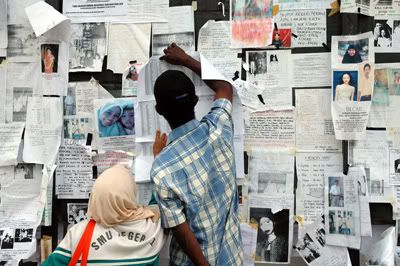
Looking for survivors.
It is a different world on the ground. For us working in the field, it is a world of mobile clinics, relief distribution, logistics, IDPs (internally displaced persons), UN coordination meetings, health surveillance meetings, etc…Ironically, while you’re at the place where the real stuff is and if you’re focused on one project, you can feel quite insulated from the news that is circulated outside of ground zero.
That was how I felt when I heard of Malaysian well-wishers who would like to adopt orphans after reading heart-rending news about children who lost their parents in the tsunami that hit northern Sumatra on a day after Christmas last year.
The subject of “adopting” orphans was raised by one Malaysian reporter working for a Japanese news station. He was with his two other colleagues when they ran into me and the Hospital Tentera KESDAM where our Mercy medical team was based. Expressing admiration for Mercy’s work, they gave us the thumbs up and said they were proud to be Malaysians.
One of them told me that with all the news about orphans, he knew at least five Malaysians who would like to be part of an “adopt-an-orphan” project and if we knew of such a programme would we notify him.
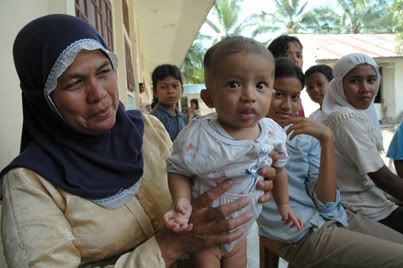
Orphaned survivors: alive and happy.
I’ve seen those programmes. It gives the benefactor much satisfaction knowing that his or her money goes into raising an orphaned kid. In some programmes, the benefactor can choose a child from a photo album a child whose face calls out to him. Personally, I find that distasteful. It reminds me of men in priviledged position choosing post-mail brides from a less wealthier country.
I told our friend, the reporter, that there is no such programme here. Not that I know of. With 80% of Banda Aceh devastated, things were just starting to move, not to normality, but to move out of shock phase into relief response. I can’t imagine a project that demands such complex administrative effort in place.
And I was thinking of the orphanage we visited yesterday. The religious association that housed them was swamped with 200 children orphaned by the disaster. The ustaz (religious teacher) used to run a sekolah mengaji (school for learning to read the Quran) and suddenly found themselves with requests to take in orphans from surrounding villagers destroyed by the deluge.
All the kids have lost one or both parents. And yet, we would not have known their harrowing experience had we not probed. When asked by Mercy volunteer psychologist Loh Sit Fong to draw what was troubling them, many hauntingly depicted the same things.
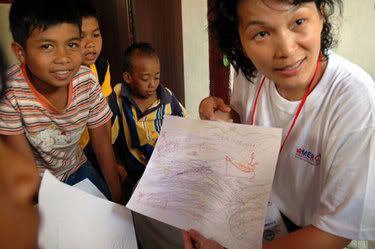
The children's drawings depict their haunting memories.
Giant waves bearing down on people, houses and trees; capsized boats, helicopters hovering above, and survivors escaping into the mountains. When asked if they were in the picture, they would point out to one of the stick figures running on the hills. According to our doctors, some of them complained of heart palpitations and insomnia. These are post-traumatic symptoms.
But we were amazed by their resilience. Loh said the kids told her that it was because everyone had the same experience that they could rationalize their own experience. They were not alone. It was indeed a fate of humanity, God’s will. “We thought it was hari kiamat (Judgment Day),” they said. It was with this knowledge of collective suffering that they could find strength to let go the lost of their families, find solace with each other and camaraderie with the living.
At the orphanage, they were all treated equally, wearing old donated clothes, eating the same food, getting the same treatment from their teachers, praying at the same time and sleeping on the same plank beds. After the unimaginable chaos, the routine gives them a sense of security. They went wild when we gave each a balloon and a soft toy to play with. They were equal in suffering and equal in receiving love and care.
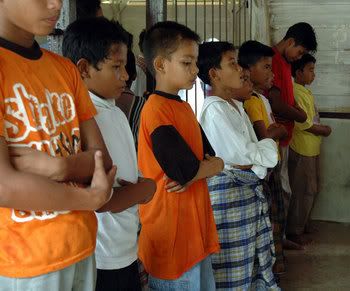
Praying together at set times gave them a sense of routine and stability.
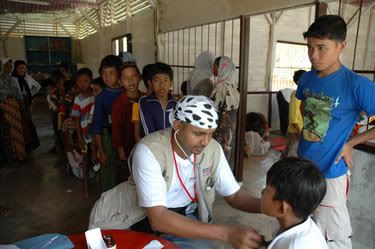
Volunteer doctors say the orphans have post-traumatic symptoms such as insomnia.
I can’t imagine an “adopt-a-child-programme” being in place here. How do you tell an orphan who has a sponsor that he or she is more deserving than the others? How do you tell the other children that they are less deserving or that they have to wait for sponsors before they could get their uniforms to go to school? Or if indeed if all 200 orphans each had a benefactor, how do you control what each benefactor sends to his adopted child?
What if the sponsor forgets about the kid after a year or a few months of sponsoring him? How do you explain this to the kid?
It would be an administrative nightmare to organize a one to one “adopt-an-orphan programme” here where the most basic communication infrastructure has been destroyed.
The Christian-based World Vision runs a sponsor-a-child programme. Each child costs USD$30 a month but sponsors are not told how much of it goes to administration and how much of it goes to the child. I was told half of it goes to the community and half goes to the kid eventhough the child is advertised as the receiver, picture, hobbies and all.
Yes, the children need help. The people who run orphanages need help too- to run it. If Malaysians care for orphans, then they should care too for the people closest to them - the people managing the orphanages. Many have lost family members too. Everyone in Aceh is affected one way or another by the disaster. I talked to a father who lost his entire family to the sea.
“We could not outrun the waves coming behind us. My wife was running in front of us with our youngest child, and I was holding my two children. When the waves hit, I could not hold on to them. I had to let go off my children.”
He thought he would drown under the fury of the waves, and he called out Allah’s name over and over. The third time he surfaced, he found himself hanging on to a roof. Everyone was gone.
I could not hold back my tears as he spoke with such equanimity and reverence to his own lost. “Betapanya kuasa Allah” (How very powerful God is)," he said.
When he saw my tears he said: “Child, do not cry. Allah yang memberi, Allah yang mengambil.” (Allah gives and Allah takes away.)
Most Acheneses whom I spoke to are happy to tell me that they have connections to Malaysia. They are grateful that we have come to their aid. They have either worked or studied in Malaysia, have relations there, or have been arrested at Semenyih detention camp for being “illegal immigrants.”
One told me that because of our amnesty programme just before the new year’s crackdown on undocumented migrant workers, they have returned home bringing with them electronic items and other gifts for families, which unfortunately have all been lost in the earthquake and tsunami.
In Malaysia, an Achenese is an “illegal immigrant”. We do not recognise Achenese escaping from political unrest in the conflict-ridden province as political refugees. We detained them for months and sent them back to die, if they had not already died from treatable diseases in the notorious Semenyih detention camp.
Our hypocrisy makes me angry - that our xenophobic paranoia would not allow us to see them as brothers, but now we are queuing up to adopt their children.
And they are our brothers. We share the same types of foods, the same language, the same religion. We are the same people violently separated by an artificial boundary imposed by our colonial masters (the British in Malaya and the Dutch in Indonesia) for political and economic interest just less then a hundred years ago. But now our governments hang on to them as if it was God-given, as if we have been different people from eternity.
This outpouring of generosity… how genuine are we in being generous? Can we only respond to a forgotten people after a tragedy of this scale? Can we not see them as human beings equal to us? Can we only respond to them as unequals – hate and fear them (as illegal immigrants) or pity them (as victims of tsunami)?
Is pity the only emotion that can move us to help?
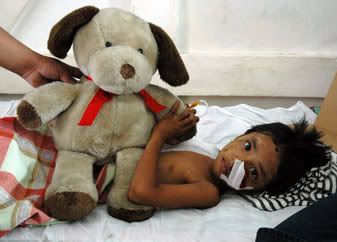
I believe it is because we do not see them as equals that we are talking about adopting their orphans as a way to save them. They do not deserve only our pity.
They are an independent and resilient people. Many are going back to rebuild their homes and lives because they could not just wait while their government decides what to do. They are tired of receiving hand-outs of old clothes and instant noodles. Already it seems like the small town of Lumbaro a little away from the devastated area - noisy and clogged with animals, people and traffic - has become the new centre.
I believe if we offer them a little head start - some capital and later, jobs- they would be able to rebuild their lives on their own, while the billions of aid concentrates on rebuilding infrastructure like roads, providing clean water and electricity. It is not pity they need, some help, yes, but respect and dignity as a people.
Ong Ju Lin was in Banda Aceh with Mercy Malaysia 2nd Mission from Jan 2, 2005 to Jan 15, 2005. The opinions expressed in this feature is entirely my own and do not represent that of Mercy Malaysia.
Sunday, July 04, 2004
AIDS - The "Lucrative" Disease
by Ong Ju Lin
The Aids cause is no longer a fringe movement. It has become mainstream. The cause now belongs to governments, world leaders and corporations. From a marginalised movement championed by gay activists in America, it has become a multibillion dollar industry supporting research institutions, governments, NGOs and pharmaceuticals.
This year’s International Aids Conference held from July 11 to July 16 in Bangkok is a reflection of how rich and powerful the “Aids industry” has become. The organiser paraded the record number of participants and abstracts received as if figures reflected the conference’s success. A total of 17,000 delegates and 3,000 journalists descended on Bangkok for the biennial gala which costs US$17 million of which almost 10,000 participants paid US$1,000 to get in.
The organiser - Stolkholm-based International Aids Society - said its theme was an attempt to bring back the focus on people. Access for all is to provide access of treatment and prevention services to all infected people and access to resources to scientists, community workers and leaders in the public and private sectors.
But critical questions, as Chief Rapporteur of Clinical Research, Treatment and Care Bernard Hirschel asked “Access to what, to whom, by whom and at what costs and consequences?” were not addressed.
After 20 years living with HIV/Aids, access to treatment invariably means access to anti-retrovirals (ARVs), the standard drug for Aids, of which 93 percent living with HIV/Aids have no access to due to high pricing and lack of public health infrastructure.
Even if the question of access is resolved, ARVs are not cures, but more like stopgap measures. Based on chemotherapy drugs to treat cancer, they are highly toxic and users develop resistance to it. In America, as many as 30 percent have resistant strains in them.
Furthermore, free ARVs do not translate to free treatment as the costs of monitoring, treatment of side effects, not to mention the costs of second line drugs when the viral strain develops resistance to first line drugs must be factored in. These are hidden costs that invariably gets lost in ARVs delivery.
This year, there are no breakthrough on drugs and vaccines recognised at the conference. Although vaccines have the potential to wipe out the pandemic, global private efforts in vaccine research has been estimated at USD$100 million a year; this in contrast with investments in drug research that run into billions with a sales return of an estimated USD$ 5 billion.
According to investigative journalist Jon Cohen, big pharmas were “avoiding vaccines like the plague” because they take a longer time to develop, rasied serious liability issues and offer a paltry profit margin compared to drugs.
Are there no alternative cheaper and safer prevention and treatments methods? Or are they excluded from the conference’s agenda?
Affordable, effective treatments excluded
A look at the conference abstract revealed that effective, affordable and safe treatments but not sponsored by pharmaceuticals were excluded. For instance, multivitamin therapies, nutrition and diet regiments, selenium combination therapies and treatments using traditional herbs that have proven to be effective, such as Metrafaids developed in Senegal.
These marginalised studies are undergoing research not only with little support from governments and international funders, but continually face obstacles in getting their products recognised. Some, for instance, a Thai-based oral therapeutic vaccine with prophylactive potential, the V1 Immunitor, has been highlighted in peer reviewed journals such as Vaccine and Immunology with very promising results.
These journals publish only scientifically evaluated findings according to validated protocols. However, their abstracts for presentation at the conference were rejected again as they were two years ago in Barcelona.
Dr Laurent Hiffler of the International Project for Affordable Therapy for HIV (Europe) said because these treatments are cheap and affordable, they have been largely ignored by governments and conferences such as this.
“There is vested interest and the element of profit over the healthcare of people who are in need,” he said. The IAS acknowledge that it is the big pharmaceutical companies that have the money to fund their projects. The conference programme named GlaxoSmithKline, Gilead, Pfizer, Roche, Abbott Virology, Bristol-Myers Squib and MSD as “preferred sponsors” of the conference.
“What do you tell doctors who have people queuing up for highly active antiretrovirals (HAART) and there is none available. There must be something between HAART and palliative care. Treatments that yield benefits to patients must be given the same amount of attention and funding as ARVs,” he said
Questioning science
The International Aids Conference was one of those few Aids initiative that linked community and science together in one conference. The premise is good. Science and research into HIV and Aids should not be divorced from the concerns of community work, social activism and public policy.
But how effective is such an arrangement without a real understanding of the basic questions about science? From my observation, other than press announcements of scientific progress, there is little intermingling between the two sectors.
Science speaks in a language largely incomprehensible to most people. Community workers, activists and policymakers leave drug and vaccine research to the experts while they focus on raising awareness and prevention. Most scientists look down on social and community activism as a waste of time, thinking that community work is merely driven by rhetoric and vacuous activities while they are doing the real work.
Yet, more than ever, there needs to be more scrutiny on what scientists are doing. Are we going on the right path? Are the types of scientific research that are conducted being done only because they were funded by the promise of big returns rather than the goal of eradicating the disease?
Dr Yahaya Sekagya, Prometra (Uganda) representative who was co-charing the only session for traditional medicines, asked some provocative questions: "When does science begins? At what point does practice become science? What do we mean by evidence? Whose philosophical approach are we using when we define efficacy and evidence?"
Sekagya said conventional Western-based science assumes a universality defined by a paradigm of knowledge that is not open to other forms of knowledge.
The definitions used for best treatments during the rapporteur session is telling. Best treatments for HIV/Aids, according to the Chief Rapporteur are measured by a drug treatment that could bring down viral load by 50 percent in six months with low toxicity, long term drug efficacy without resistance, and long term survival of the patient.
What about the patient’s quality of life? What happens to the patient as a thinking, feeling and living person? Has the patient been reduced to viral load, drug efficacy and survival rate?
It is no wonder that the Global Network of People Living with HIV/Aids (GNP+) complained at the conference, that HIV positive people are referred to as an abstraction and not as a person.
In conventional science, good data are ones supported by evidence in numbers. Fair enough, but how does one quantify a patient saying that he can go back to work, or that his skin infections have cleared and he can join society again without being stigmatized because he “looks like an Aids patient”?
Patient-specific evidence are often brushed away as anecdotal evidence. Therapies that are patient-specific, that employ different kinds of treatments according to patient needs cannot be subjected to double-blind placebo trials. These controlled trials are good for drugs or very specific kinds of treatments that assume every patient is the same.
Aids is an autoimmune disease that manifests itself into so many life threatening symptoms, where diet, nutrition, lifestyle and behaviour are variables that affect the progression of the disease. This science that depersonalise patients in exchange for “scientific rigor” is not necessarily the best way to find the best treatment for Aids. A science with a more human face and patient-based therapies must be explored to measure treatment efficacy.
This year 10,000 abstracts were submitted and 8,641 were accepted for presentation. The numbers are large, but they do not necessarily represent a wide range of diversity. In treatments, ARVs continue to dominate, while other more affordable treatments are neglected. The criteria for successful acceptance and reasons for rejection must be revealed for public scrutiny.
Community rapporteur Shawn Mellor called for a more diverse representation of ideas and experiences for the next conference in 2006 in Toronto. “The review committee for abstracts needs to be renewed to represent the diversities from the ground.”
If the UNAIDS ‘3 by 5' aim of providing treatment for three million by 2005 were to be realised, there must be greater commitment to source out safe, affordable and effective treatment, other than ARVs. Aids activists who protest for multinational pharmaceutical companies to lower drug prices and demand for generic drugs are all narrowly focused on access to the 20 available ARV drugs in the world, manufactured by Western-based pharmaceuticals.
It is time they turn their attention to seek out alternative treatments and push for affordable therapies to be recognised and supported.
ONG JU LIN was reporting on the conference from Bangkok for Malaysiakini. Published in http://www.malaysiakini.com/ on Jul 20, 2004 12:49pm
The Aids cause is no longer a fringe movement. It has become mainstream. The cause now belongs to governments, world leaders and corporations. From a marginalised movement championed by gay activists in America, it has become a multibillion dollar industry supporting research institutions, governments, NGOs and pharmaceuticals.
This year’s International Aids Conference held from July 11 to July 16 in Bangkok is a reflection of how rich and powerful the “Aids industry” has become. The organiser paraded the record number of participants and abstracts received as if figures reflected the conference’s success. A total of 17,000 delegates and 3,000 journalists descended on Bangkok for the biennial gala which costs US$17 million of which almost 10,000 participants paid US$1,000 to get in.
The organiser - Stolkholm-based International Aids Society - said its theme was an attempt to bring back the focus on people. Access for all is to provide access of treatment and prevention services to all infected people and access to resources to scientists, community workers and leaders in the public and private sectors.
But critical questions, as Chief Rapporteur of Clinical Research, Treatment and Care Bernard Hirschel asked “Access to what, to whom, by whom and at what costs and consequences?” were not addressed.
After 20 years living with HIV/Aids, access to treatment invariably means access to anti-retrovirals (ARVs), the standard drug for Aids, of which 93 percent living with HIV/Aids have no access to due to high pricing and lack of public health infrastructure.
Even if the question of access is resolved, ARVs are not cures, but more like stopgap measures. Based on chemotherapy drugs to treat cancer, they are highly toxic and users develop resistance to it. In America, as many as 30 percent have resistant strains in them.
Furthermore, free ARVs do not translate to free treatment as the costs of monitoring, treatment of side effects, not to mention the costs of second line drugs when the viral strain develops resistance to first line drugs must be factored in. These are hidden costs that invariably gets lost in ARVs delivery.
This year, there are no breakthrough on drugs and vaccines recognised at the conference. Although vaccines have the potential to wipe out the pandemic, global private efforts in vaccine research has been estimated at USD$100 million a year; this in contrast with investments in drug research that run into billions with a sales return of an estimated USD$ 5 billion.
According to investigative journalist Jon Cohen, big pharmas were “avoiding vaccines like the plague” because they take a longer time to develop, rasied serious liability issues and offer a paltry profit margin compared to drugs.
Are there no alternative cheaper and safer prevention and treatments methods? Or are they excluded from the conference’s agenda?
Affordable, effective treatments excluded
A look at the conference abstract revealed that effective, affordable and safe treatments but not sponsored by pharmaceuticals were excluded. For instance, multivitamin therapies, nutrition and diet regiments, selenium combination therapies and treatments using traditional herbs that have proven to be effective, such as Metrafaids developed in Senegal.
These marginalised studies are undergoing research not only with little support from governments and international funders, but continually face obstacles in getting their products recognised. Some, for instance, a Thai-based oral therapeutic vaccine with prophylactive potential, the V1 Immunitor, has been highlighted in peer reviewed journals such as Vaccine and Immunology with very promising results.
These journals publish only scientifically evaluated findings according to validated protocols. However, their abstracts for presentation at the conference were rejected again as they were two years ago in Barcelona.
Dr Laurent Hiffler of the International Project for Affordable Therapy for HIV (Europe) said because these treatments are cheap and affordable, they have been largely ignored by governments and conferences such as this.
“There is vested interest and the element of profit over the healthcare of people who are in need,” he said. The IAS acknowledge that it is the big pharmaceutical companies that have the money to fund their projects. The conference programme named GlaxoSmithKline, Gilead, Pfizer, Roche, Abbott Virology, Bristol-Myers Squib and MSD as “preferred sponsors” of the conference.
“What do you tell doctors who have people queuing up for highly active antiretrovirals (HAART) and there is none available. There must be something between HAART and palliative care. Treatments that yield benefits to patients must be given the same amount of attention and funding as ARVs,” he said
Questioning science
The International Aids Conference was one of those few Aids initiative that linked community and science together in one conference. The premise is good. Science and research into HIV and Aids should not be divorced from the concerns of community work, social activism and public policy.
But how effective is such an arrangement without a real understanding of the basic questions about science? From my observation, other than press announcements of scientific progress, there is little intermingling between the two sectors.
Science speaks in a language largely incomprehensible to most people. Community workers, activists and policymakers leave drug and vaccine research to the experts while they focus on raising awareness and prevention. Most scientists look down on social and community activism as a waste of time, thinking that community work is merely driven by rhetoric and vacuous activities while they are doing the real work.
Yet, more than ever, there needs to be more scrutiny on what scientists are doing. Are we going on the right path? Are the types of scientific research that are conducted being done only because they were funded by the promise of big returns rather than the goal of eradicating the disease?
Dr Yahaya Sekagya, Prometra (Uganda) representative who was co-charing the only session for traditional medicines, asked some provocative questions: "When does science begins? At what point does practice become science? What do we mean by evidence? Whose philosophical approach are we using when we define efficacy and evidence?"
Sekagya said conventional Western-based science assumes a universality defined by a paradigm of knowledge that is not open to other forms of knowledge.
The definitions used for best treatments during the rapporteur session is telling. Best treatments for HIV/Aids, according to the Chief Rapporteur are measured by a drug treatment that could bring down viral load by 50 percent in six months with low toxicity, long term drug efficacy without resistance, and long term survival of the patient.
What about the patient’s quality of life? What happens to the patient as a thinking, feeling and living person? Has the patient been reduced to viral load, drug efficacy and survival rate?
It is no wonder that the Global Network of People Living with HIV/Aids (GNP+) complained at the conference, that HIV positive people are referred to as an abstraction and not as a person.
In conventional science, good data are ones supported by evidence in numbers. Fair enough, but how does one quantify a patient saying that he can go back to work, or that his skin infections have cleared and he can join society again without being stigmatized because he “looks like an Aids patient”?
Patient-specific evidence are often brushed away as anecdotal evidence. Therapies that are patient-specific, that employ different kinds of treatments according to patient needs cannot be subjected to double-blind placebo trials. These controlled trials are good for drugs or very specific kinds of treatments that assume every patient is the same.
Aids is an autoimmune disease that manifests itself into so many life threatening symptoms, where diet, nutrition, lifestyle and behaviour are variables that affect the progression of the disease. This science that depersonalise patients in exchange for “scientific rigor” is not necessarily the best way to find the best treatment for Aids. A science with a more human face and patient-based therapies must be explored to measure treatment efficacy.
This year 10,000 abstracts were submitted and 8,641 were accepted for presentation. The numbers are large, but they do not necessarily represent a wide range of diversity. In treatments, ARVs continue to dominate, while other more affordable treatments are neglected. The criteria for successful acceptance and reasons for rejection must be revealed for public scrutiny.
Community rapporteur Shawn Mellor called for a more diverse representation of ideas and experiences for the next conference in 2006 in Toronto. “The review committee for abstracts needs to be renewed to represent the diversities from the ground.”
If the UNAIDS ‘3 by 5' aim of providing treatment for three million by 2005 were to be realised, there must be greater commitment to source out safe, affordable and effective treatment, other than ARVs. Aids activists who protest for multinational pharmaceutical companies to lower drug prices and demand for generic drugs are all narrowly focused on access to the 20 available ARV drugs in the world, manufactured by Western-based pharmaceuticals.
It is time they turn their attention to seek out alternative treatments and push for affordable therapies to be recognised and supported.
ONG JU LIN was reporting on the conference from Bangkok for Malaysiakini. Published in http://www.malaysiakini.com/ on Jul 20, 2004 12:49pm
Tuesday, September 02, 2003
Reversing a Destruction
Photos and story by Ong Ju Lin
The idyllic fishing village of Leam Markham in Trang Province, Southern Thailand, is a classic example of how restoration of coastal mangrove forests can bring a new wave of prosperity to poverty-stricken fisherfolk, writes Ong Ju Lin.

The fishing village of Lean Markham in Trang province is cradled in a lush mangrove forest on the coast of southern Thailand, off the Andaman Sea.
BU NUANSI came home tired but smiling. Wiping his furrowed brows, he pulled out a stool and gestured to us to sit with him. A cat lying nearby stretched itself and sauntered off. The sweet aroma of fried cempedak, served for tea, was invigorating on that hot, humid afternoon.
The good news that the village elder, popularly known as Pak Bu, bore that day was like the clear blue sky – a respite from the monsoon rains.
Pak Bu sat down and looked at us with a confident smile etched on his lined face. “This time, it will be different. We will win.”
Pak Bu, 67, turned conservationist when he realised the only way for his people to eat and live well was to organise themselves to fight for their rights and to protect the environment. He had relinquished his post as village imam (Islamic religious head) to focus on environmental protection and community development.
Pak Bu and his men had just returned from the Muang District police station after having their statements recorded. The day before, he and 10 villagers escorted by policemen had gone out in three boats to arrest a recalcitrant fishing trawler which had eluded them for six years.
They gave chase and surrounded the boat. The four men on board surrendered. The fishing trawler had been infiltrating the 3km coastal conservation zone, dredging the seabed and destroying traditional fishing gear for years. Their faster Apollo boat always managed to evade the smaller fishing boats belonging to subsistence-based fisherfolk.
“Reporters interviewed me this morning. When our story is published it will become a hot issue. The owner of the trawler wanted to settle the matter by paying us off but the whole village refused. The four men are now in police lock-up,” said Pak Bu.
Until recently, such initiative and group action were unheard of in this quiet Muslim community in a Buddhist majority country. For years, they were victims of commercial trawlers, destructive fishing practices and middlemen. Their complains fell on deaf ears as they believed, rich owners of commercial trawlers were in league with corrupt government officials.
Weak enforcement saw big trawlers flouting sea laws. Their huge gaping trawler nets scraped the seabed, crunching up coral reefs and hauling in fries before they had time to grow. Depleted catches forced some fishermen to resort to dynamite fishing and cyanide poisoning which further degraded the marine ecosystem.
Soon the men were returning from sea with empty nets. To help support their families, the women worked for meagre wages in factories, leaving behind malnourished children under the care of the elderly. Impoverished and helpless, the community fell into debt to middlemen.
Many turned to chopping down mangrove wood for charcoal factories to eke out a living. Over the last two and a half decades, more than 50% of the vast mangrove forests along Thailand’s 2,560km-coastline had been destroyed by charcoal companies and tiger prawn aquaculture. The degraded mangroves resulted in even smaller catches and the people were unable to break free from the cycle of poverty.
It was at that low point that Yadfon (Raindrop) Association established contact with this remote village, accessible then only by boat. “When we first came here 19 years ago, there were so many problems we didn’t know where to start. But we were determined to help out, so we stayed on and slowly learned from the villagers and gained their trust,” said Pisit Charnsnoh, 57, who co-founded the organisation with his wife, Luong.

Pisit Chansnoh with a map of the river basin.
“Yadfon creates a learning process. We are not standing in front and teaching. We give equal respect and learn from each other to create something new,” said Pisit, a graduate in animal husbandry.
Their early work includes digging wells to supply clean drinking water, setting up revolving funds for the poor to buy fishing gear and engines for their boats, and rearing of groupers which was very profitable at that time.
In 1986, Yadfon and Pak Bu helped the villagers to create a 95ha community mangrove forest which covered Leam Markham and the neighbouring villages. It was the first of its kind in Thailand. The restoration results were dramatic. From 1991 to 1994, there was a 40% increase in total catch, resulting in increased income levels in the local villages. The success of the community forest caught the attention of the government which gave its tacit support.
Three years ago, charcoal concession was abolished as a result of Yadfon’s work and years of lobbying by environmental groups.
Today, there are nine community managed forests modelled after Leam Markham. The grassroot effort inspired the first-ever popularly-written Community Forest Act which is currently awaiting parliamentary sanction. The Act mandates that villagers are allowed to live and harvest from the forest if they can properly manage the forest in a sustainable manner.
During our trip, we were also taken on a mangrove tour in a fishing boat by Meliwan Menpoh, 36, head of the Leam Markham Women’s Cooperative. She had helped to replant the mangroves and was proud to show us the results of her village’s collective effort.

Meliwan Menpoh showing us the mangroves she helped to replant.
At the periphery, two signboards bore the words “Community Mangrove Forest”. As we glided along the canal flanked by verdant mangrove trees, Meliwan pointed out several species whose leaves, roots or barks have medicinal values.
Since the mangroves grew back, the fish, crabs and shellfish have returned, said Meliwan. Their nets are full. The children no longer go hungry.
In the neighbouring village of Tung Tase, the women took us on the 750m mangrove boardwalk sponsored by the Queen of Thailand. With dexterity, they descended the swampy earth and walked with ease among the gnarled roots. One of them bent down and plucked out a clam from the mud. Then another, and another. Soon her hands were full. Scanning the rich black mass, I could not even spot one measly clam, while she was already returning the ones she picked back to the exact spots she found them.
The mangrove forest is like a “supermarket” to the villagers. The only difference is that the items are free for all.
Back at the women’s co-op, we had curried clams and bamboo shoots. In fact, everything that was laid on the mat was locally harvested. Globalisation has yet to make its mark here.
Part of Yadfon’s work is empowering the women to play an essential role in environmental protection and community building. In almost all the communities that Yadfon has touched, there is a women’s co-op to generate funds to supplement the family income or tide the family over during the monsoon months when the men cannot go out to sea.
In Leam Markham, the women also weave baskets, purses and spectacle cases from pandanus (mengkuang) leaves. The plant grows in abundance in the area.
Further south from Leam Markham in Thambon village, the sale of handicraft has become the main source of income during the monsoons. When the men could not go out to sea, they would take over the women’s traditional role.
Buya Yaji, 46, is proud that her husband has taken to weaving baskets and purses, and can make them more skilfully then she could, although not as fast.
Luong, who helped set up the co-op in 1986, said that weaving has given the elderly a productive activity and a way to contribute to the family income.
A Thammasat University graduate, Luong shares a warm intimacy with the womenfolk. Almost 30 years ago, as a young activist, she had helped the villagers to get a piece of land to build a school. Many of the women in the co-op were educated there. When she returned to the village in 1985, it was a reunion of sorts and the community was open to Yadfon’s community development work.
Leam Markham’s model of sustainability has been repeated in 40 other coastal communities in Trang province and it is now spreading inland. It is Pisit’s dream to see the conservation of the whole watershed area, and the communities living sustainably along the length of the river.
Yadfon Association president Pisit Charnsoh explaining the importance of conserving the Trang wetlands in its entirety.
Upriver, it is not the protection of mangroves or seagrass, but the conservation of the sago ecosystem which is dominant in brackish wetlands. A Centre of Sago Learning has been set up to teach children about the importance of sago as a food source, as material for roof thatch and forest covering for water catchments.
Yadfon’s work has not gone unnoticed. Last year, Pisit won the prestigious Goldman Environmental Prize and US$125,000 (RM$475,000) for his work in improving the conditions of poor fishing communities in Trang.
With their four children all grown, Pisit and Luong want to spend more time cultivating their half hectare of land, now overgrown with weeds but bountiful with rambutans, mangosteens and durians.
“We’re so busy, we never have time to live in our dream house in the village,” said Luong. Both are past retirement age but carry on with the same fervour that they had when they first returned to Trang.
But their work is not over. Ultimately, they want to see communities becoming guardians of the entire watershed ecosystem. Asked what drives him, Pisit said it is his vision to see man co-existing peacefully with nature.
published in The Star Malaysia, September 2, 2003 (www.thestar.com.my)
The idyllic fishing village of Leam Markham in Trang Province, Southern Thailand, is a classic example of how restoration of coastal mangrove forests can bring a new wave of prosperity to poverty-stricken fisherfolk, writes Ong Ju Lin.
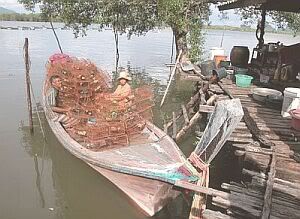
The fishing village of Lean Markham in Trang province is cradled in a lush mangrove forest on the coast of southern Thailand, off the Andaman Sea.
BU NUANSI came home tired but smiling. Wiping his furrowed brows, he pulled out a stool and gestured to us to sit with him. A cat lying nearby stretched itself and sauntered off. The sweet aroma of fried cempedak, served for tea, was invigorating on that hot, humid afternoon.
The good news that the village elder, popularly known as Pak Bu, bore that day was like the clear blue sky – a respite from the monsoon rains.
Pak Bu sat down and looked at us with a confident smile etched on his lined face. “This time, it will be different. We will win.”
Pak Bu, 67, turned conservationist when he realised the only way for his people to eat and live well was to organise themselves to fight for their rights and to protect the environment. He had relinquished his post as village imam (Islamic religious head) to focus on environmental protection and community development.
Pak Bu and his men had just returned from the Muang District police station after having their statements recorded. The day before, he and 10 villagers escorted by policemen had gone out in three boats to arrest a recalcitrant fishing trawler which had eluded them for six years.
They gave chase and surrounded the boat. The four men on board surrendered. The fishing trawler had been infiltrating the 3km coastal conservation zone, dredging the seabed and destroying traditional fishing gear for years. Their faster Apollo boat always managed to evade the smaller fishing boats belonging to subsistence-based fisherfolk.
“Reporters interviewed me this morning. When our story is published it will become a hot issue. The owner of the trawler wanted to settle the matter by paying us off but the whole village refused. The four men are now in police lock-up,” said Pak Bu.
Until recently, such initiative and group action were unheard of in this quiet Muslim community in a Buddhist majority country. For years, they were victims of commercial trawlers, destructive fishing practices and middlemen. Their complains fell on deaf ears as they believed, rich owners of commercial trawlers were in league with corrupt government officials.
Weak enforcement saw big trawlers flouting sea laws. Their huge gaping trawler nets scraped the seabed, crunching up coral reefs and hauling in fries before they had time to grow. Depleted catches forced some fishermen to resort to dynamite fishing and cyanide poisoning which further degraded the marine ecosystem.
Soon the men were returning from sea with empty nets. To help support their families, the women worked for meagre wages in factories, leaving behind malnourished children under the care of the elderly. Impoverished and helpless, the community fell into debt to middlemen.
Many turned to chopping down mangrove wood for charcoal factories to eke out a living. Over the last two and a half decades, more than 50% of the vast mangrove forests along Thailand’s 2,560km-coastline had been destroyed by charcoal companies and tiger prawn aquaculture. The degraded mangroves resulted in even smaller catches and the people were unable to break free from the cycle of poverty.
It was at that low point that Yadfon (Raindrop) Association established contact with this remote village, accessible then only by boat. “When we first came here 19 years ago, there were so many problems we didn’t know where to start. But we were determined to help out, so we stayed on and slowly learned from the villagers and gained their trust,” said Pisit Charnsnoh, 57, who co-founded the organisation with his wife, Luong.
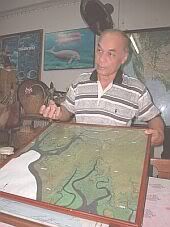
Pisit Chansnoh with a map of the river basin.
“Yadfon creates a learning process. We are not standing in front and teaching. We give equal respect and learn from each other to create something new,” said Pisit, a graduate in animal husbandry.
Their early work includes digging wells to supply clean drinking water, setting up revolving funds for the poor to buy fishing gear and engines for their boats, and rearing of groupers which was very profitable at that time.
In 1986, Yadfon and Pak Bu helped the villagers to create a 95ha community mangrove forest which covered Leam Markham and the neighbouring villages. It was the first of its kind in Thailand. The restoration results were dramatic. From 1991 to 1994, there was a 40% increase in total catch, resulting in increased income levels in the local villages. The success of the community forest caught the attention of the government which gave its tacit support.
Three years ago, charcoal concession was abolished as a result of Yadfon’s work and years of lobbying by environmental groups.
Today, there are nine community managed forests modelled after Leam Markham. The grassroot effort inspired the first-ever popularly-written Community Forest Act which is currently awaiting parliamentary sanction. The Act mandates that villagers are allowed to live and harvest from the forest if they can properly manage the forest in a sustainable manner.
During our trip, we were also taken on a mangrove tour in a fishing boat by Meliwan Menpoh, 36, head of the Leam Markham Women’s Cooperative. She had helped to replant the mangroves and was proud to show us the results of her village’s collective effort.
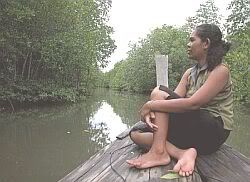
Meliwan Menpoh showing us the mangroves she helped to replant.
At the periphery, two signboards bore the words “Community Mangrove Forest”. As we glided along the canal flanked by verdant mangrove trees, Meliwan pointed out several species whose leaves, roots or barks have medicinal values.
Since the mangroves grew back, the fish, crabs and shellfish have returned, said Meliwan. Their nets are full. The children no longer go hungry.
In the neighbouring village of Tung Tase, the women took us on the 750m mangrove boardwalk sponsored by the Queen of Thailand. With dexterity, they descended the swampy earth and walked with ease among the gnarled roots. One of them bent down and plucked out a clam from the mud. Then another, and another. Soon her hands were full. Scanning the rich black mass, I could not even spot one measly clam, while she was already returning the ones she picked back to the exact spots she found them.
The mangrove forest is like a “supermarket” to the villagers. The only difference is that the items are free for all.
Back at the women’s co-op, we had curried clams and bamboo shoots. In fact, everything that was laid on the mat was locally harvested. Globalisation has yet to make its mark here.
Part of Yadfon’s work is empowering the women to play an essential role in environmental protection and community building. In almost all the communities that Yadfon has touched, there is a women’s co-op to generate funds to supplement the family income or tide the family over during the monsoon months when the men cannot go out to sea.
In Leam Markham, the women also weave baskets, purses and spectacle cases from pandanus (mengkuang) leaves. The plant grows in abundance in the area.
Further south from Leam Markham in Thambon village, the sale of handicraft has become the main source of income during the monsoons. When the men could not go out to sea, they would take over the women’s traditional role.
Buya Yaji, 46, is proud that her husband has taken to weaving baskets and purses, and can make them more skilfully then she could, although not as fast.
Luong, who helped set up the co-op in 1986, said that weaving has given the elderly a productive activity and a way to contribute to the family income.
A Thammasat University graduate, Luong shares a warm intimacy with the womenfolk. Almost 30 years ago, as a young activist, she had helped the villagers to get a piece of land to build a school. Many of the women in the co-op were educated there. When she returned to the village in 1985, it was a reunion of sorts and the community was open to Yadfon’s community development work.
Leam Markham’s model of sustainability has been repeated in 40 other coastal communities in Trang province and it is now spreading inland. It is Pisit’s dream to see the conservation of the whole watershed area, and the communities living sustainably along the length of the river.
Yadfon Association president Pisit Charnsoh explaining the importance of conserving the Trang wetlands in its entirety.
Upriver, it is not the protection of mangroves or seagrass, but the conservation of the sago ecosystem which is dominant in brackish wetlands. A Centre of Sago Learning has been set up to teach children about the importance of sago as a food source, as material for roof thatch and forest covering for water catchments.
Yadfon’s work has not gone unnoticed. Last year, Pisit won the prestigious Goldman Environmental Prize and US$125,000 (RM$475,000) for his work in improving the conditions of poor fishing communities in Trang.
With their four children all grown, Pisit and Luong want to spend more time cultivating their half hectare of land, now overgrown with weeds but bountiful with rambutans, mangosteens and durians.
“We’re so busy, we never have time to live in our dream house in the village,” said Luong. Both are past retirement age but carry on with the same fervour that they had when they first returned to Trang.
But their work is not over. Ultimately, they want to see communities becoming guardians of the entire watershed ecosystem. Asked what drives him, Pisit said it is his vision to see man co-existing peacefully with nature.
published in The Star Malaysia, September 2, 2003 (www.thestar.com.my)
Subscribe to:
Posts (Atom)


