Monday, February 17, 2003

The Road to Polygamy


How would you like to get hitched in this town? Doesn’t look too romantic, huh? This is Pekan Siam, across the border from Padang Besar where rice retailing and polygamy peddling can go in the same shoplot, ONG JU LIN investigates.

JUST across the border of Padang Besar is a small rectangular town made up of rows of shop houses which survive on a steady diet of Malaysian tourists. In the day, the streets are subdued.

The hot, lazy afternoons see its residents milling away the hours in the shadows of ugly cement shop blocks under the blazing sun.

At night, the town comes alive with bright neon lights, blaring music, and loud, garish posters promising a “Thai paradise”, as one massage parlour advertises.

Like many border towns over on the Thailand side, Pekan Siam retained the comparative advantage of cheaper goods and laxer laws. Here, Thai rice, tour packages, full body massage and easy sex are offered side by side with instant marriages.

For as little as 2,000 baht (USD$50), a Muslim couple could get hitched with few questions asked.

“You don’t need a marriage course; you don’t need to seek the bride’s parents’ permission or to let your old wife know. All you need to know is how to lafaz (utter the intention to wed a woman),” said our Thai tour guide.

We were among a group of reporters who has just been taken over the border on a fact-finding tour sponsored by the Perlis state government. Following the fracas over Perlis’ loosening of conditions for polygamy, Mentri Besar Datuk Seri Shahidan Kassim invited the press to see for themselves the “cowboy marriages” that had lured Malaysian couples over the border.

Putting the blame of southern Thailand’s lack of law and enforcement as the source of the polygamy problems besetting his state, Shahidan had urged southern Thailand’s Islamic religious authorities to clamp down on these unauthorised Thai kadis whom he branded as “polygamy peddlers”.

Last year, Malaysian consul general to Songkhla Wan Jaafar Wan Mahamud revealed that out of 500 Malaysian men who go to Thailand to tie the knot, 102 were from Perlis. The figure is believed to be only a fraction of the actual number of illegal border marriages.

These clandestine marriages, which do not have the permission of Malaysia's syariah courts, are deemed illegal under the Islamic Family Act.

In Malaysia, Syariah Courts in most states place restrictions and conditions on the man before he is allowed to take a second (or third or fourth) wife.

The present wife is informed of her husband’s intention and is usually called as witness to testify to the husband’s capability as provider. Men wanting to escape that scrutiny, as well as for various other reasons only known to them, are the ones who would hide their polygamous marriage by contracting it in Thailand.

A host of problems have cropped out of these marriages – for example, when first wives get a whiff of their husband’s polygamous marriage and when a husband reneges on his responsibilities towards the first family, leading to break-ups and the creation of single mothers who depend on state-sponsored welfare organisations.

A new couple who has gotten hitched illegally would also run into a host of problems. Without the authorisation of the Malaysian Syariah Court, their Thai marriage certificate is not recognised and if they have a child, the child is technically stateless.

Perlis Mufti Datuk Mat Jahaya Hussin said that these problems are what prompted Perlis to loosen its polygamy conditions. In short, the justification for the removal of restrictions on polygamy is to level the playing field, so to speak, with Thailand

The rice shop owner entertaining queries from reporters about his side business: marriage service. For an additional charge, he can also arrange a honeymoon package with a local tour operator.

But the announcement that really got women’s groups incensed was Shahidan’s invitation to prospective couples to get hitched in Perlis instead of Thailand. Critics wonder if it had anything at all to do with “Visit Perlis Year” this year.

The price of a certificate

Back at Pekan Siam, a grocery store selling different strains of rice has been identified as the target. The façade gives no indication of its other service of the clandestine nature. At the entrance, a notice board bears the words “Perniagaan Muslim” (Muslim business) in Malay and Jawi (Arabic script).

Just the day before, state Wanita Umno assistant secretary Azizah Salleh who was also part of the fact-finding team, had posed as a potential bride of a Muharis Mokhtar, a party colleague. In her 50s, Azizah is about 20 years older than Muharis.

Relating her experience, Azizah said the shop owners, who acted as the brokers, led them into a room inside the shop before explaining the process of getting their surat nikah (marriage
certificate).

“They even served us tea and kuih (cakes). They looked a bit puzzled, perhaps because of our age difference, but never asked us anything about why we were getting married.
“All that was needed was our ICs so they could put our names down. The fee was RM200,” she said.

Determined to do our own investigations, we went into the shop pretending to buy rice. Then, we popped the question: “Do you offer marriage service here?”

“It can be done here,” the female shop assistant replied.

Right here?

“Yes, you could get married inside the shop or you could go to the ustaz’s home. It’s just around the corner,” she said.

This is the same ustaz (religious teacher) who is said to marry 100 couples a month.

“You can come back tomorrow because the ustaz is in Patani today. Anyway, the whole thing can be completed in half an hour,” she added.

Later, she was joined by the shop owner. This time, he said the service fee was RM300. Also, a honeymoon package can be arranged with a local tour operator, for an additional charge.

(Couples can also opt for an easier way, albeit with a higher fee. Agents at a certain taxi stand at Padang Besar can arrange a package deal for prospective couples, inclusive of transportation to the mosque and back across the border – all within a day.)

To say the least, getting married behind a rice store is hardly something memorable to be cherished. Couples who resort to such an undertaking must be desperate.

And they are. Later, during the roundtable dialogue between Shahidan and southern Thailand religious authorities, Yala Islamic Committee (fatwa ulama) secretary Basir Mahmud said there had been “not a few cases where there was already the seed inside the woman’s womb”.

“Sometimes, we feel pressured into marrying the couple as they will be spending the night together in Thailand before going home. Marrying them as husband and wife before such a situation occurs would prevent them from sinning,” he said.

In the dialogue, we were also told that any kadi not authorised by the Yala Islamic Committee had no right to solemnise marriages of foreign couples.

Songkhla province Islamic Committee president Abd Aziz Ismail said there were no sanctioned kadi in border areas such as Padang Besar (Pekan Siam) and Danok.

"If marriages were solemnised by these unauthorised persons, then they were conducted without the consent of the Songkhla religious authorities. In Songkhla, there are 25 kadis and their deputies who have been given tauliah (authority); in Yala, there are four. The lists (of authorised kadis) have been given to the Perlis Islamic Council.”

A marriage by an authorised kadi would cost a fixed rate of 3,000baht (RM300), of which a registration fee of 1,400baht (RM140) would be handed to the province Islamic Committee, he said.

During the session, a visibly angry Shahidan shouted: “Send your men to the border and attack all those polygamy peddlers. It is for your own good name and the image of Islam in Thailand that you must do this.”

But his outburst was mere histrionics. Thailand’s state religion is Buddhism, and there is no enforcement arm to ensure Islamic laws of the province are obeyed.

“We can’t get the police here to catch these culprits. Some (of these culprits) belong to syndicates. All we can do is to ask Malaysia to tell their people not to fall for these bogus kadis who are unable to issue the proper documents,” said Aziz.

In either case, whether Malaysians contracted their marriages through a sanctioned or unsanctioned kadi, the marriage is still illegal without the permission of the state Islamic Council in Malaysia.

Failure to obtain permission beforehand constitutes an offence and the man is liable to a fine of up to RM1,000 or six months' jail. But usually he only gets a slap on the wrist, with fines of about RM300 and no jail sentence. The marriage eventually gets registered.

Women's group Sisters in Islam (SIS) had argued that the penalty hardly serves as deterrent and it is no wonder the number of illegally contracted marriages keeps on rising. Its legal officer Nora Murat said since she started the free legal advice clinic last March, she has been receiving about 25 polygamy-related cases every week.

“Relaxing laws to match Thailand’s is not the answer. The solution is to make men respect the syariah courts and the laws. You can’t allow them to run off to the border to escape the law. Enforce the RM1,000 fine and six months' jail sentence and see the difference that can make,” she said.

In defending the move, Perlis Mufti Mat Jahaya said that hukum syarak (Islamic laws) had not stated the need for the first wife to be notified of her husband’s second marriage, and those who criticise are at risk of terlajak cakap (going overboard) in opposing what is embedded in Islam as the rights of men to polygamy.

SIS had been called syirik (blasphemous) by Shahidan for saying that polygamy is not a man’s right but a woman’s privilege practised in circumstances of war and strife.

SIS, in its information booklet on Islam and Polygamy, pointed out that while hukum syarak is silent on the necessity to inform the present wife, it was also silent on the need to register with the syariah courts, or to have a wali (father or male relative of the bride who gives her away, or in their absence, an authorised figure) or the administrative purposes that evolved along with the system of delivering justice.

Says Nora: “The spirit of the syarak is justice. There is no common decency, much less justice in allowing men to take another wife without at least informing his present wife. The Quran talks about love and tenderness in the partnership of husband and wife. It says: “You are each other’s garment.” Marriage is about trust, and it is against the spirit of the Quran when women are treated so unjustly.”

The following weeks would be a challenge to women, civil rights groups, and Women and Family Development Minister Datuk Sharizat Abdul Jalil, who has openly called the Perlis ruling a humiliation to women to make their voices heard.

The agreement to standardise syariah laws throughout the country has not touched on whether to relax or reinforce the conditions for polygamy, but it is learnt that the controversial and much-maligned Perlis ruling would be used as the yardstick.

Thursday, May 09, 2002

Legacy for sale

Amidst calls at the recent Penang Story International Conference for conserving historical living communities, some long-time residents of inner Georgetown have to pack up and leave what has been home to their families for the past hundred years, writes ONG JU LIN.

KHOO Chye Huat, 96, and her two sons watched from the patio of their clan home as the long line of dignitaries, accompanied by musicians clanging gongs and beating drums, streamed into the courtyard at the Khoo Kongsi, Cannon Square, Penang.

It did not quite matter that she and her family were not invited for the closing dinner of the Penang Story International Conference, even though they lived right where the dinner was held. They felt privileged that the Chief Minister, who was the guest of honour, had walked up Khoo’s home of 90 years to greet them before proceeding towards the VIP table.

Her son, Goh Chye Chin, 61, proudly showed me a photograph of Prime Minister Datuk Seri Dr Mahathir Mohamad shaking hands with his mother. They even caught a glimpse of China’s vice-president Hu Jintao who was whisked into the courtyard in a tinted Mercedes Benz.

Khoo was getting used to seeing tourists and VIPs “invading” the empty square to view the magnificent clan temple. Until about a year ago, the courtyard still had the semblance of a clan village, filled with the bustle of family, religious and clan activities.

Since the repeal of the Rent Control Act two years ago, the residents of the 24 clan-houses in the square, most of whom were Khoo clansmen, have been systematically evicted by the Leong San Tong Khoo Kongsi trustees to make way for a multi-million ringgit tourism development project.
The project will see the pre-war double storey-terrace houses surrounding the central square consisting of the temple and the stage being converted into souvenir shops and bed and breakfast motels.

Touted as the finest Chinese temple in the nation, the trustees forked out a whopping RM4mil for the restoration of what would be the Penang Hokkien heritage contribution to the world.

At the dinner address, even as Penang Heritage Trust (PHT) chairman Dr Choong Sim Poey spoke about the conference as perhaps “a turning point” that would make Penang recognised as a World Heritage Site, the remaining eight tenants, including Khoo, had received eviction notices to vacate by July 3, failing which they would be charged double rental.

“As Khoo clansmen, my family members have lived here for 102 years, and it has been my home since I was five. I am not used to living anywhere else,” said Chye Huat, displaying the eviction notice.

However, the irony of it all was lost to most of the congregation of academics and activists who had, for four days during the conference, talked about conserving Penang’s heritage, including the historical living communities of George Town, which constituted the cultural heritage.

Their passionate cries for conservation (people, not just buildings!) seemed as hollow as the surrounding clan houses in the square, now emptied of their inhabitants.

I asked Goh what he thought about the government’s effort to get Penang listed as a World Heritage Site. “I hope the government is not successful in getting Penang into the list so that we don’t have to move out. We were told by the Khoo Kongsi trustees that it is a government initiative and how can we go against the government?”

His view reveals what the so-called conservation effort meant to the “little people” of George Town’s inner city.

Goh was also worried that the old house would collapse on his family and if that happened “it would be hard for both parties (the trustees and his family as tenants).”

“To be fair, the trustees are also helping us look for a new home and have compensated my mother with RM5,000,” he said, not realising that the clan ethics stipulate the trustees must bear the responsibility of looking after their clansmen.

For the people, it is about having a roof over their heads. Goh does not mind staying elsewhere but, for Khoo, who has lived there all her life, no place is better than home. She has an emotional attachment to the community and the lifestyle she has always known.

But what is happening to the Khoo Kongsi, and in many places in historical George Town, is actually contrary to what heritage conservation is about.

On the same day, Unesco regional advisor for culture in Asia and the Pacific Richard Englehardt, said: “Heritage conservation has nothing to do with tourism. If you preserve it only to sell it, you will be better advised to develop an amusement park from scratch out of concrete. “The worst thing you can do is to take the people out and let them tinker with handicrafts for the entertainment of tourists.”

These are the basic dos and don’ts of heritage conservation, and if Penang is serious about its joint application with Malacca to the much-vaunted Unesco World Heritage inscription, it should heed that advice.

Sadly, it appears that Penang has moved in the wrong direction with the repeal of the Rent Control Act two years ago. At the rate tenants are either being evicted or forced to move out due to skyrocketing rentals, George Town might become, in the words of Save Ourselves secretary Ong Boon Keong, a “ghost town.”

According to Ong, a survey done by SOS last year showed that about 10% of the 8,000 pre-war houses were found to be vacant – only a year after the repeal.

Landlords are converting them to what they hoped would have more lucrative returns. Rows of pre-war houses have been converted into pubs, bars, restaurants and hotels – for instance, the renovated houses at Leith Street, Eight Row off Jalan MacAlister, and Chow Thye Road off Jalan Burmah. Others remain empty.

Some of the urban poor have been relocated to government housing for the poor out of the town centre like the River Road and Rifle Range flats. The less fortunate walk the streets while homeless trishaw riders sleep in their trishaws.

As the inner city is being emptied gradually, traditional traders such as goldsmiths, signboard carvers, joss-stick makers and carpenters are seeing their twilight years with their sons and daughters reluctant to pick up their skills and continue the trades.

Kampung Kolam assemblyman Lim Gim Soon, whose constituency has thousands of pre-war homes, said he fears that when the economy starts to pick up, there would be another mass displacement as landlords race to develop their properties.

It is little wonder that George Town has been listed as site number 50 of the world’s 100 most endangered sites by the World Monument Watch Fund.

The state government is fully aware of the threat of urban blight, but viewed it as a normal phenomenon affecting old towns prior to its rejuvenation – a theory that is subject to debate.

At the panel on World Heritage Nominations, Chief Minister Tan Sri Dr Koh Tsu Koon, who handled with poise and composure the gruelling questions posed to him, admitted that the RM100mil renovation fund for pre-war buildings had not been disbursed to a single landlord as the conditions attached were too stringent.

The purpose of the fund was to help landlords finance renovation works of their decontrolled buildings with a 4% interest loan, and then rent them out to tenants.

“We are studying it now. We realise that landlords don’t want to spend money to repair their properties only to rent it out to tenants. And the 4% interest on the loans is no longer competitive as it is even higher than what is offered by some banks,” he said.

The state government is also hampered by the fact that it does not own those buildings and areas it is trying to demarcate as world heritage sites, and must work with the federal government which has broad policies and which more often than not appears to be less in touch with local realities and pressing issues in states.

“The state government only owns 11% of land on the island, and 9% is hilly land and water catchment areas. The 2% on flat land is predominantly occupied by government offices,” said Dr Koh, adding that the state government does not have the legal right to tell owners what to do with their properties as private property rights is entombed in the constitution.

But more than what the government could or could not do is the fact that the heritage conservation ethos has not reached the targets that matter most.

At the panel, when asked whether developers are aware of the value of heritage, Housing Developers Association chairman Datuk Ong Gim Huat said: “It is not that developers are not supportive of heritage conservation. Most of the developers and Chinese businesses in town are either illiterate or they speak Chinese. But the language of heritage conservation is English.

“There is a lack of information. Many don’t even know where the actual area is. The information we get is from the grapevine. There is also a lack of trust as we feel that things are being planned quietly and then suddenly they are revealed and we’re supposed to live with it.”

And many still see heritage conservation as freezing development. Recently, the Tanjung Umno division called on the government to exclude all wakaf buildings and government land in the constituency from being included in the World Heritage Site alignment. It is feared that the inclusion of wakaf land would hamper development in the constituency.

This fear, however, is unfounded. The examples of many world heritage sites have shown that property values both within world heritage protection sites and in adjacent areas experienced a jump immediately after inscription, said Englehardt.

“For towns pursuing tourism promotion as part of their development strategy, statistics have shown that within two years after world heritage inscription, the number of visitor arrivals increased by 40% and grew steadily at a rate double that experienced by sites not on the world heritage list.

“A world heritage city attracts invaluable intellectual capital, as in the case of Barcelona, and prevents brain drain to other less desirable locations. It is the surest reason to pursue heritage conservation as a long-term development strategy,” he said.

It may take a while for the understanding of heritage conservation to change – that conservation is not freezing time but managing change. That when conservationists talk about preserving traditional trades and skills, it is about creating a vibrant economy and a culture that thrives and appreciates these trades, and not putting them away in tourist complexes as exotica to be gawked at. That when they talk about preserving the physical integrity of buildings and structures, it is about rejuvenating and reutilising these spaces, and not preserving them as monuments or museum artefacts.

Published in The Star Malaysia Thursday, May 9, 2002 (www.thestar.com)

Friday, September 21, 2001

Who are the Penang Malays?

by Ong Ju Lin

WHO are the Malays of Penang? It seems there is no easy answer to this question of identity. What emerged at a Malay Colloquium held last month was that the “Malay identity” comprises a kaleidoscope of diverse cultures and ethnicities. Discussions at the colloquium revealed how interrelated communities on the island are, and how the history of one community cannot be fully understood without having a picture of the whole.

The colloquium threw up other fascinating nuggets of information on what makes Penang, Penang. For instance, did you know Penang was a penal colony and a slave-trading centre? Did you know that some Penang Straits Chinese and Straits Malays are descendants of slaves or of convicts from the British empire?

Datuk Dr Nazir Ariff of the Penang Heritage Trust and co-chairman of the colloquium, began his introduction by stating that the goal of the Malay Colloquium was “to trace the history of the Muslims in Penang.’’ For in the context of historical Penang, the only thing the diverse communities that became subsumed under the “Malay race’’ have in common is that they professed the Islamic faith.

If defined by lineage alone, indigenous Malays form only a small part of the Malay population of Penang today. But, together with the pot-pourri of immigrant Muslims who made Penang their homeland, the Malays are an integral part of the creation of the Malay culture.

This was the main thrust of the colloquium, the first of a series of four colloquiums under the year-long Penang Story project organised by The Star and the Penang Heritage Trust.

In the evolution of Penang’s social landscape, the Malay community assumed dominance after dispersing the nomadic Semang-Pangan orang asli, said Prof Dr Mohd Razha Rashid, a panellist at the colloquium. His presentation painted a picture of pre-historical Penang.

Archaeological evidence shows that Penang (island, and its mainland territory, Seberang Prai) was inhabited by the Semang-Pangan of the Juru and Yen lineage, both now considered extinct cultures. They were dispersed by the Malays as far back as 900 years ago. The last orang asli settlement recorded in Penang was in the 1920s in Kubang Semang, he said, adding that many of the towns and villages in Penang have names derived from orang asli words.

When Francis Light arrived, there were already many permanent fishing and rice-planting Malay communities in Penang. After acquiring Penang through illegal means from Kedah’s Sultan Abdullah Muazzam Shah, Light made the island a British trading post and, for better or worse, set in motion the process of immigration that began the melting of the ethnic pot.
Muslim traders – from the Arabs of the Middle-East, and the Tamils and the Bengalis of the Indian continent, to the Achenese, Minangs and Mandailings of the Malay Archipelago – became a part of Penang’s urban landscape.

To cement their ties with this new land and to maintain their status, these immigrants of faraway lands married indigenous Malay women, creating the Jawi Peranakan, that is, Straits Malays – or, as they’re known locally, the Jawi Pekan.

Unlike indigenous Malays who mainly fished and cultivated rice, the Jawi Pekan lived in towns – “pekan” is Malay for “town” – and traded in spices, textile and cloth. How these diverse communities with their distinct cultures, foods, and lifestyles became assimilated under the “Malay identity’’ was not discussed at length during the colloquium. But panellist Yusuff Azmi Merican, a former teacher, in his frank presentation about the Jawi Peranakans, shared his experience on the disappearing cultures.

In his 60s now, Yusoff recounted how surprised he was to find out quite late in life that he was classified as Jawi Peranakan in his birth certificate.
“I’d never bothered to look at my birth cert until the marriage of my son. He needed my birth cert and when I found it in the drawers of an old cupboard, I was actually shocked to find that I was identified as a Jawi Peranakan,’’ he said during the Oral History Panel of the colloquium.

He said that Jawi Peranakans had forgotten their identity because, in the 1940s, it became imperative for all the Muslim communities to unite as Malays in order to fight the common enemy, the British.

“Mamaks (Indian Muslims) forgot about being mamaks, Arabs forget about being Arabs, and we all came together to establish Umno to fight for independence.

“We may have forgotten our differences and have all come together as Malays, but let us not forget the roles of these people in the development of Penang and the country. The Mamaks build mosques, established wakaf (endowment) lands, and made great strides in education. The great ‘Malay’ historian Abdullah Munshi was a Jawi Peranakan, and so was the first president of Umno,’’ he said.

The Jawi Peranakans also enriched the Malay culture through their boria (a popular entertainment that used to be performed during the Muslim new year, Awal Muharram) and bangsawan (traditional theatre).

Panellist Abdur-Razzaq Lubis had more scathing things to say about the forces that led to the disappearance of the identities of these ethnic communities. Attempts to localise the history of Malaysia had forced a narrow interpretation of an exclusive “Malay identity’’, he said.

In his paper entitled The Indonesians in Penang, the Asian Public Intellectual scholar said that the separation of Malaysia from Indonesia was an artificial boundary imposed by the British and Dutch colonialists. The boundary has limited and confused discussions on the political, cultural and economical spheres of the Malay Archipelago.

“This is an enduring colonialist legacy which had been defended by a narrow, nationalistic interpretation of the Malay race. The prejudicial identity of the ‘pure Malay’ brought about an administrative ethnic cleansing which extinguished the history of other non-Malay inhabitants of the land.’’

Doing the joget (1938). The joget, the most popular Malay folk dance, was performed at cultural festivals and weddings. It is a good example of how elements from various culture can merged together into a single dance form. The joget has Portuguese roots and uses the Western violin, the Arab rebana, South-East Asian gongs, and Kelantanese singing style.

Abdur-Razaaq, who is of Mandailing descent, added that by reducing the rich human diversity of the Peninsular into three races – Malays, Chinese and Indians – many historical ethnic cultures were lost.

He also talked about the slave trade in Penang, a topic to which another panellist promptly added a poem he remembered learning as a child:

Tanjong Tokong tanah merah
Anak dara murah-murah
Satu dua diut saja.
(Tanjong Tokong, the red land
Virgins come cheap
Only one or two cents.)

According to British records dated 1823, the “girls and boys” (slaves) from Nias, Sumatra, were much sought after. Nias female slaves had a high market value as they were fair of complexion and were a favourite of wealthy Chinese merchants. Slave-owners, however, were not limited to a particular racial group. Slavery was the privilege of the wealthy and the practice continued into the late 19th century despite a ban by the British.

The otherwise somber colloquium was lit up by the final panellist, Mohd Bahroodin Ahmad, better known as Cikgu (Teacher) Bahar. Having recited the poem on slavery in Tanjong Tokong, Penang, he went on to illustrate life in Penang in the days before independence. His central theme was the diversity of what constituted the Malay language and culture.

Clad in a traditional Penang Malay costume, he explained the origin of each item of clothing during the Oral History Panel’s session. “The shirt is called baju kancing prak, and the coat, kot asam pedas. The belt is very Indian in origin, while the songkok (cap) is a little higher then what is worn now, reflecting Achenese influence,’’ he said.

Then he broke into song and dance, imitating the different Malay accents and slang used in different parts of Penang, singing excerpts of popular old songs, and acting out P. Ramlee movie scenes.

So entertaining and informative was Cikgu Bahar’s presentation that a panellist suggested that he be videotaped while he related his story of the Penang he knew. “This is more than oral history. This is visual history!’’ remarked panellist Prof Omar Farouk Bajunid of Hiroshima City University.

Orally or visually, Penang’s rich history needs to be retold. The Penang Story is a story of the ordinary people. It is the retelling of history in the light of its own people, the purveyors of the multicultural heritage of this unique place on earth.

As colloquium co-chairman Prof Dr Wazir Jahan Karim of the Academy of Social Sciences Malaysia put it: “The history of the Straits Malay has not ended. It is being lived today. Their history needs to be redefined by the protectors of Malay heritage.’’

· The Penang Story project is organised by the Penang Heritage Trust in collaboration with Star Publications (M) Bhd with the aim of assisting Penang and Malacca’s joint listing in the United Nation Educational, Scientific and Cultural Organisation’s World Heritage list.

Published in The Star Friday, September 21, 2001

Tuesday, May 09, 2000

To 'interfere' or not

by ONG JU LIN

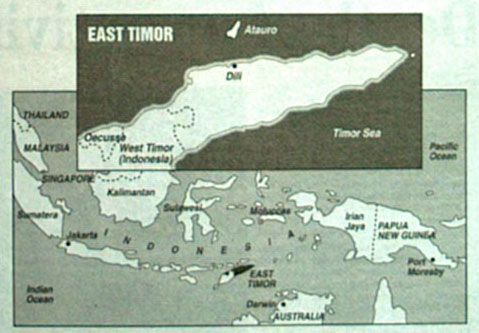
XANANA Gusmao and Jose Ramos Horta's visit to Malaysia in February signified a new era in Malaysia's relationship with East Timor. Just six months before that, Malaysia had accused the West of taking advantage of Indonesia following the fall of Suharto and orchestrating East Timor's independence. Today, the Malaysian Government has pledged to help East Timor rebuild their country.

Foreign Minister Datuk Seri Syed Hamid Albar, in welcoming the East Timorese leaders, said, "It is important for us to look at East Timor as an independent country and we will continuously build up the relationship based on this.''

This rapid turnaround in Malaysia's response to East Timor before and after its independence calls for more scrutiny of our foreign policy, observes Dr Sumit Mandal, lecturer at Institute of Malaysian and International Studies (Ikmas) of Universiti Kebangsaan Malaysia.

"The implications of recent events concerning East Timor beg us to look into the meaning of the non-interference principle which Malaysia held to during the 24 years of Indonesian domination,'' he says.

As an Asean member country, Malaysia abides by that principle in the internal affairs of a member country. This is the founding principle of Asean, the basis of which is to avoid political and military conflicts and to foster regional economic development.

Right from the start, when Indonesia invaded East Timor, Asean had dismissed East Timor's long struggle for independence as an internal affair of Indonesia. When Indonesia invaded East Timor in 1975, Malaysia, with all other Asean member countries (except Singapore), in an act of Asean solidarity, voted for Indonesia when the United Nations General Assembly condemned the invasion and called for Indonesia to withdraw. Singapore fell in line in 1977.

The invasion was not only sanctioned by Asean countries but by Western superpowers too. American complicity in Indonesia's invasion and subsequent repression of East Timor has been amply documented. According to American author and political analyst Noam Chomsky, US backing of Indonesia came as a result of fear that East Timor would become a "South-East Asian Cuba''.

The fear of communism taking root in an economically and politically important region drove the United States into providing the means of invasion. In fact, the invasion was in full force after the visit of American President Gerald Ford to Jakarta in 1975 during which his Secretary of State, Henry Kissinger, gave his blessings to Suharto, asking the invasion to be quick and efficient.

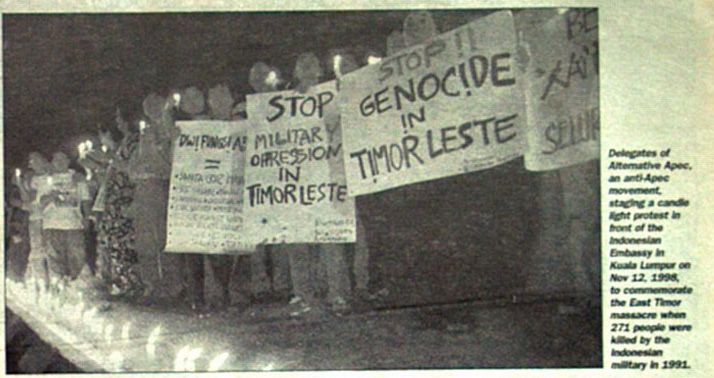
In another show of support for Indonesia, Asean member countries again abided by the policy of non-interference in the Nov 12, 1991, Dili Cemetery Massacre. Eye-witness accounts and a video recording by British filmmaker Max Stahl showed that the Indonesian military had opened fire at unarmed demonstrators, killing 271 people, including 20-year-old Malaysian student Kamal Bamadhaj who was shot outside the cemetery.

Kamal's death went largely unreported in the Malaysian media. But the Dili killings brought international attention to East Timor's struggle and even seeped through to the citizens of Asean member countries. However, efforts to help the Timorese were mostly confined to NGOs.
One such effort was the Asia-Pacific Coalition on East Timor (Apcet) conference. It was first held in Manila in 1994 to show South-South solidarity with the Timorese.

The second Apcet was held in Kuala Lumpur in 1996 despite the expressed disapproval of the Malaysian Government. The conference was disrupted by members of the ruling coalition Barisan Nasional Youth Wing who blamed the organisers for spoiling the good relations between Indonesia and Malaysia. Police arrested 59 participants, including foreign journalists, and most of the organisers, who were locked up for up to a week.

Despite all this, the Malaysian Government's conscience appears to be clear. Expressing the Malaysia's government's sentiment, political scientist Dr Lukman Thaib of Universiti Kebangsaan Malaysia says that East Timorese leaders were given the opportunity to understand Malaysia's position during their February visit.

"It was not morally proper to support the East Timorese struggle at the expense of the non-interference policy until the outcome of the 1999 referendum which showed the real intention of the people,'' he argues.

Furthermore, it is said that Malaysia's policy on East Timor has never changed.
"We have always supported Indonesia when East Timor was its territory and now, when it has ceased to be. We have always been consistent with our policy,'' says Kamal Ismaun, under secretary for South-East Asia and South Pacific Division at Wisma Putra.

The rationalisation now is that since Indonesia has acceded to East Timor's wish to be an independent nation through the August 1999 referendum, Malaysia will accord East Timor the respect of an independent nation and recognise it as such.

Former Asean secretary-general Tan Sri Datuk Ajit Singh says that in East Timor's case, we should put the past behind, look ahead and try to help the fledgling nation get back on its feet.
"East Timor has gone through some very tragic events and it is time to rebuild it."

Indeed, Malaysia's response to East Timor since the referendum has been largely positive. It has promised technical aid as well as diplomatic and administrative assistance in reconstructing East Timor.

However, for many observers, such nationalistic rasionalisations are far from adequate. Not only do the wrong-doers of the past have to be brought to justice, but lessons have to be learnt from the East Timor experience.

Suaram spokesperson Elisabeth Wong says that it is time Asean takes a critical look at the policy of non-interference because it deflects questions of human rights violations. "Asean must take a stronger stand on issues of human rights abuses. It must respond to calls for help by people in troubled areas within Asean.''

Parti Rakyat President Dr Syed Husin Ali calls for greater flexibility in the policy of non-interference. "The policy of non-interference is good in that it prevents conflict at government level, but it should not be taken to such an extreme at the cost of human lives. Asean should be flexible and tolerant of mutual criticisms.

"Raising issues of greater democratisation and giving its views to overcome problems and conflicts in another member country should not be seen as interference in the internal affairs of another country,'' he says.

However, Ajit Singh contends that Asean should still stand firm on its principle of non-interference. He believes that it is because of the principle that Asean has been able to avoid major conflicts among members and resolve problems peacefully for the last 32 years.
"Lately, it has come under close scrutiny as a result of what happened in East Timor, Kosovo and other parts of Africa. But in my opinion, the principle should still stand,'' he says.

Ajit Singh, however, concedes that if there are violations of human rights in a certain member country, it is within one's right to comment and bring to the attention of the international community and try to help. "But it must not be done by commenting negatively,'' he says.

Dr Khoo Boo Teik of Universiti Sains Malaysia agrees that it is very difficult for neighbouring countries to continually interfere in the affairs of each member country. Alternatively, he says, Asean could allow citizen groups, NGOs, and peoples' initiatives to carry out networking and create solidarity among member countries in voicing out concerns of human right abuses and similar issues.

Says Khoo: "The question is, would Asean make a commitment to allow for more democratic space and solidarity among its people?''

While Asean is still a long way from having an actual clause on human rights, leaders from the Philippines and Thailand have spoken out for greater democratic space and awareness of human rights issues among member countries.

Indonesia has since adopted a more democratic approach and has a greater awareness on human rights with Abdurrahman Wahid's government which was elected in a free and fair election. And deposed president Suharto is to be tried by the new government for alleged corruption during his 32 years of power.

The challenge now is for Asean to come to terms with lessons learnt from East Timor and adopt a more effective mechanism to address similar problems in future.

Published in The Star Malaysia May 9, 2000 (www.thestar.com.my)

Monday, May 08, 2000

Death of an Activist

by Ong Ju Lin

“He was totally, totally innocent and his death was an abosolutely unforgivable murder.”
Jose Ramos Horta, independence deputy leader of East Timor


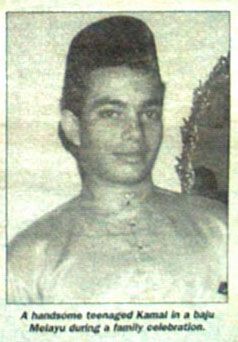
Unlike most Malaysians who recently became familiar with East Timor’s long and tragic struggle for independence, one young man, Kamal Bhamadhaj, worked tirelessly from 1989 until his death in 1991to raise international support and awareness for the East Timorese. He was killed by the Indonesian military on Nov 12, 1991, because he had become too visible and activist. These series of articles trace the life of this remarkable young man whose life and death became an award-winning documentary and explain why hardly anyone in this country has heard of him.


NINETEEN-ninety-one was an eventful year. Problems in Bosnia were brewing. The Israelis were settling on the Gaza strip and the West Bank in greater concentration, displacing the Palestinians from their land. Apartheid was being dismantled in South Africa.

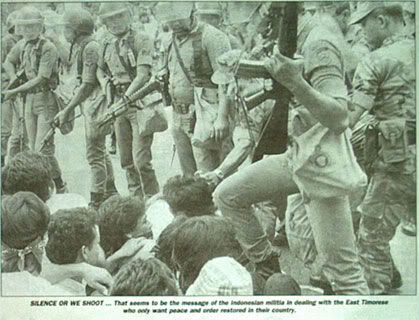
In all three cases, Malaysia responded with strong statements in support of the oppressed and displaced. But few Malaysians were aware of the extent of fear, violence and starvation wrought on a people since 1975 on an island much closer to home. That was the year Indonesia invaded East Timor. In the years that followed, the Timorese were subjected to rape, torture, arbitrary arrests (leading to many disappearing without a trace) and widespread starvation.

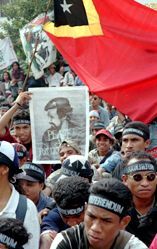
In 1991, too, Indonesian soldiers fired bullets at a crowd of 2,000 unarmed Timorese protestors demonstrating for an end to military brutalities and demanding for independence. In what has become known as the Dili Cemetery Massacre, 271 people were killed. One of them was a Malaysian. His name was Kamal Ahmed Bamadhaj.

Shortly after his death, an Utusan Malaysia report entitled Kamal Ahmed Bamadhaj, "He Blew the Fire of Love of Humanity" and printed an excerpt from his diary. But what was very strange was that the report made no mention of where he was killed, merely saying vaguely that it was "in a territory in a region in the world."


Such was the secrecy that enveloped Kamal's death and the slaughter of 270 East Timorese on Nov 12, 1991, in vast contrast to the ample coverage given by the local media to affairs of nations as far as Africa, the Middle East, and Europe.

In recounting the events after the Dili Massacre, Kamal's sister, Nadiah, 31, says: ``Nothing could be a clearer (indication) of Asean complicity than the local media's treatment of the killings."

For fear of angering Indonesia, the media downplayed Kamal's death and the massacre. As a member of Asean, Malaysia abides by the principle of non-interference that means a member country does not interfere in the domestic affairs of another member country. Indonesia's invasion of East Timor in 1975 was considered the domestic affair of Indonesia.

Reports of torture and other atrocities committed against the Timorese were muted in Asean's media. In the name of non-interference, Asean leaders stood in solidarity with the Suharto regime as far as East Timor was concerned even when a Malaysian became a casualty of the Indonesian military.


Kamal was barely 21 when he died. His death was, as East Timorese leader Jose Ramos Horta describes it, "(an) absolutely unforgivable murder."

Kamal, who had been living in Sydney, Australia, in 1991 was planning to go to Dili to act as an interpreter for an Australian aid worker, Bob Muntz, when word got around that Ramos Horta was looking for someone to act as a courier.

Ramos Horta wanted to send information to the East Timorese resistance concerning the itinerary of the visit of the United Nations/Portugal Delegation to East Timor.

Kamal had been involved in the resistance movement two years before and wanted to help by bringing world attention to the oppression and human rights abuses in East Timor. He arrived in Dili on Oct 24, 1991, several days ahead of the delegation's expected arrival. But on Nov 3, word went out that the visit had been cancelled. If they had come, the Portuguese would have been the first foreign delegation allowed into the troubled territory since Indonesia's annexation 16 years before.

"Hearts sank. People cannot believe it. In the past month, Timorese have been taking extraordinary risks organising themselves in anticipation of the delegation, wrote Kamal in his diary. "They claim that any risk they took was worth it because the visit will offer them so much hope. But now the visit is off and the Timorese are once again in the all too familiar position of being defenceless from arbitrary arrest, maltreatment or even death."

These were to be Kamal's last words in his diary. In his final conversation with Bibi Langker, his Australian girlfriend, Kamal had sounded different that morning. "He was totally relaxed and being silly. It was unlike his earlier conversations where he sounded totally freaked out and tensed," says Langker in the New Zealand-made documentary, Punitive Damage, which recounts Kamal's death and his mother's four-year battle to bring his killer to justice.

On the morning of Nov 12, 1991, Kamal set off to join demonstrators in commemorating the killing of 16-year-old Sebastiao Gomes who was shot on Oct 28 by Indonesian soldiers who attacked a church, where Gomes and several youths were staying. The commemoration mass swelled to several thousand people and, as they marched in protest from the church to the Santa Cruz cemetery where Gomes was buried, they unfurled banners calling for independence and a stop to the atrocities committed against the Timorese people.

Upon reaching the cemetery, according to the testimony of eye-witness Allan Nairn, an American journalist, truckloads of armed soldiers descended from their vehicles in an orderly fashion, marched up into the crowd and, without warning, started shooting. The terrifying scene of people falling on top of each other trying to escape through the main exit of the cemetery was vividly caught by British filmmaker Max Stahl in his documentary, In Cold Blood.

The high walls of the cemetery prevented many from escaping. In one scene, the camera captured a man dying from gunshot wounds, his head cradled by his friend. Kamal was shot moments later, outside the cemetery.

"Kamal did not die for nothing. It's intriguing that years after his death, he is still remembered in different ways," says his father, Ahmed. His death spurred those who knew him to work towards East Timor's peace in their own ways.

To deal with her grief, his sister Nadiah, for instance, took to learning about Kamal's activism in South-East Asia and human rights issues. And what she learnt, she shared with others. Nadiah went on to write on East Timor and publish Kamal's diaries and letters in the book, Aksi Write(Rhino Press), in 1997. She is currently working on the second edition to be published some time in June this year.

Recounting the events after Kamal's death, Nadiah says: "I did not know that world leaders were turning a blind eye to such atrocities in East Timor. I guess that knowledge is the most beneficial thing that came out of Kamal's death for me. But it is too terrible a price to pay for that knowledge."

In 1994, Kamal's mother, Helen Todd, aided by the US Center for Constitutional Rights, sued the Indonesian army's regional commander, General Sintong Panjaitan, holding him responsible for her son's death and the deaths of the 270 others.

After the massacre, in response to international outrage, the Indonesian Government sent Panjaitan and another commander to Harvard University in Boston to study English as "punishment''. Using a little-known 200-year-old US law which allowed human rights violators to be tried wherever they were found, Todd sued for compensatory and punitive damages.

Panjaitan, upon receiving his summons, immediately fled back to Indonesia. The suit, however, continued and the US court eventually awarded Todd and Kamal's estate a total of US$22mil (RM83.6mil). Panjaitan refused to acknowledge the court's jurisdiction, calling the suit a "joke''.

Todd gave countless interviews to the international media and played a crucial role in the documentary, Punitive Damage. Her tireless work contributed to a greater awareness of what actually happened in East Timor during the 24 years of Indonesian occupation and the events on that fateful day in November 1991.

But her collaboration with the filmmakers was her last "public appearance'', as she put it when contacted for this article. "It was very painful doing the film. I don't want to play the grieving mother anymore,'' she said, in turning down our request for an interview.

Kamal's friends in the students' organisation, Network of Overseas Student Collectives (Nosca) in Australia, pledged to work in their own capacities until East Timor was independent. Elisabeth Wong, a Malaysian who is now coordinating the collection of clothes and food to be sent to East Timor says: "Kamal's death changed us. We were no longer a bunch of idealists. We were suddenly faced with the reality that our friend, whom we considered a family member, died in the cause of his activism. It made our struggles more real and we became more committed to the cause."


In 1996, Wong and former Nosca members, with the support of other organisations, organised the Apcet II (Asia-Pacific Coalition on East Timor) conference to raise awareness on East Timor issues and to find a peaceful solution to the struggle.The conference, however, was disrupted by UMNO Youth (the ruling party's youth wing) members and the organisers detained. The incident made it crystal clear that the Malaysian Government was determined to silence any attempts by citizens' groups to bring up the issue of East Timor or of Kamal's death.

The fall of Suharto in 1998, which paved the way for East Timor's independence, and the ensuing excitement of rebuilding have overshadowed old horrors. But the memories of Kamal remain. He is remembered in quiet ways by people who may or may not have known him when he was alive.

"Months after he was buried, there were still notes, flowers, letters, on his grave,'' says Ahmed who visits his son's grave in Bukit Kiara, Kuala Lumpur, regularly to offer prayers. "I was told by the gatekeeper that even now someone would come, sit for an hour, and then another couple would come, sit and weep together. People remember him.

"Retracing Kamal's travels in Indonesia a few years after he was killed, Wong recalls that villagers whom Kamal met along the way still remembered him. "When I told them that Kamal had been killed, they wept openly."

"Kamal did what he did, not because of religious affiliations or regional politics or for any kind of fame. Observes Ahmed: "It was something very simple, very basic: He loved people, and their suffering tormented him. He did what he could for a forgotten people."

To date, the Malaysian Government has yet to acknowledge, much less put up any protest in recognition of, that one of its citizens was wrongfully killed by Indonesia under the Suharto regime.

The Center for Constitutional Rights, however, is pursuing the case and Todd has said any money she receives from the damages would be donated to families of the victims of the Dili Massacre.

Sintong Panjaitan, who joined the Indonesian public service, rose to become an adviser to President B.J. Habibie. Attempts to locate him came to naught. Thus far, he has not been brought to answer for his crimes.

Published in The Star Malaysia on May 8, 2000. (www.thestar.com.my)

Friday, May 05, 2000

Kamal's Final Moments

by June HL Wong and Ong Ju Lin


WHEN the Indonesian soldiers started pumping bullets into the East Timorese protesters at the Santa Cruz cemetery in Dili on Nov 12, 1991, Malaysian activist Kamal Bamadhaj was near the front of the crowd.

He somehow survived the murderous hail, apparently sustaining only an arm injury, acording to a medical report his mother, Helen Todd received later. Eye-witnesses saw him walking away alone from the scene of carnage, barefoot.

In the documentary, Punitive Damage, Jose Verdial, a Timorese who took part in the demonstration, said he saw Kamal walking towards him, outside the cemetery, when a military truck that was following him pulled up next to him. An argument ensued, apparently over the camera Kamal was holding.


Seconds later, Kamal was shot in his chest by a military intelligence officer who had come out of the truck. He was left lying on the roadside. Kamal did not die immediately and had managed to flag down a passing Red Cross ambulance.

"When he was helped by the Red Cross, he was still talking,'' recounted Verdial. "Every time he spoke, blood gushed out from his wound.''

Further investigations by Todd revealed that Kamal died of blood loss as a result of delays in getting him to the hospital. The Red Cross ambulance was stopped twice by military and police road blocks.

At the second block, the police forced the ambulance driver into a police station compound and demanded he dump Kamal there. The courageous driver refused. He was finally allowed to send Kamal, who was bleeding profusely, to hospital. By that time, it was too late. He died 20 minutes later.

In Punitive Damage, American journalist Allan Nairn, who knew Kamal, recalled how tense and explosive the situation was in Dili, following the killing of a Timorese youth, Sebastiao Gomes, in a church by Indonesian soldiers on Oct 28 and the cancellation of the United Nations sponsored visit by a delegation of Portuguese parliamentarians on Nov 3.

Nairn said that when the soldiers attacked the Motael Church, it stunned the people because their "final sanctuary had been violated."

When word got out that the delegation's visit had been called off, the Timorese were in total despair. They had pinned tremendous hopes on the visit. At last, after 16 years of brutal oppression and isolation, the world would finally learn of their plight.

Many of the Timorese, defying the authorities' warnings of reprisal if they spoke to the Portuguese, had been preparing to gain the delegation's attention with banners and petitions. With the beacon of hope extinguished, they feared they would be singled out and killed.

Kamal, who knew many of the young Timorese, felt their fear and despair. He called his Australian girlfriend, Bibi Langker, in Sydney begging her to do something.

"He was desperate for the Portuguese to come. He asked me to go to the embassy to get them to come. He was really, really upset," she said in Punitive Damage.

When the Timorese decided to organise a memorial march for Gomes, Kamal begged the Western journalists (who were staying in the same hotel with him in Dili) to be present in the hope it would prevent violence by the Indonesian troops.

"Kamal himself was actually quite nervous about going. Then he decided to go and he got himself a camera," said Nairn.

Helen Todd marvels that "this boy who could never get up in the morning" set his alarm clock for 5.30am and woke everyone else.

The march started from the church near the beach and moved on to the cemetery. As they went along, the protestors pulled out banners calling for freedom.

As they gathered in the cemetery, Indonesian soldiers arrived and started shooting. "I couldn't believe it. At first I thought they were firing blanks. Then I saw people crumpling. They were being shot in the back as they tried to escape," recounted Nairn.

He said when the shooting stopped, the soldiers moved in and beat and stabbed the hapless Timorese still trapped in the cemetery.

Nairn, who sustained a cracked skull, said he survived because he shouted to the soldiers that he was American. He guessed, apparently correctly, that the Indonesians wouldn't kill a citizen of a nation which was supplying them with the guns and bullets.

A total of 271 people died that day, including Kamal, Malaysia's only casualty in the East Timorese cause.

Todd was prevented by the Indonesian authorities from going to Dili to bring his body back.

She was kept in Jakarta where a coffin arrived three days later. She was unable to identify the body because she was told Kamal had been buried immediately and then exhumed, rendering him unrecognisable.

Kamal's sister, Nadiah, says that when her uncle helped to bury the body in the grave in Bukit Kiara, Kuala Lumpur, he remarked that the body seemed too tall.
"Who knows, maybe it's a Timorese in Kamal's place," she speculates.

Her father, Ahmed Bamadhaj, however, believes it's his son's body, saying he had recognised Kamal's hair. The alternative, that it's not Kamal's body, is too terrible for him to contemplate.

Ahmed remembers a conversation he had with Kamal the last time he saw his son.
"He said to me: 'You know, Aba, there are some things in this world that are worth fighting for. And if it is going to cost me my life, I am prepared to give it.'

"I knew then that I could not stop him from doing what he believed in. I could only tell him to be careful."

But many, including East Timorese leader Jose Ramos Horta, who had used Kamal as a courier, and his mother, believe Kamal was marked for death by the army intelligence.

Says Todd, "He was deliberately targeted and murdered."

In Punitive Damage, Timorese activist Abel Guterras paid Kamal a moving tribute:

"He was a friend; a foreigner who came and showed his solidarity with us. It was sad that he came to our land and died for our freedom."

Published in The Star May 9, 2000


The Boy Who Loved People
by Ong Ju Lin


NINE years after Kamal Bamadhaj's death, as East Timor prepares for its independence from Indonesia, the young man is barely remembered by most Malaysians. But for his father, businessman Ahmed Bamadhaj, it is as if his son had died the day before.

"I still have nightmares occasionally about how he was killed. I still see him. I go around the streets of KL and sometimes see someone who looks like Kamal from the back ... and hope against hope that it is him,'' says Ahmed, his voice thick with emotion.

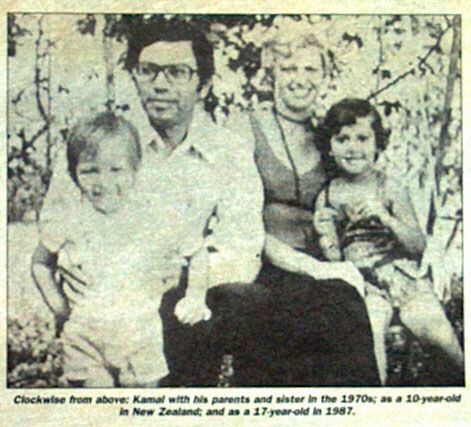
Kamal as born on Dec 23, 1970, the second child of Ahmed and his first wife, Helen Todd. They have two daughters, Nadiah, 31, and Haanim, 22.

Ahmed, who had never spoken openly about his son's death, remembers Kamal as an extraordinary child. As a young boy, he had shown a glimpse of the man he was to be.
"Kamal was a curious child and was always enthusiastic about learning new things. He was popular with everyone. He moved around without barriers or any hang-ups. And he was thoughtful and compassionate towards the less privileged,'' says his father at his home in Kuala Lumpur.

Ahmed recalls an incident during Hari Raya when Kamal was eight. "We had done our Hari Raya shopping and Kamal approached me and very gently asked, "Can you buy a pair of shoes for my friend?' I asked him why and he replied that his friend was poor and that he needed new shoes to replace his tattered ones. That was Kamal.

With his university friends, Kamal was known as the "peacemaker''.

"In debates, he was always calming everyone down, resolving conflicts and finding the middle way,'' says Elisabeth Wong who now works with the human rights organisation, Suaram.

Rather than being sucked into the arguments about capitalism or socialism as the end to poverty and social ills, Kamal believed that there were many other unexplored alternatives.

In a diary entry entitled, Dreams of a Thousand Roads, Kamal wrote: "While we were busy becoming more entrenched in the 'to be a socialist or to be a capitalist' debate, the fundamental aims of our loving humanitarian idealism (promoting social justice, creating egalitarianism, helping those with nothing no food, no shelter, no self-esteem) was fading away.''

Kamal's ideas on justice reflected his personality. He was described by his friends as someone who was liked by people because he was warm, personal and generous to everyone he met.

"Kamal was a compassionate young man. He had a big heart and a tremendous conviction toward humanitarianism,'' says Wong. The first time Wong met Kamal, he had bounded up to her to ask her if she was interested in joining a peace protest against Indonesia.

"He was barefoot. When I asked him why he went around kaki ayam, he replied that one must feel close to Mother Earth. He was also a devout vegetarian,'' Wong says.

Kamal's affinity to the plight of the East Timorese was no surprise to those who knew him. He grew up in a family where political awareness and social activism were discussed openly. Kamal's mother, Helen Todd, was a great influence.

A New Zealander, she married Ahmed Bamadhaj in 1968. In 1977 she gained her Malaysian citizenship and joined the New Straits Times as a journalist, writing under the byline Halinah Todd. She resigned from the paper in 1985.

Nadiah recalls that she and Kamal were exposed to many socio-political issues by their mother, including abuses by institutions of power. In Aksi Write (Rhino Press, 1997), a book by Nadiah on Kamal and his diaries, she wrote of Kamal's early influences.


Once such account was when Kamal was 11. Todd had taken him to Tasik Bera in Pahang to write on how the Felda land schemes were drying up the lake which the Semelai tribe depended on. Nadiah remembers Todd and Kamal staying up all night while the tribal elders nursed a sick child.

Todd was, and still is, involved in Amanah Ikhtiar Malaysia (AIM), a project to eradicate poverty among the hard-core poor.

During his teens, Kamal worked in Sabak Bernam, Selangor, hauling bags of poultry feed for the farmers who were involved in the project. Later, using the same AIM concepts, he tried to implement the project in East Timor in 1990. Todd, who was divorced from Ahmed when Kamal was still a boy, will accomplish her son's dream by implementing a similar project in East Timor later this year.

Kamal first became interested in East Timor in 1989, as a result of his involvement in student activism at the University of New South Wales, Australia. He became part of the Network of Overseas Student Collectives (Nosca), a highly politicised student group consisting of mainly Malaysians, campaigning on domestic and international issues.

Despite giving so much of his time to his activism work, writing (he was extremely prolific, judging from his letters, diary entries and poems) and weekend jobs to support himself, Kamal was a brilliant and conscientious student, consistently scoring A's, says Ahmed.

In 1990, Kamal visited East Timor for the first time and witnessed for himself the situation which he had only read and heard about. This visit was crucial in making Kamal return to the troubled territory a year later.


Nadiah remembers that the last time she saw Kamal was a year before he was killed, just after his travels. "I remember that he was really troubled. He had just come back from East Timor and had witnessed the extent of the suffering there. He came back to Kuala Lumpur and was shocked that people were completely clueless about East Timor.''

A passage that Kamal wrote in a letter to his parents at the end of 1990 sheds some light on his concern and frustration:

"The Timorese are surrounded by fear. Fear like I've never felt before. There are intelligence and military people everywhere and hence it is difficult to get into conversation with people who are frightened or suspicious or both!

"I met victims of torture and people who had lost most of their families in the massacre of the 1970s when Indonesia invaded East Timor ... the most glaring thing was the huge military presence and the atmosphere of fear.

"People are still being taken away by the military at night and killed. (They) ... seem to have no one to appeal to ... no protection. It is frustrating and scary.''

From then on, all his activities were focused on his political beliefs aimed at social change. He took up the Asian studies programme, giving up law studies for he had begun to believe that little change could come out of the human rights situation in South-East Asia through legal channels.

With Tian Chua, Kamal founded Aksi, an off-shoot of Nosca, to raise awareness on human rights issues in Indonesia. Chua, a human rights activist and Keadilan vice-president, remembers Kamal as an enthusiastic, energetic young man whose passion for justice was infectious.

In commemorating the death of Kamal in a public forum welcoming East Timor leaders Xanana Gusmao and Jose Ramos Horta in February, Chua said: "There comes a time when one has to make a decision whether to stand on the sidelines or stand in solidarity with one's fellow man.''

Undoubtedly, Kamal chose the latter, and paid the price with his life.

Published in The Star Malaysia, (www.thestar.com.my) May 5, 2000