Why are we fighting over a word to refer to Divinity that historically have been used by Arabs of the Muslim, Christian and Jewish faith to describe God? A simple research on the internet will tell you this.
The word Allah does not belong exclusively to Malaysian Muslims, and this is a fact of today and the past backed by evidence. Go to the middle east and ask. It is the West that has assigned Allah to be the word used by Muslims. Don't be a Western bodek but understand the reality of diversity in the Arab world in which the word Allah came to be.
This is from Wikipedia, but check out their source from the Encyclopædia Britannica,and the Encyclopedia of the Modern Middle East and North Africa.
Allah is the standard Arabic word for God.[1] While the term is best known in the West for its use by Muslims as a reference to God, it is used by Arabic-speakers of all Abrahamic faiths, including Christians and Jews, in reference to "God".[1][2][3] The term was also used by pagan Meccans as a reference to the creator-god, possibly the supreme deity in pre-Islamic Arabia.[4]
The concepts associated with the term Allah (as a deity) differ among the traditions. In pre-Islamic Arabia amongst pagan Arabs, Allah was not considered the sole divinity, having associates and companions, sons and daughters - a concept which Islam thoroughly and resolutely abrogated. In Islam, the name Allah is the supreme and all-comprehensive divine name. All other divine names are believed to refer back to Allah.[5] Allah is unique, the only Deity, creator of the universe and omnipotent.[1][2] Arab Christians today use terms such as Allāh al-ʼAb ( الله الأب, "God the Father") to distinguish their usage from Muslim usage.[6] There are both similarities and differences between the concept of God as portrayed in the Qur'an and the Hebrew Bible.[7]
Friday, January 08, 2010


Wednesday, October 15, 2008
Teo Kok Seong: Rakyat Perlu Menguasai Bahasa Melayu
This is a good discussion on Bahasa Melayu. I like it because it is answered by a Chinese Malaysian - Dr Teo Kok Seong, professor sosiolinguistic of Universiti Kebangsaan Malaysia (UKM). In this series on how the national language is perceived by non-Malays....
Teo Kok Seong: ...Kata mereka, kita tidak boleh kata bahawa orang cina yang tidak boleh berbahasa melayu ini tidak patriotik.
Saya tak kata mereka tidak patriotik. Cuma saya kata agak pelik. Ini kerana hal ini tidak semestinya berlaku. Sebab bagi saya, seorang warganegara Malaysia mesti mempunyai pengetahuan bahasa melayu yang mencukupi. Sikit-sikitpun tidak mengapa. Sedangkan kita tengok ada yang sepatah pun tak tahu. Jadi macamana?
More...
So do you agree that to be a Malaysian, one needs to at least know Malay?
I have met some Chinese Malaysian who don't know how to speak Malay, or they speak it so badly you want to ask them to shut up. These people just hang out with Chinese their whole lives and never want to venture out of their own language community. They study in Chinese schools, they do business with Chinese, and they eat Chinese food. I want to ask them, hey are you Malaysian or China Chinese?
Teo Kok Seong: ...Kata mereka, kita tidak boleh kata bahawa orang cina yang tidak boleh berbahasa melayu ini tidak patriotik.
Saya tak kata mereka tidak patriotik. Cuma saya kata agak pelik. Ini kerana hal ini tidak semestinya berlaku. Sebab bagi saya, seorang warganegara Malaysia mesti mempunyai pengetahuan bahasa melayu yang mencukupi. Sikit-sikitpun tidak mengapa. Sedangkan kita tengok ada yang sepatah pun tak tahu. Jadi macamana?
More...
So do you agree that to be a Malaysian, one needs to at least know Malay?
I have met some Chinese Malaysian who don't know how to speak Malay, or they speak it so badly you want to ask them to shut up. These people just hang out with Chinese their whole lives and never want to venture out of their own language community. They study in Chinese schools, they do business with Chinese, and they eat Chinese food. I want to ask them, hey are you Malaysian or China Chinese?
Tuesday, October 07, 2008
What Environment? It's Occupation and Terrorism

I watched What Rainforest? and immediately felt that it should not be called an "environmental" documentary. But it's seemingly environmental sounding name belies the cruel reality of the story.
At the Freedom Film Fest where it debuted, it was put under the category "Native Rights and Conservation" and many like me would be wont to expect an environmental film. But how wrong was I.
As environmental issues become mainstream, its messages becomes simplified and stereotyped…. and boring. Add the indigenous people, and the hollywood theme of Guardian of the Rainforest gets even more tiresome.
Here goes – Primitive but wise with the way of the jungle, the indigenous people fight a losing battle against modern development to protect their way of life and identity. How heroic. How sad. Period.
I think it's time to move on. Because if you sing this refrain over and over, people stop caring. And it gives ammunition to those who don't give two hoots about the environment or native rights to respond: Hey, wake up man. We have to develop. We have hungry stomachs to fill. Why should we be sorry for cutting down a few trees? The West finished cutting their trees and now wants to stop us?! And those lazy natives, why are you so anti-development? You want to be uneducated, poor and hungry ah? (as if they were offered any choices).
That's the typical answer politicians in Sarawak love to give when you present them facts about illegal logging. Nevermind the criminal element of illegal logging, they will bring out that tiresome narrative about development vs environment.
The 36 minute documentary What Rainforest? by Chi Too and Hilary Chiew is a different sort of film albeit with an environmental sounding name. It made me sit up. It made me burn. It's not about development vs environment with pretty pictures of virgin rainforests and its denizens thrown in.
It's really about occupation and terrorism. Much akin to what the Palestinians are facing in their homeland. Driven out of their land and occupied by others while the rest of the world looks on.
Except that in this case, it is perpetuated not by foreign enemies but done with the aggressive support of the state using our tax dollars backed by dubious sections of the law. So in effect, it's state terrorism.
Ok, I'd say the Palestinians have it much worse, but the fact of the matter is that Occupation and Terrorism is happening in the Land of the Hornbills. Occupation - people's land are being occupied illegally. Terrorism - people are being threatened and even beaten if they refuse to leave, if they put up blockades, or if they're organising their people. There have been cases of mysterious disappearences and deaths of activists. Recently, Penan women and girls claimed that they were raped and sexually abused by loggers. All these are terrorism tactics to cow a people into submission so they abandon their claim to the land.
If the same events were to be transplanted into Peninsular Malaysia middle-class life, there would be lawsuits, and rolling heads. No, it wouldn't even happen to begin with. If it did, the closest thing that can bring that kind of outrage is the demolition of places of worship. It would bring no less than a Hindraf Makkal Sakti kind of respond.
When handbags get snatched, when houses get burglarized, especially when it's a politician's wife and a minister's house, they get frontpaged. When someone's land in Sarawak is being grabbed in broad daylight, and the owners terrorized by gangsters and police stand and watch, it's either too sensitive or too complicating to report. Let me just put it simply.
Imagine someone coming into your house and cart all your furniture out. Then, they put their own furniture inside your house and tell you, get out, this house belongs to us now. You go to the police. They do nothing. Ok now, put yourself in the native's shoes, or bare feet. Those bulldozers and loggers come, and they plunder your trees – trees that give shade, wood and fronds to build homes, herbs and roots for medicine, trees that shelter animals so you can hunt them for food, and strong roots to keep soil in place so you have water to drink and wash from clean rivers– in short, everything you need to survive. No need to venture into global warming talk or critters at the brink of extinction.
The greedy loggers don't care about any of that. They show you their license to log with Sarawak Chief Minister Taib's signature on it and laugh in your face. While you're slogging out in court moving at a snail's pace to prove that the land belongs to you because your ancestors were there first, they flout court decrees and start logging anyway. Before the judge can postpone the next trial date, they start planting oil palm. Then they claim the land is theirs because instead of leaving the land "idle", they cultivate it. Next they apply ownership papers to justify it.
What do you do? You'd better start planting oil palm before they come. Forget about your old life of living in harmony with nature. Forget about your cultural identity and traditional way of life, and least of all, the environment. Log the trees, sell the timber and with the money, plant oil palm. Lots of them. Then you can prove that the land is yours. Beat the greedy companies in their own game ha ha. That's what the last man standing did, Segan anak Degon. Hmm, tidak Segan sama sekali, brave man.
Hell, that's what I'll do if I were in his place.
To watch What Rainforest? Here
(Note to future film fest organizers interested in showing this film: This film should be put under the category: Occupation and Terrorism and shown with other films of this nature, such as the Palestinian conflict, and the War against Terrorism. Not under Environment.)
Tuesday, September 09, 2008
ANCAMAN KEPADA MELAYU
"UTUSAN MALAYSIA: Sekarang ini ada pula Melayu liberal yang juga mahu supaya diwujudkan kesamarataan?
DR. SHAM RAHAYU: Kelompok ini yang menjadi racun, saya sebut ini adalah Melayu yang makan Melayu, Melayu yang menjadi racun kepada Perlembagaan.
Tidak mustahil mereka yang mencetuskan semua ini.
Mereka yang nak jadi juara memperjuangkan hak sama rata, tanpa memahami sejarah Perlembagaan secara semangatnya.
Mereka melihat Perkara 153 itu seolah-olah membawa pandangan buruk kepada Melayu, mereka rasa keistimewaan itu macam bantuan kepada orang cacat, benda yang buruk kepada orang Melayu.
Ini menjadikan orang memijak Perlembagaan.
Mereka ini tali barut yang menjadikan Perkara 153 dan orang Melayu sendiri bencikan keistimewaan Melayu.
Kita tidak menafikan perkembangan mutakhir ini menunjukkan wujud dua Melayu iaitu Melayu liberal dan Melayu Perlembagaan. [Mingguan Malaysia]"
DR. SHAM RAHAYU: Kelompok ini yang menjadi racun, saya sebut ini adalah Melayu yang makan Melayu, Melayu yang menjadi racun kepada Perlembagaan.
Tidak mustahil mereka yang mencetuskan semua ini.
Mereka yang nak jadi juara memperjuangkan hak sama rata, tanpa memahami sejarah Perlembagaan secara semangatnya.
Mereka melihat Perkara 153 itu seolah-olah membawa pandangan buruk kepada Melayu, mereka rasa keistimewaan itu macam bantuan kepada orang cacat, benda yang buruk kepada orang Melayu.
Ini menjadikan orang memijak Perlembagaan.
Mereka ini tali barut yang menjadikan Perkara 153 dan orang Melayu sendiri bencikan keistimewaan Melayu.
Kita tidak menafikan perkembangan mutakhir ini menunjukkan wujud dua Melayu iaitu Melayu liberal dan Melayu Perlembagaan. [Mingguan Malaysia]"
Wednesday, June 18, 2008
Media independence: Don't just leave it to the journalists

I refer to Mirror, Mirror by A. Asohan on StarMag June 15.
I was at the National Press Club when de facto Law minister Zaid Ibrahim gave a disingenuous speech to a roomful of journalists, bloggers and activists who work for press freedom.
He seemed to be the appropriate person from the government to be invited to speak in the Walk for Press Freedom event on June 1st. Firstly, because he seemed like a progressive fella with his talk and action on reforming the judiciary.
Secondly, because he is the de facto law minister, he would perhaps do something about the oppressive laws that continue to muzzle the media.
I think his speech was not only condescending, but showed his lack of understanding of the issues at stake. He started off by saying that he was not there to support press freedom nor was he the right person for that matter to be addressed to. Then he lectured the retinue of journalists and activists that they should blame themselves for the lack of media freedom, and NOT the government.
I think if we were more self-respectable, we would’ve just walked out. Luckily, some of us boo-ed and jeer-ed him. Afterall, we didn’t go there to be lectured by some politician about media freedom. We want to see if this government after March 8 is committed to media freedom, as it seems to be, about the state of the judiciary.
A media of integrity, a fair and balanced media, is not just the prerogative of journalists. It is in the interest of everyone – it is the right of the citizens in a democratic country. It should provide a fair and balance view of issues important for the people, and to be the voice of the voiceless, rather than a mouthpiece of the government.
After Operasi Lallang in 1987, the government under the former Prime Minister effectively brought all mainstream media under its control either directly, or indirectly. Newspapers were bought over by political parties and laws like the Printing and Publication Act, the Official Secrets Act and the Sedition Act instill fear and self-censorship among its senior editors and working journalists.
In this climate of fear, the lack of critical journalism is precisely what’s driving people online to get their news. The explosion of bloggers and online news and the millions of hits they get show the people’s hunger for REAL NEWS and VIEWS that matter. That power is now accorded some respect after the fallout of the recent general election. Good. Now let’s hope something is done to lift those laws that curtail the independence of mainstream media.
If we leave it to the current batch of working journalists and senior editors to revamp the state of the media, with those laws still hanging over their heads like a Damocles’ sword, we won’t get anywhere. After all, their bread and butter depend on retaining the status quo.
In the same way, let me ask Zaid, why didn’t he tell the judges to clean the judiciary up? Can we leave it to the judges to clean themselves up, when some of them are implicated as beneficiaries of executive interference? Why talk about an independent commission to elect judges, why bother when judges themselves haven’t said anything about overhauling the justice system?
A strong, independent media is an integral institution of a functioning democracy. Like an effective, independent judiciary – those two pillars of democracy should not just be left just to working judges or working journalists. They are too important.
And this time I agree with Asohan - the press, the powers-that-be and the public – are stakeholders here. It is in the interest of the Malaysian public to be served news that is fair and balanced and that reflects their needs and aspirations. If you believe that you deserve to know the truth and make informed decision, make it known by signing on this petition http://benar.org/
Come on, take that first step.
Thursday, June 05, 2008
FOOD CRISIS: IS THE ANSWER MORE TECHNOLOGY, MORE FREE TRADE? Burma's numbers don't lie
---
I came across some startling numbers in Newsweek while taking my usual lrt train to work in downtown KL. "By the Numbers" is my favourite section in the magazine because it makes you double back and think again. This time it's about Burma and food.
Since the media broke stories about the food crisis and rising food prices, I've been trying to get my head around this new global life threatening issue. Food shortage due to climate change and biofuel taking away land for food crops are among the things that have been blamed. And the solutions - I've read that we need another green revolution, we need more genetic modified seeds, we need to modernise and corporatise agriculture, and we need more free trade.
But are those the answers? Or are they the very reasons why we're facing the food crisis now.
These numbers from a very "backward" country confirms my suspicion about the mis-conceptions and mis-information about the global food crisis.
By the Numbers (reprint from Newsweek May 25 - June 2)
Burma is a land of agricultural bounty - its rice yield ranks as one
of the highest in Southeast Asia. This richness has cushioned the
ruling junta from the food riots that are starting to plague
neighbouring states.
206 - number of kilograms of rice per person per year consumed in
Burma, the highest in the region.
3.8 - number of tons per hectare of Burma's rice yield - 44 percent
higher than that of neighboring Thailand.
2,912 - average number of daily calories consumed by Burma's citizens,
the highest in Southeast Asia
6% - of Burma's people who are malnourished, as opposed to 20 % of
Thais and 19 % of Vietnamese.
Now for those of you who have little idea about the wealth disparity of these South East Asian nations, here are their GDPs per capita.
Burma USD 1,800
Thailand USD 9,200
Malaysia USD 12,200
Indonesia USD 3,900
Philipines USD 5,000
Thailand's GDP per capita is more than FOUR times that of Burma, and Malaysia's is almost SEVEN times that of Burma. If you walk in downtown Bangkok or Kuala Lumpur, and then in Rangoon, you'd think that you've been transported 50 years back. Yet there are more malnourished people in Thailand than Burma.
I am amazed that whatever we think about the Burmese, as being oppressed and starved by their fat military rulers, they are amazingly self-sufficient. Left to their own devices, left to their antiquated agricultural tools and their traditional way of farming, Burma's rice yield per hectar is 44% higher than Thailand, which has an export oriented agriculture and has embraced all kinds of new technologies, modern chemical fertilisers and pesticides.
That leads me to ask: Is modern farming depleting the richness of soil and thus, reducing the capacity of land to produce? Is the corporatisation of food decreasing food sustainability and food security?
I want you to read Vandana Shiva's interview with ALTER net. She is a world-renowned environmental activist, physicist, and authour of 300 papers in leading scientific and technical journals. Here she explains how corporation-friendly economic schemes got us into this mess in the first place.
Vandana Shiva: Why We Face Both Food and Water Crises
--
I came across some startling numbers in Newsweek while taking my usual lrt train to work in downtown KL. "By the Numbers" is my favourite section in the magazine because it makes you double back and think again. This time it's about Burma and food.
Since the media broke stories about the food crisis and rising food prices, I've been trying to get my head around this new global life threatening issue. Food shortage due to climate change and biofuel taking away land for food crops are among the things that have been blamed. And the solutions - I've read that we need another green revolution, we need more genetic modified seeds, we need to modernise and corporatise agriculture, and we need more free trade.
But are those the answers? Or are they the very reasons why we're facing the food crisis now.
These numbers from a very "backward" country confirms my suspicion about the mis-conceptions and mis-information about the global food crisis.
By the Numbers (reprint from Newsweek May 25 - June 2)
Burma is a land of agricultural bounty - its rice yield ranks as one
of the highest in Southeast Asia. This richness has cushioned the
ruling junta from the food riots that are starting to plague
neighbouring states.
206 - number of kilograms of rice per person per year consumed in
Burma, the highest in the region.
3.8 - number of tons per hectare of Burma's rice yield - 44 percent
higher than that of neighboring Thailand.
2,912 - average number of daily calories consumed by Burma's citizens,
the highest in Southeast Asia
6% - of Burma's people who are malnourished, as opposed to 20 % of
Thais and 19 % of Vietnamese.
Now for those of you who have little idea about the wealth disparity of these South East Asian nations, here are their GDPs per capita.
Burma USD 1,800
Thailand USD 9,200
Malaysia USD 12,200
Indonesia USD 3,900
Philipines USD 5,000
Thailand's GDP per capita is more than FOUR times that of Burma, and Malaysia's is almost SEVEN times that of Burma. If you walk in downtown Bangkok or Kuala Lumpur, and then in Rangoon, you'd think that you've been transported 50 years back. Yet there are more malnourished people in Thailand than Burma.
I am amazed that whatever we think about the Burmese, as being oppressed and starved by their fat military rulers, they are amazingly self-sufficient. Left to their own devices, left to their antiquated agricultural tools and their traditional way of farming, Burma's rice yield per hectar is 44% higher than Thailand, which has an export oriented agriculture and has embraced all kinds of new technologies, modern chemical fertilisers and pesticides.
That leads me to ask: Is modern farming depleting the richness of soil and thus, reducing the capacity of land to produce? Is the corporatisation of food decreasing food sustainability and food security?
I want you to read Vandana Shiva's interview with ALTER net. She is a world-renowned environmental activist, physicist, and authour of 300 papers in leading scientific and technical journals. Here she explains how corporation-friendly economic schemes got us into this mess in the first place.
Vandana Shiva: Why We Face Both Food and Water Crises
--
Friday, May 09, 2008
The Boxing Ring
I've been publishing all the comments that come to the Chinese school debate - weather it is pro or against without fear or favour.
This is what I found:
1) I am very,very moderate. Sickeningly so. So I can be a referee, but I'm pretty sure the wrestlers on opposite side of the ring will accuse me of favouritism. And very soon they will both turn against me.
So here goes:
On one side of the ring is the pro-national school "extremist" who says - BAN CHINESE SCHOOLS! You are Malaysian, not Chinese ok, try going back to China and see if you're accepted!-- and this coming from a young Chinese student.
On the other side of the ring are the pro-Chinese school "extremist" who seem to think that any talk that is not supporting Chinese school whole-heartedly is against it. Some of them are also prone to call me Banana, American, no-culture, no roots dsb.
This is my analysis:
The way some Chinese "extremist" feel about Chinese schools is almost similar to the way people would protect their religion and places of worship. It's sacred. It's like the institution of their identity and survival. In a way, it's true. They feel they really have to protect their identity and survival in a threatening environment that they do not feel any sense of belonging.
Many Chinese, even after the 4th and 5th generation here, (longer than a lot of Malays here) still feel besieged. And that feeling of being besieged feeds on itself. It starts from seeing that Malays get certain government privileges that you don't get by virtue of your descent. And we see certain politicians still calling us a pendatang, and say that if we "challenge" them, the keris will be bathed with a certain group's blood.
Inspite of that, we all stand up and sing Negaraku, pay taxes, makan belacan, durian and drink teh tarik. And to try to placade our sense of justice, they bombard us with Malaysia Truly Asia propoganda - everybody different colour but happy happy under one banner. This hypocrisy is truly an insult to all of us who know fully well that some people are more equal than others. It's really painful. And when you feel like giving up and moving to another country, which is a really really painful decision, you felt a glimmer of hope just watching one of Yasmin Ahmad's petronas ads....I'm sure by now you should know about Tan Hong Ming and his beau Umi Qazrina. If not click here: http://www.youtube.com/watch?v=8rHRgCiS22o. Damn it Yasmin.
So, in a way, I can understand that feeling of not-belonging and trying to protect their survival and identity. But I also think it is getting out of hand. Even though many Chinese have already made it, they still feel threatened. I liken it to the Zionist state of Israel, because of the historical injustice against Jews, they keep feeling threatened even when they are threatening others. Their defense becomes an offense to many people.
I observe that about a lot of Malaysian Chinese, even when they are discriminating others, they still feel justified. And many Malays do feel very discriminated and looked down upon in companies where the majority are Chinese.
These people look down on other races, and they dont know how to give and take with other races becasue they think they are superior. It's in their eyes, and in their body language and I hate that. I observe it better than other Chinese because I can blend and I look neither Chinese nor Malay.
But as a Chinese (3/4) myself, I want to call on Chinese to stop feeling fearful, and stop being so cocooned. Come out and engaged, and change that oppressive system. Becasue you are not the only one who feel discriminated and oppressed. Many Malays and many Indians feel that too. By coming out to engage is to move beyond your comfort zone and change that system so that there is more space for all of us to feel a sense of belonging. I think to keep on defending your right to send all your kids to Chinese schools, so that they wont have a chance to engage with others is only defending the status quo. Becasue when you do that, you are allowing national schools to become Malay schools. you are denying Malays of having the opportunity to mix with Chinese kids, and allowing fear and prejudice to breed. And you will also breed another generation of Chinese fearful or too proud to engage with others.
This is what I found:
1) I am very,very moderate. Sickeningly so. So I can be a referee, but I'm pretty sure the wrestlers on opposite side of the ring will accuse me of favouritism. And very soon they will both turn against me.
So here goes:
On one side of the ring is the pro-national school "extremist" who says - BAN CHINESE SCHOOLS! You are Malaysian, not Chinese ok, try going back to China and see if you're accepted!-- and this coming from a young Chinese student.
On the other side of the ring are the pro-Chinese school "extremist" who seem to think that any talk that is not supporting Chinese school whole-heartedly is against it. Some of them are also prone to call me Banana, American, no-culture, no roots dsb.
This is my analysis:
The way some Chinese "extremist" feel about Chinese schools is almost similar to the way people would protect their religion and places of worship. It's sacred. It's like the institution of their identity and survival. In a way, it's true. They feel they really have to protect their identity and survival in a threatening environment that they do not feel any sense of belonging.
Many Chinese, even after the 4th and 5th generation here, (longer than a lot of Malays here) still feel besieged. And that feeling of being besieged feeds on itself. It starts from seeing that Malays get certain government privileges that you don't get by virtue of your descent. And we see certain politicians still calling us a pendatang, and say that if we "challenge" them, the keris will be bathed with a certain group's blood.
Inspite of that, we all stand up and sing Negaraku, pay taxes, makan belacan, durian and drink teh tarik. And to try to placade our sense of justice, they bombard us with Malaysia Truly Asia propoganda - everybody different colour but happy happy under one banner. This hypocrisy is truly an insult to all of us who know fully well that some people are more equal than others. It's really painful. And when you feel like giving up and moving to another country, which is a really really painful decision, you felt a glimmer of hope just watching one of Yasmin Ahmad's petronas ads....I'm sure by now you should know about Tan Hong Ming and his beau Umi Qazrina. If not click here: http://www.youtube.com/watch?v=8rHRgCiS22o. Damn it Yasmin.
So, in a way, I can understand that feeling of not-belonging and trying to protect their survival and identity. But I also think it is getting out of hand. Even though many Chinese have already made it, they still feel threatened. I liken it to the Zionist state of Israel, because of the historical injustice against Jews, they keep feeling threatened even when they are threatening others. Their defense becomes an offense to many people.
I observe that about a lot of Malaysian Chinese, even when they are discriminating others, they still feel justified. And many Malays do feel very discriminated and looked down upon in companies where the majority are Chinese.
These people look down on other races, and they dont know how to give and take with other races becasue they think they are superior. It's in their eyes, and in their body language and I hate that. I observe it better than other Chinese because I can blend and I look neither Chinese nor Malay.
But as a Chinese (3/4) myself, I want to call on Chinese to stop feeling fearful, and stop being so cocooned. Come out and engaged, and change that oppressive system. Becasue you are not the only one who feel discriminated and oppressed. Many Malays and many Indians feel that too. By coming out to engage is to move beyond your comfort zone and change that system so that there is more space for all of us to feel a sense of belonging. I think to keep on defending your right to send all your kids to Chinese schools, so that they wont have a chance to engage with others is only defending the status quo. Becasue when you do that, you are allowing national schools to become Malay schools. you are denying Malays of having the opportunity to mix with Chinese kids, and allowing fear and prejudice to breed. And you will also breed another generation of Chinese fearful or too proud to engage with others.
Wednesday, April 23, 2008
Tuesday, April 15, 2008
Chinese school non-arguments
I see now, why Chinese school debate is "sensitive," It's actually not sensitive, it's just that people don't understand what the other side is saying.
Four people wrote back to me. Three lambasted me for
1) wanting to ban Chinese schools
2) being an American and have no roots
3) accusing me of not honouring Chinese culture and history.
The other one asked for evidence that national schools are being Islamised.
First of all, I never agree to the banning of Chinese schools.
Secondly, I value culture and history and learning of civilisations. And if you don't think national schools do enough of that, than push to have electives so that our children have choices. And if you still don't think that is enough, than send them to Chinese schools.
The people who are pro-Chinese schools say that it is not just language but Chinese culture that is important, Chinese history, Chinese civilisation... etc.
I truly support your right to study Chinese culture and history. But no one has addressed my biggest concern.
IS IT HEALTY THAT OUR KIDS STUDY AND GROW UP IN AN ENVIRONMENT OF MONOCULTURE, WHEN THE REALITY IS THAT WE LIVE IN A MULTICULTURAL SOCIETY?
And why are national schools so unattractive? Why are we paying tax money to support an institution that is not attractive to a majority of Chinese? Shouldn't we do something about it? Shouldn't we be a part of nation buidling and make sure that it represents our needs too? Afterall we are citizens of this country.
I think if someone had addressed my primary concern, we would actually get somewhere. Like how about Chinese schools try to increase their percentage of non-Chinese to make sure that kids of different ethnicities mingle?
And, let's really advocate for a better kind of national education that can cater to the needs of different ethnicities. Let's find a common shared goal.
Four people wrote back to me. Three lambasted me for
1) wanting to ban Chinese schools
2) being an American and have no roots
3) accusing me of not honouring Chinese culture and history.
The other one asked for evidence that national schools are being Islamised.
First of all, I never agree to the banning of Chinese schools.
Secondly, I value culture and history and learning of civilisations. And if you don't think national schools do enough of that, than push to have electives so that our children have choices. And if you still don't think that is enough, than send them to Chinese schools.
The people who are pro-Chinese schools say that it is not just language but Chinese culture that is important, Chinese history, Chinese civilisation... etc.
I truly support your right to study Chinese culture and history. But no one has addressed my biggest concern.
IS IT HEALTY THAT OUR KIDS STUDY AND GROW UP IN AN ENVIRONMENT OF MONOCULTURE, WHEN THE REALITY IS THAT WE LIVE IN A MULTICULTURAL SOCIETY?
And why are national schools so unattractive? Why are we paying tax money to support an institution that is not attractive to a majority of Chinese? Shouldn't we do something about it? Shouldn't we be a part of nation buidling and make sure that it represents our needs too? Afterall we are citizens of this country.
I think if someone had addressed my primary concern, we would actually get somewhere. Like how about Chinese schools try to increase their percentage of non-Chinese to make sure that kids of different ethnicities mingle?
And, let's really advocate for a better kind of national education that can cater to the needs of different ethnicities. Let's find a common shared goal.
Friday, April 11, 2008
WHERE IS THE CARROT?
CHINESE SCHOOLS AND NATIONAL INTERGRATION
I DO NOT agree that ethnic based schools – Chinese, Tamils, or Islamic schools – should be banned. Each ethnic groups have a RIGHT to set up schools and make sure that their kids learn their mother tongue or religion, but the government should make it more ATTRACTIVE for parents of ALL ethnicities to send their kids to national schools. Now, HOW?
I’m trying to get my head around Chinese school education and building a cohesive Malaysian society. I am a national schooler and whenever I try to discuss with my friend who is from a Chinese ed school, we would surely hit a brick wall.
Even though she is my best friend, I cannot stand it when she says that Chinese schools are superior and Chinese kids have a right to study their language, culture etc. Yes, but you are also a Malaysian, not a China Chinese. Yes, you have your ethnic rights, but how can you justify having kids just growing up and mixing just with their own ethnic kind in a multicultural country?
When I was growing up, I think some 30% of Malaysian Chinese parents send their kids to Chinese schools. Now, did I read from somewhere, it is 90%? Shocking! It’s a real recipe for disaster in building a young multicultural nation. I blame the government and Chinese chauvinist for allowing that to happen. The government has really failed in nationalizing schools and making them a preferred place for education from all ethnicities.
How could it have happened?
I believe the situation is as it is now because of racial politics played by the BN all these years. In order for the BN to govern without problems, each racist party is supposed to take care of their own race, so they are left to their own devices to feed into race chauvinistic sentiments. One of the outcomes - instead of developing national schools to fit the needs of Malaysians, it has allowed communal schools to thrive and develop.
But listen to the parents. Parents who send their kids to Chinese schools complain that national schools are becoming so Islamic. And the quality of education has gone down. They also want their kids to learn Mandarin, not just because of Chinese chauvinism, but I believe it is because China is coming up as a superpower, and they think it is practical to have your kids know the language to compete in the global world.
WHAT TO DO?
I do not agree that ethnic based schools – Chinese, Tamils, or Islamic schools – should be banned. Each ethnic groups do have a right to set up schools and make sure that their kids learn their mother tongue or religion, but the government should make it more ATTRACTIVE for parents of ALL ethnicities to send their kids to national schools. Don’t use the stick, because, yes, it is their rights, but use the CARROT method.
1) Stop making national schools more Islamic. National schools are for all Malaysians to get an education and mix freely with students of all background. Stop playing on racial and religious sentiments.
2) Improve the standard of education. Pay teachers more money so it is attractive to good, capable people. Take lessons from other countries that have good teachers and good systems. Allow more openness and play to education. Respect kids point of views, allow that flourishing of young minds to think and create.
3) If Mandarin is a priority, then make Mandarin important. We’re talking about practicalities, not chauvinism. Even non-Chinese realize this, and many Malays are actually sending their kids to Chinese schools so they can be fluent in Mandarin. English is important, it’s a global lingua franca and we recognize that. But China is really becoming important, maybe we should have a Mandarin subject in its own right. Not just 2 hours a week. Offer it as a choice but with more seriousness. Goes the same for Tamil and Kadazan, Iban language. It’s not impossible for a student to learn many languages, in fact it is good for us.
I don’t think those are difficult things to do. Why can’t we do it as a nation? We have not been doing that because instead of thinking of ourselves as Malaysians, we think only of our own ethnic survival. And that, I believe is fed by the racist, racialist government that has continued the same divide and rule method of the British colonialist.
BTW, this is a good site for discussion based on one parent’s dilemma of whether to send her/his Xin Yin to SK(J) Cina or national school.
EDUCATION IN MALAYSIA
http://educationmalaysia.blogspot.com/2005/06/national-vs-chinese-school-i.html
and Tony Pua is also thinking of his 3 year old
http://tonypua.blogspot.com/2008/01/racial-integration-starts-in-schools.html
I DO NOT agree that ethnic based schools – Chinese, Tamils, or Islamic schools – should be banned. Each ethnic groups have a RIGHT to set up schools and make sure that their kids learn their mother tongue or religion, but the government should make it more ATTRACTIVE for parents of ALL ethnicities to send their kids to national schools. Now, HOW?
I’m trying to get my head around Chinese school education and building a cohesive Malaysian society. I am a national schooler and whenever I try to discuss with my friend who is from a Chinese ed school, we would surely hit a brick wall.
Even though she is my best friend, I cannot stand it when she says that Chinese schools are superior and Chinese kids have a right to study their language, culture etc. Yes, but you are also a Malaysian, not a China Chinese. Yes, you have your ethnic rights, but how can you justify having kids just growing up and mixing just with their own ethnic kind in a multicultural country?
When I was growing up, I think some 30% of Malaysian Chinese parents send their kids to Chinese schools. Now, did I read from somewhere, it is 90%? Shocking! It’s a real recipe for disaster in building a young multicultural nation. I blame the government and Chinese chauvinist for allowing that to happen. The government has really failed in nationalizing schools and making them a preferred place for education from all ethnicities.
How could it have happened?
I believe the situation is as it is now because of racial politics played by the BN all these years. In order for the BN to govern without problems, each racist party is supposed to take care of their own race, so they are left to their own devices to feed into race chauvinistic sentiments. One of the outcomes - instead of developing national schools to fit the needs of Malaysians, it has allowed communal schools to thrive and develop.
But listen to the parents. Parents who send their kids to Chinese schools complain that national schools are becoming so Islamic. And the quality of education has gone down. They also want their kids to learn Mandarin, not just because of Chinese chauvinism, but I believe it is because China is coming up as a superpower, and they think it is practical to have your kids know the language to compete in the global world.
WHAT TO DO?
I do not agree that ethnic based schools – Chinese, Tamils, or Islamic schools – should be banned. Each ethnic groups do have a right to set up schools and make sure that their kids learn their mother tongue or religion, but the government should make it more ATTRACTIVE for parents of ALL ethnicities to send their kids to national schools. Don’t use the stick, because, yes, it is their rights, but use the CARROT method.
1) Stop making national schools more Islamic. National schools are for all Malaysians to get an education and mix freely with students of all background. Stop playing on racial and religious sentiments.
2) Improve the standard of education. Pay teachers more money so it is attractive to good, capable people. Take lessons from other countries that have good teachers and good systems. Allow more openness and play to education. Respect kids point of views, allow that flourishing of young minds to think and create.
3) If Mandarin is a priority, then make Mandarin important. We’re talking about practicalities, not chauvinism. Even non-Chinese realize this, and many Malays are actually sending their kids to Chinese schools so they can be fluent in Mandarin. English is important, it’s a global lingua franca and we recognize that. But China is really becoming important, maybe we should have a Mandarin subject in its own right. Not just 2 hours a week. Offer it as a choice but with more seriousness. Goes the same for Tamil and Kadazan, Iban language. It’s not impossible for a student to learn many languages, in fact it is good for us.
I don’t think those are difficult things to do. Why can’t we do it as a nation? We have not been doing that because instead of thinking of ourselves as Malaysians, we think only of our own ethnic survival. And that, I believe is fed by the racist, racialist government that has continued the same divide and rule method of the British colonialist.
BTW, this is a good site for discussion based on one parent’s dilemma of whether to send her/his Xin Yin to SK(J) Cina or national school.
EDUCATION IN MALAYSIA
http://educationmalaysia.blogspot.com/2005/06/national-vs-chinese-school-i.html
and Tony Pua is also thinking of his 3 year old
http://tonypua.blogspot.com/2008/01/racial-integration-starts-in-schools.html
Friday, April 04, 2008
WHY A RIGHT TO INFORMATION ACT IS SO IMPORTANT
For all the fight corruption rhetoric that Pak Lah has been saying but little done, he could have done it and won admiration from people by repealing the Official Secrets Act (OSA) and enacting the Right to Information Act (RTI) or Freedom of Information. No amount of fighting corruption can be successful when there is an OSA to protect files and documents from the glare of public scrutiny.
With a Right to Information, anyone, not just journalist but any man on the street, can go into a government office and ask to see the account books of how government and local authotirities are spending our hard earned taxes. It is a formidable tool of empowerment for the rakyat, to participate in democracy and help ensure good governance and citizenship.
When things don't tally, anyone can bring the authorities to court to explain the discrepancies. That is the power of the right to information. You don't need to have a centralised body, more bureaucracy and more (corruptable) officers to investigate corruption. The public can do it, with an efficient police force and a clean justice system.
The Selangor MB has got it right। In the first week of his new administration, he said that he will find ways to block the OSA and implement a Right to Information Act. This is good business, good politics and good governance. Indeed, such a refreshing departure from the old BN ways of doing everything behind close doors.
India enacted the RTI in 2005 and it has been used by its citizens to safeguard what is due to them. In one case, they exposed a scam involving food grain officers who had siphoned 87% of wheat and rice meant for the poor. By demanding to see the account books, ordinary peasants brought the culprits to court by invoking the RTI.
Read how this man, empowered common people to use the RTI to safeguard their rights. He won the Magsaysay Award for this silent revolution taking place in India.
।indiatogether.org/2006/aug/ivw-arvind.htm">http://www।indiatogether.org/2006/aug/ivw-arvind.htm
07 August 2006 - An IIT graduate and a former bureaucrat with the Indian Revenue Service, Arvind Kejriwal has created a silent social revolution in the Right To Information (RTI) movement in the country through his organization, 'Parivartan'. Propelling common people to invoke the Act, he streamlined the Public Distribution System (PDS) in Delhi where information obtained under the RTI revealed that the shopkeepers and food grain officers siphoned off 87 percent of wheat and 94 percent of rice meant for the poor. He used Gandhiji's favourite weapon of Satyagraha in cases where the government departments hesitated to appoint Public Information Officers (PIOs) or where they refused to adopt transparency, as required by the RTI Act. He has been guiding hundreds of faceless citizens to use the RTI for their right to have proper public utility services, since they are the taxpayers to whom the local and state governments are duty-bound to provide the information.
His passion and dedication to this movement in India have been aptly recognized with this year's Ramon Magsaysay award for Emergent Leadership, recently bestowed upon him. In an exclusive interview to India Together, Kejriwal gives an insight into the RTI movement in India, and worries that this formidable tool of empowerment might slip out of the hands of citizens if amendments proposed by Manmohan Singh's government are enacted. Vinita Deshmukh spoke with him.....
With a Right to Information, anyone, not just journalist but any man on the street, can go into a government office and ask to see the account books of how government and local authotirities are spending our hard earned taxes. It is a formidable tool of empowerment for the rakyat, to participate in democracy and help ensure good governance and citizenship.
When things don't tally, anyone can bring the authorities to court to explain the discrepancies. That is the power of the right to information. You don't need to have a centralised body, more bureaucracy and more (corruptable) officers to investigate corruption. The public can do it, with an efficient police force and a clean justice system.
The Selangor MB has got it right। In the first week of his new administration, he said that he will find ways to block the OSA and implement a Right to Information Act. This is good business, good politics and good governance. Indeed, such a refreshing departure from the old BN ways of doing everything behind close doors.
India enacted the RTI in 2005 and it has been used by its citizens to safeguard what is due to them. In one case, they exposed a scam involving food grain officers who had siphoned 87% of wheat and rice meant for the poor. By demanding to see the account books, ordinary peasants brought the culprits to court by invoking the RTI.
Read how this man, empowered common people to use the RTI to safeguard their rights. He won the Magsaysay Award for this silent revolution taking place in India.
।indiatogether.org/2006/aug/ivw-arvind.htm">http://www।indiatogether.org/2006/aug/ivw-arvind.htm
07 August 2006 - An IIT graduate and a former bureaucrat with the Indian Revenue Service, Arvind Kejriwal has created a silent social revolution in the Right To Information (RTI) movement in the country through his organization, 'Parivartan'. Propelling common people to invoke the Act, he streamlined the Public Distribution System (PDS) in Delhi where information obtained under the RTI revealed that the shopkeepers and food grain officers siphoned off 87 percent of wheat and 94 percent of rice meant for the poor. He used Gandhiji's favourite weapon of Satyagraha in cases where the government departments hesitated to appoint Public Information Officers (PIOs) or where they refused to adopt transparency, as required by the RTI Act. He has been guiding hundreds of faceless citizens to use the RTI for their right to have proper public utility services, since they are the taxpayers to whom the local and state governments are duty-bound to provide the information.
His passion and dedication to this movement in India have been aptly recognized with this year's Ramon Magsaysay award for Emergent Leadership, recently bestowed upon him. In an exclusive interview to India Together, Kejriwal gives an insight into the RTI movement in India, and worries that this formidable tool of empowerment might slip out of the hands of citizens if amendments proposed by Manmohan Singh's government are enacted. Vinita Deshmukh spoke with him.....
Tuesday, March 25, 2008
Seeking Justice and Equality: Chandra Muzaffar replies
I wrote an Open Letter to Dr Chandra Muzaffar in response to his article in The Star (see post before this), and this is his reply. I'm glad he did reply. But after reading Obama's speech on race, I know that there has to be a way that does not divide us. His readings on race in America has everything to do with Malaysian issues on race and unity. Read/watch and be inspired. Anyway, without bias, I present to you Dr Chandra's reply to my Open Letter:
http://malaysiavotes.com/wp/
http://malaysiavotes.com/wp/
Tuesday, March 18, 2008
An Open Letter to Chandra Muzaffar
Dear Dr Chandra Muzaffar,
I remember the first time I saw you speaking. I was in my sixth form and you were speaking in a public forum at the Komtar Dome in Penang. I was in awe of your intellectual courage. You spoke the language of justice and equality in an environment where equality seemed a dirty word.
Fast forward two decades later, reading your analysis on BN's dismal showing at the polls (The Polls - and the BN debacle, The Star, March 17), I must say, I was disappointed. You seemed to have regressed. And your words belie a lack of understanding and sympathy for fellow Malaysians who long to be counted as equal citizens of this country.
I have no problems when you criticised Anwar Ibrahim although it was clear you took advantage of the platform readily offered to you by the pro-BN media. You are entitled to your opinions and I believed that you had your reasons to warn us against Anwar.
Although your choice of platform dents your integrity, I am all too willing to give you the benefit of the doubt. After all, I too, do not trust Anwar Ibrahim entirely, just as I distrust any DAP, PKR, PAS or BN leaders. I would rather invest my time not in bolstering support for any political parties or leaders, but in strengthening the democratic structures of this country - the media, the judicial system, the electoral process, the right to information. For only these structures can guarantee a nation free from the corruption of power and the tyrannies of all too powerful governments.
Back to your article in The Star, I thought your analysis on the Opposition's sterling performance was myopic. You suggest that the Opposition managed to attract votes because they harnessed ethnic discontentment "to the hilt" - from the Hindraf debacle, the Malay response towards it, to the keris waving incident and the non-Malay reaction against it.
You seem to see everything through a racial lens. And instead of moving beyond it, you are imprisoned by it. Your analysis of why non-Malays voted heavily for the Opposition is one of protest and racial dissatisfaction. But I think you fail to realize that many of us voted for a new politics, one that is non-racial based, non-discriminatory and inclusive.
Referring to Anwar as being a successful personality in harnessing this racial dissatisfaction, you said:
"...whenever a prominent Malay leader articulates non-Malay grievances, the Chinese and Indian anti-establishment vote shoots up significantly. It is as if they are encouraged, even emboldened, by the stance of the Malay leader."
I am one of the many, many who voted for the Opposition and I did so NOT because I am encouraged, even embolddened by a Malay leader. To suggest that is offensive, and it shows your ignorance and condescension to non-Malay voters.
I voted the Opposition because I am sick of BN racialised politics and corruption. I want a party that reflects my vision of a Malaysia for all Malaysians. Not one that tells me that I need an MCA or an MIC to fight for my rights. As a citizen of this country, why aren't my rights already protected? Why do I need a party to fight for my rights based on my ethnicity?
I also do not agree with you assessment that racial discontentment is the reason why voters deserted the BN. Many international media portrayed the elections like this: "Malaysians go to the polls amidst racial tension." That's misleading. This election is not one of interracial discontentment.
Malaysian Malays, Chinese and Indians are NOT fighting among themselves or hating each other. What they are doing is throwing out the old order that divide us and continually tell us that some of us are above others, and others should just be thankful for being allowed to exist on this land.
That is why we see so many first time voters, and non-Malays voting heavily against the BN, but voting not just for the DAP but for PAS and PKR. In Titiwangsa, a mixed constituency where Dr Lo Lo of PAS was contesting, I saw many lower income Chinese in their 40s and 50s wearing PAS caps and campaigning for the party. At many constituencies where PKR was contesting, I saw Indian youths carrying PKR flags, zig zagging on their motorbikes. At Lembah Pantai, when Raja Petra with Anwar Ibrahim declared that Indians and Chinese would be defended with Malay bodies, the largely Malay audience erupted into cheers. All this clearly shows that many, many of us have transcended the racial allegiance that the BN expects us to hang on to.
I believe we are seeing the dawn of a new nationalism. Malaysians are asking - what does it mean to be a Malaysian. In fact, we are not only asking, we are answering it with our votes. It's a search for a new Identity. We want a Malaysia where all Malaysians are equal.
I think the role of public intellectuals like you should be to articulate that hunger and move the nation away from the harmful ideology and practices that may have served us before, but no longer now.
In doing so, we need to be aware of our language. Quit drawing on that same old racialised language because it won't work anymore. And listen to the youths of today. It is their vision that will define the country from now on.
This letter is in response to Dr Chandra Muzaffar's article on "The Polls - and the BN Debacle" http://thestar.com.my/news/story.asp?file=/2008/3/17/nation/20664583&sec=nation published in The Star newspaper on Monday, March 17, 2008.
I remember the first time I saw you speaking. I was in my sixth form and you were speaking in a public forum at the Komtar Dome in Penang. I was in awe of your intellectual courage. You spoke the language of justice and equality in an environment where equality seemed a dirty word.
Fast forward two decades later, reading your analysis on BN's dismal showing at the polls (The Polls - and the BN debacle, The Star, March 17), I must say, I was disappointed. You seemed to have regressed. And your words belie a lack of understanding and sympathy for fellow Malaysians who long to be counted as equal citizens of this country.
I have no problems when you criticised Anwar Ibrahim although it was clear you took advantage of the platform readily offered to you by the pro-BN media. You are entitled to your opinions and I believed that you had your reasons to warn us against Anwar.
Although your choice of platform dents your integrity, I am all too willing to give you the benefit of the doubt. After all, I too, do not trust Anwar Ibrahim entirely, just as I distrust any DAP, PKR, PAS or BN leaders. I would rather invest my time not in bolstering support for any political parties or leaders, but in strengthening the democratic structures of this country - the media, the judicial system, the electoral process, the right to information. For only these structures can guarantee a nation free from the corruption of power and the tyrannies of all too powerful governments.
Back to your article in The Star, I thought your analysis on the Opposition's sterling performance was myopic. You suggest that the Opposition managed to attract votes because they harnessed ethnic discontentment "to the hilt" - from the Hindraf debacle, the Malay response towards it, to the keris waving incident and the non-Malay reaction against it.
You seem to see everything through a racial lens. And instead of moving beyond it, you are imprisoned by it. Your analysis of why non-Malays voted heavily for the Opposition is one of protest and racial dissatisfaction. But I think you fail to realize that many of us voted for a new politics, one that is non-racial based, non-discriminatory and inclusive.
Referring to Anwar as being a successful personality in harnessing this racial dissatisfaction, you said:
"...whenever a prominent Malay leader articulates non-Malay grievances, the Chinese and Indian anti-establishment vote shoots up significantly. It is as if they are encouraged, even emboldened, by the stance of the Malay leader."
I am one of the many, many who voted for the Opposition and I did so NOT because I am encouraged, even embolddened by a Malay leader. To suggest that is offensive, and it shows your ignorance and condescension to non-Malay voters.
I voted the Opposition because I am sick of BN racialised politics and corruption. I want a party that reflects my vision of a Malaysia for all Malaysians. Not one that tells me that I need an MCA or an MIC to fight for my rights. As a citizen of this country, why aren't my rights already protected? Why do I need a party to fight for my rights based on my ethnicity?
I also do not agree with you assessment that racial discontentment is the reason why voters deserted the BN. Many international media portrayed the elections like this: "Malaysians go to the polls amidst racial tension." That's misleading. This election is not one of interracial discontentment.
Malaysian Malays, Chinese and Indians are NOT fighting among themselves or hating each other. What they are doing is throwing out the old order that divide us and continually tell us that some of us are above others, and others should just be thankful for being allowed to exist on this land.
That is why we see so many first time voters, and non-Malays voting heavily against the BN, but voting not just for the DAP but for PAS and PKR. In Titiwangsa, a mixed constituency where Dr Lo Lo of PAS was contesting, I saw many lower income Chinese in their 40s and 50s wearing PAS caps and campaigning for the party. At many constituencies where PKR was contesting, I saw Indian youths carrying PKR flags, zig zagging on their motorbikes. At Lembah Pantai, when Raja Petra with Anwar Ibrahim declared that Indians and Chinese would be defended with Malay bodies, the largely Malay audience erupted into cheers. All this clearly shows that many, many of us have transcended the racial allegiance that the BN expects us to hang on to.
I believe we are seeing the dawn of a new nationalism. Malaysians are asking - what does it mean to be a Malaysian. In fact, we are not only asking, we are answering it with our votes. It's a search for a new Identity. We want a Malaysia where all Malaysians are equal.
I think the role of public intellectuals like you should be to articulate that hunger and move the nation away from the harmful ideology and practices that may have served us before, but no longer now.
In doing so, we need to be aware of our language. Quit drawing on that same old racialised language because it won't work anymore. And listen to the youths of today. It is their vision that will define the country from now on.
This letter is in response to Dr Chandra Muzaffar's article on "The Polls - and the BN Debacle" http://thestar.com.my/news/story.asp?file=/2008/3/17/nation/20664583&sec=nation published in The Star newspaper on Monday, March 17, 2008.
Thursday, March 13, 2008
THE REBIRTHING OF MALAYSIA
It is not a Race thing, it is an Identity thing।
A number of international media reported that Malaysians head to the polls amidst racial tensions. They show pictures of Hindraf supporters throwing rocks, PAS within the Bersih march and FRUs spraying on demonstrators. It gives the misleading picture that racial strife is the main factor for the defeat of BN.
I don't believe that analysis is correct. I believe that we are seeing a new nationalism. Malaysians are asking - what does it mean to be a Malaysian. In fact, they're not only asking, they are answering it with their votes. It's a search for a new Identity. We want a Malaysia where all Malaysians are equal. That is why we see such a high turnout of first time voters who predominantly vote for the opposition.
These are the younger generation who were born after independance and do not share the divisive racial politics that came with the creation of the Malaysian nation state. They ask: Why should some Malaysians be less equal than others?
They vent their frustrations through the unofficial channels. If BN leaders have bothered to read blogs and web news, they would have an inkling into how huge this discontentment is. Instead they only believed in the mainstream media that has ironically created a bubble of illusion that led to their own downfall.
Non-Malays voted overwhelmingly for the opposition because they don't want to be 2nd and 3rd class citizens anymore. The Indian's call for Makkal Sakti- People Power which demolished the MIC and in places that are split between BN and opposition, their "minority" vote tip the scales away from BN.
As for the sway of Malay votes away from the BN, there is a palpable disgust that the BN is not doing enough to fight corruption and Bumiputera privileges meant little to them when they feel that wealth is only distributed among BN elites.
Anwar Ibrahim is savvy and he has been echoing this sentiment in all his ceramahs. He calls for an end to the NEP, and still attracted the Malay votes. And that's because the opposition coalition recognised that hunger, that cry for equality and the need to belong and answered it - Justice and equality for all. Even PAS has caught on. Nik Aziz says Islam does not discriminate. I saw many Indian youths and elderly Chinese bearing PAS flags campaigning for PAS.
The only party that is oblivious to this hunger is well - the BN। They are still scratching their heads wondeing what hit them. They can't hope to understand because their very existence is what is so hateful to many. They represent the old politics of divide and rule. Race-based politics where UMNO as the Malay party must be KIng to all other ethnic groups. And if you are not Malay by their definition, you are merely a "pendatang" who is here by their grace. "We should be grateful" is perhaps the most hated oft repeated line of the BN leaders to any dissenting voice. I say to them -They should be grateful for the overtime we have given them.
Wednesday, March 12, 2008
CAPTURE THE MOMENT: LAY DOWN THE FUNDAMENTALS FOR THE FUTURE
I am a happy and proud Malaysian. In fact, I am deliriously gleeful!
Why?
One: All the BNs are forced to एअत humble pie. Now what happened to all the keris waving arrogance? And what a waste of front cover pages speculating the next Chief Minister among BN chinese last week.
Two: The electoral process is actually working? I was one of the many, many whose name has been moved to another constituency without my knowledge and can't move it back.
Three (and this is the most important): The people found their voice and their power!
The victory goes to my Indian brothers and sisters who are sick of being talked down and treated like 3rd class citizens. Perhaps they didnt know the power they have in their hands - literally. And with every pangkah against the BN, they spoke their minds clearly and decisevily. Hasta la vista Samy!
Also, to the young and first time voters who made the biggest bullk of opposition voters. It's time we don't discount their idealism because the country belongs to them now. It is their time and they will decide what kind of government they want and who to be entrusted to run it.
There must be so many things to do, so many policies to reform and so many drains to unclog, while having to deal with the still majority BN.(I'm talking to the opposition because I have no faith in any BN reps. They are so used to preaching without listening.)
The opposition must prioritise their fight so that at the end of their 5 years, they have something strong and concrete to show - something that will last and will ensure that the pillars of democracy - a free and vibrant media, a clean judiaciary, and the rule of law (end to corruption) - will be nurtured, developed and last. Even when they have long been voted out, they will be remembered for their brief time they serve as wakil rakyat - servants of the people. Forget about all the nitty gritties and focus on the meat.
1) First, push for a RIGHT TO INFORMATION bill. This is the only way to weed out corruption and ensure accountability. When the rakyat have THE RIGHT to ask for information - to see the account books, to ask why it's not an open tender and demand for it, why a certain project is being done and how it will impact them - only then can we ever hope to weed out corrupt practices and cronyism.
2) Throw out the Printing and Publication Act. Let the press do what they are supposed to do. Only a vibrant media can ensure that the people whom we elect to serve us, actually serve us, instead of enriching themselves or subverting the judiciary for their own ends.
3) Bring back local elections! So that local authorities can be accountable for their actions. Remember Highland Towers, and how they lost their suit against the MPAJ (Ampang Jaya Municipal Council) because of a special immunity protected by the Housing and Building Act. At the very least, those inept and corrupt councilors can be voted out every few years.
4) Reform the NEP so that the poor of every ethnicity benefits and not just race based. This will spell the end of race based politics and bring in a new era of Malaysia belonging to ALL MALAYSIANS.
And please, I want a government who have ethics - Put a stonger voice for Myanmar's plight and the thousands of refugees stuck on our soil without papers, any right to work or any form of protection. Protect foreign workers and disband the RELA thugs!
There are loads more to do, but I think those are good to start with. And now to my MP and representative at DUN: Sivarasa Rasiah and Elizabeth Wong (both PKR banner) -- I know who you are and where you stay!
Why?
One: All the BNs are forced to एअत humble pie. Now what happened to all the keris waving arrogance? And what a waste of front cover pages speculating the next Chief Minister among BN chinese last week.
Two: The electoral process is actually working? I was one of the many, many whose name has been moved to another constituency without my knowledge and can't move it back.
Three (and this is the most important): The people found their voice and their power!
The victory goes to my Indian brothers and sisters who are sick of being talked down and treated like 3rd class citizens. Perhaps they didnt know the power they have in their hands - literally. And with every pangkah against the BN, they spoke their minds clearly and decisevily. Hasta la vista Samy!
Also, to the young and first time voters who made the biggest bullk of opposition voters. It's time we don't discount their idealism because the country belongs to them now. It is their time and they will decide what kind of government they want and who to be entrusted to run it.
There must be so many things to do, so many policies to reform and so many drains to unclog, while having to deal with the still majority BN.(I'm talking to the opposition because I have no faith in any BN reps. They are so used to preaching without listening.)
The opposition must prioritise their fight so that at the end of their 5 years, they have something strong and concrete to show - something that will last and will ensure that the pillars of democracy - a free and vibrant media, a clean judiaciary, and the rule of law (end to corruption) - will be nurtured, developed and last. Even when they have long been voted out, they will be remembered for their brief time they serve as wakil rakyat - servants of the people. Forget about all the nitty gritties and focus on the meat.
1) First, push for a RIGHT TO INFORMATION bill. This is the only way to weed out corruption and ensure accountability. When the rakyat have THE RIGHT to ask for information - to see the account books, to ask why it's not an open tender and demand for it, why a certain project is being done and how it will impact them - only then can we ever hope to weed out corrupt practices and cronyism.
2) Throw out the Printing and Publication Act. Let the press do what they are supposed to do. Only a vibrant media can ensure that the people whom we elect to serve us, actually serve us, instead of enriching themselves or subverting the judiciary for their own ends.
3) Bring back local elections! So that local authorities can be accountable for their actions. Remember Highland Towers, and how they lost their suit against the MPAJ (Ampang Jaya Municipal Council) because of a special immunity protected by the Housing and Building Act. At the very least, those inept and corrupt councilors can be voted out every few years.
4) Reform the NEP so that the poor of every ethnicity benefits and not just race based. This will spell the end of race based politics and bring in a new era of Malaysia belonging to ALL MALAYSIANS.
And please, I want a government who have ethics - Put a stonger voice for Myanmar's plight and the thousands of refugees stuck on our soil without papers, any right to work or any form of protection. Protect foreign workers and disband the RELA thugs!
There are loads more to do, but I think those are good to start with. And now to my MP and representative at DUN: Sivarasa Rasiah and Elizabeth Wong (both PKR banner) -- I know who you are and where you stay!
THE BUBBLE OF TRUTH: WHY THE BN FELL
THE mainstream media has a major role to play in why BN fell. They really have to shoulder the blame. But the biggest blame of course goes to the BN itself which had over the years cowed the media and taught it how to report what it wants to read.
This is Mahathir's legacy. While he goes around shooting his mouth that Pak Lah has destroyed the BN. It is him who had the biggest hand in removing the media's teeth. Remember Operasi Lallang.
Adept at parroting the ruling party's line, the mainstream media has created a bubble for the politicians to feel safe and secure so that they truly believe everything is rosy on the ground and they can continue to behave as they do.
They can even ignore the blogs and online media - accusing them of being frivolous. How very wrong they were. They failed to see that it is a barometer of sentiments brewing on the ground.
The mainstream newspapers, radio and TV have completely failed in their duty and very reason for their existence - the simple role of being in tune with reality and providing a truthful picture of reality. The have utterly failed the rakyat and the people whom the rakyat entrusted to take care of them.
If they have reported the real sentiments on the ground, would BN leaders have ignored it? Hmmm, on second thoughts, they might not even care.
This is Mahathir's legacy. While he goes around shooting his mouth that Pak Lah has destroyed the BN. It is him who had the biggest hand in removing the media's teeth. Remember Operasi Lallang.
Adept at parroting the ruling party's line, the mainstream media has created a bubble for the politicians to feel safe and secure so that they truly believe everything is rosy on the ground and they can continue to behave as they do.
They can even ignore the blogs and online media - accusing them of being frivolous. How very wrong they were. They failed to see that it is a barometer of sentiments brewing on the ground.
The mainstream newspapers, radio and TV have completely failed in their duty and very reason for their existence - the simple role of being in tune with reality and providing a truthful picture of reality. The have utterly failed the rakyat and the people whom the rakyat entrusted to take care of them.
If they have reported the real sentiments on the ground, would BN leaders have ignored it? Hmmm, on second thoughts, they might not even care.
Monday, October 10, 2005
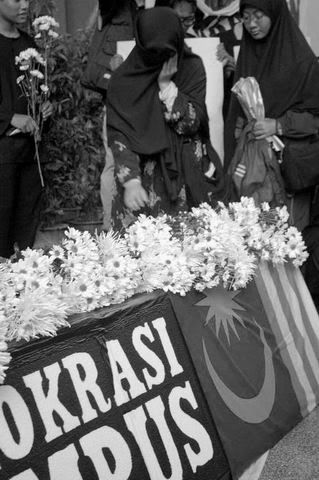
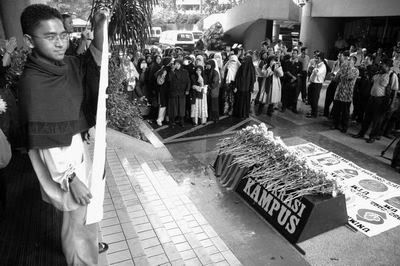
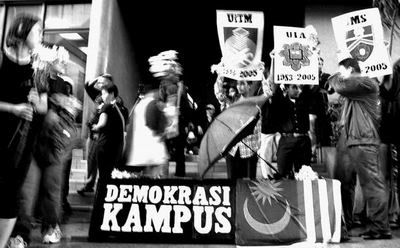
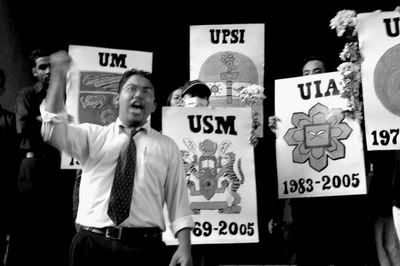

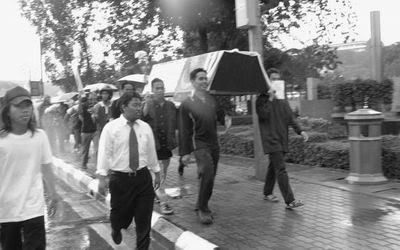
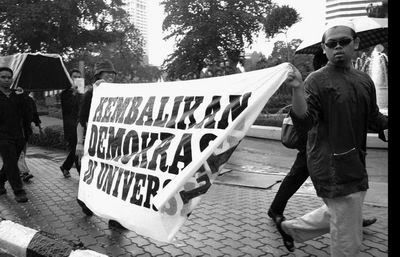
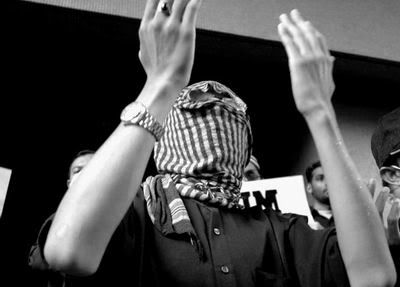
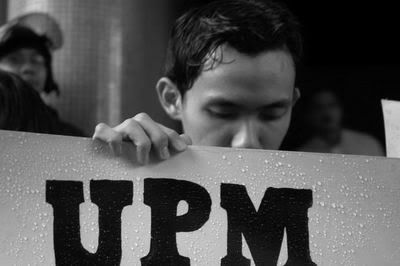
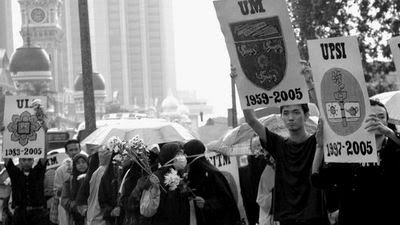
Funeral March: Demokrasi Kampus
For full story, please see Carmen Nge's site: www.smallacts.blogspot.com
Tuesday, February 01, 2005
Reporting from Aceh
ADOPT AN ORPHAN FROM ACEH? NOT.
Pictures and story by Ong Ju Lin in Banda Aceh
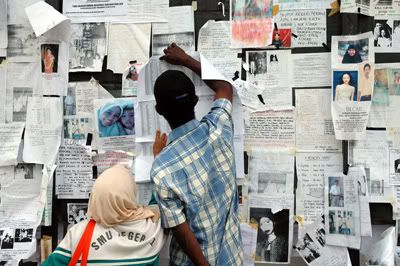
Looking for survivors.
It is a different world on the ground. For us working in the field, it is a world of mobile clinics, relief distribution, logistics, IDPs (internally displaced persons), UN coordination meetings, health surveillance meetings, etc…Ironically, while you’re at the place where the real stuff is and if you’re focused on one project, you can feel quite insulated from the news that is circulated outside of ground zero.
That was how I felt when I heard of Malaysian well-wishers who would like to adopt orphans after reading heart-rending news about children who lost their parents in the tsunami that hit northern Sumatra on a day after Christmas last year.
The subject of “adopting” orphans was raised by one Malaysian reporter working for a Japanese news station. He was with his two other colleagues when they ran into me and the Hospital Tentera KESDAM where our Mercy medical team was based. Expressing admiration for Mercy’s work, they gave us the thumbs up and said they were proud to be Malaysians.
One of them told me that with all the news about orphans, he knew at least five Malaysians who would like to be part of an “adopt-an-orphan” project and if we knew of such a programme would we notify him.
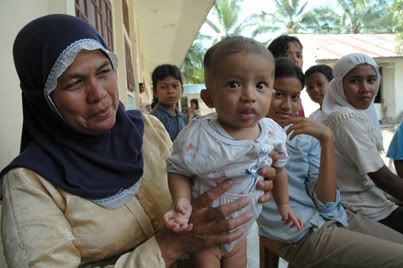
Orphaned survivors: alive and happy.
I’ve seen those programmes. It gives the benefactor much satisfaction knowing that his or her money goes into raising an orphaned kid. In some programmes, the benefactor can choose a child from a photo album a child whose face calls out to him. Personally, I find that distasteful. It reminds me of men in priviledged position choosing post-mail brides from a less wealthier country.
I told our friend, the reporter, that there is no such programme here. Not that I know of. With 80% of Banda Aceh devastated, things were just starting to move, not to normality, but to move out of shock phase into relief response. I can’t imagine a project that demands such complex administrative effort in place.
And I was thinking of the orphanage we visited yesterday. The religious association that housed them was swamped with 200 children orphaned by the disaster. The ustaz (religious teacher) used to run a sekolah mengaji (school for learning to read the Quran) and suddenly found themselves with requests to take in orphans from surrounding villagers destroyed by the deluge.
All the kids have lost one or both parents. And yet, we would not have known their harrowing experience had we not probed. When asked by Mercy volunteer psychologist Loh Sit Fong to draw what was troubling them, many hauntingly depicted the same things.
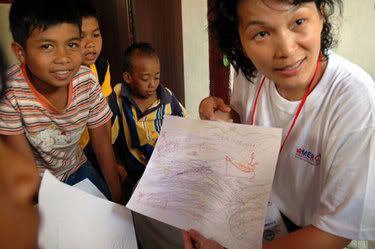
The children's drawings depict their haunting memories.
Giant waves bearing down on people, houses and trees; capsized boats, helicopters hovering above, and survivors escaping into the mountains. When asked if they were in the picture, they would point out to one of the stick figures running on the hills. According to our doctors, some of them complained of heart palpitations and insomnia. These are post-traumatic symptoms.
But we were amazed by their resilience. Loh said the kids told her that it was because everyone had the same experience that they could rationalize their own experience. They were not alone. It was indeed a fate of humanity, God’s will. “We thought it was hari kiamat (Judgment Day),” they said. It was with this knowledge of collective suffering that they could find strength to let go the lost of their families, find solace with each other and camaraderie with the living.
At the orphanage, they were all treated equally, wearing old donated clothes, eating the same food, getting the same treatment from their teachers, praying at the same time and sleeping on the same plank beds. After the unimaginable chaos, the routine gives them a sense of security. They went wild when we gave each a balloon and a soft toy to play with. They were equal in suffering and equal in receiving love and care.
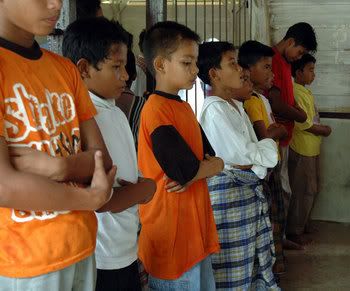
Praying together at set times gave them a sense of routine and stability.
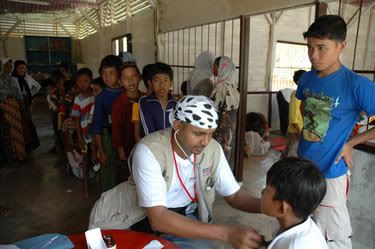
Volunteer doctors say the orphans have post-traumatic symptoms such as insomnia.
I can’t imagine an “adopt-a-child-programme” being in place here. How do you tell an orphan who has a sponsor that he or she is more deserving than the others? How do you tell the other children that they are less deserving or that they have to wait for sponsors before they could get their uniforms to go to school? Or if indeed if all 200 orphans each had a benefactor, how do you control what each benefactor sends to his adopted child?
What if the sponsor forgets about the kid after a year or a few months of sponsoring him? How do you explain this to the kid?
It would be an administrative nightmare to organize a one to one “adopt-an-orphan programme” here where the most basic communication infrastructure has been destroyed.
The Christian-based World Vision runs a sponsor-a-child programme. Each child costs USD$30 a month but sponsors are not told how much of it goes to administration and how much of it goes to the child. I was told half of it goes to the community and half goes to the kid eventhough the child is advertised as the receiver, picture, hobbies and all.
Yes, the children need help. The people who run orphanages need help too- to run it. If Malaysians care for orphans, then they should care too for the people closest to them - the people managing the orphanages. Many have lost family members too. Everyone in Aceh is affected one way or another by the disaster. I talked to a father who lost his entire family to the sea.
“We could not outrun the waves coming behind us. My wife was running in front of us with our youngest child, and I was holding my two children. When the waves hit, I could not hold on to them. I had to let go off my children.”
He thought he would drown under the fury of the waves, and he called out Allah’s name over and over. The third time he surfaced, he found himself hanging on to a roof. Everyone was gone.
I could not hold back my tears as he spoke with such equanimity and reverence to his own lost. “Betapanya kuasa Allah” (How very powerful God is)," he said.
When he saw my tears he said: “Child, do not cry. Allah yang memberi, Allah yang mengambil.” (Allah gives and Allah takes away.)
Most Acheneses whom I spoke to are happy to tell me that they have connections to Malaysia. They are grateful that we have come to their aid. They have either worked or studied in Malaysia, have relations there, or have been arrested at Semenyih detention camp for being “illegal immigrants.”
One told me that because of our amnesty programme just before the new year’s crackdown on undocumented migrant workers, they have returned home bringing with them electronic items and other gifts for families, which unfortunately have all been lost in the earthquake and tsunami.
In Malaysia, an Achenese is an “illegal immigrant”. We do not recognise Achenese escaping from political unrest in the conflict-ridden province as political refugees. We detained them for months and sent them back to die, if they had not already died from treatable diseases in the notorious Semenyih detention camp.
Our hypocrisy makes me angry - that our xenophobic paranoia would not allow us to see them as brothers, but now we are queuing up to adopt their children.
And they are our brothers. We share the same types of foods, the same language, the same religion. We are the same people violently separated by an artificial boundary imposed by our colonial masters (the British in Malaya and the Dutch in Indonesia) for political and economic interest just less then a hundred years ago. But now our governments hang on to them as if it was God-given, as if we have been different people from eternity.
This outpouring of generosity… how genuine are we in being generous? Can we only respond to a forgotten people after a tragedy of this scale? Can we not see them as human beings equal to us? Can we only respond to them as unequals – hate and fear them (as illegal immigrants) or pity them (as victims of tsunami)?
Is pity the only emotion that can move us to help?
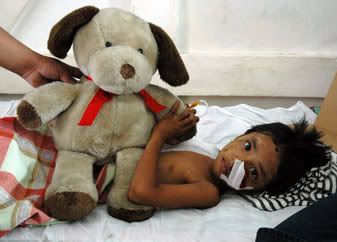
I believe it is because we do not see them as equals that we are talking about adopting their orphans as a way to save them. They do not deserve only our pity.
They are an independent and resilient people. Many are going back to rebuild their homes and lives because they could not just wait while their government decides what to do. They are tired of receiving hand-outs of old clothes and instant noodles. Already it seems like the small town of Lumbaro a little away from the devastated area - noisy and clogged with animals, people and traffic - has become the new centre.
I believe if we offer them a little head start - some capital and later, jobs- they would be able to rebuild their lives on their own, while the billions of aid concentrates on rebuilding infrastructure like roads, providing clean water and electricity. It is not pity they need, some help, yes, but respect and dignity as a people.
Ong Ju Lin was in Banda Aceh with Mercy Malaysia 2nd Mission from Jan 2, 2005 to Jan 15, 2005. The opinions expressed in this feature is entirely my own and do not represent that of Mercy Malaysia.
Pictures and story by Ong Ju Lin in Banda Aceh
Looking for survivors.
It is a different world on the ground. For us working in the field, it is a world of mobile clinics, relief distribution, logistics, IDPs (internally displaced persons), UN coordination meetings, health surveillance meetings, etc…Ironically, while you’re at the place where the real stuff is and if you’re focused on one project, you can feel quite insulated from the news that is circulated outside of ground zero.
That was how I felt when I heard of Malaysian well-wishers who would like to adopt orphans after reading heart-rending news about children who lost their parents in the tsunami that hit northern Sumatra on a day after Christmas last year.
The subject of “adopting” orphans was raised by one Malaysian reporter working for a Japanese news station. He was with his two other colleagues when they ran into me and the Hospital Tentera KESDAM where our Mercy medical team was based. Expressing admiration for Mercy’s work, they gave us the thumbs up and said they were proud to be Malaysians.
One of them told me that with all the news about orphans, he knew at least five Malaysians who would like to be part of an “adopt-an-orphan” project and if we knew of such a programme would we notify him.
Orphaned survivors: alive and happy.
I’ve seen those programmes. It gives the benefactor much satisfaction knowing that his or her money goes into raising an orphaned kid. In some programmes, the benefactor can choose a child from a photo album a child whose face calls out to him. Personally, I find that distasteful. It reminds me of men in priviledged position choosing post-mail brides from a less wealthier country.
I told our friend, the reporter, that there is no such programme here. Not that I know of. With 80% of Banda Aceh devastated, things were just starting to move, not to normality, but to move out of shock phase into relief response. I can’t imagine a project that demands such complex administrative effort in place.
And I was thinking of the orphanage we visited yesterday. The religious association that housed them was swamped with 200 children orphaned by the disaster. The ustaz (religious teacher) used to run a sekolah mengaji (school for learning to read the Quran) and suddenly found themselves with requests to take in orphans from surrounding villagers destroyed by the deluge.
All the kids have lost one or both parents. And yet, we would not have known their harrowing experience had we not probed. When asked by Mercy volunteer psychologist Loh Sit Fong to draw what was troubling them, many hauntingly depicted the same things.
The children's drawings depict their haunting memories.
Giant waves bearing down on people, houses and trees; capsized boats, helicopters hovering above, and survivors escaping into the mountains. When asked if they were in the picture, they would point out to one of the stick figures running on the hills. According to our doctors, some of them complained of heart palpitations and insomnia. These are post-traumatic symptoms.
But we were amazed by their resilience. Loh said the kids told her that it was because everyone had the same experience that they could rationalize their own experience. They were not alone. It was indeed a fate of humanity, God’s will. “We thought it was hari kiamat (Judgment Day),” they said. It was with this knowledge of collective suffering that they could find strength to let go the lost of their families, find solace with each other and camaraderie with the living.
At the orphanage, they were all treated equally, wearing old donated clothes, eating the same food, getting the same treatment from their teachers, praying at the same time and sleeping on the same plank beds. After the unimaginable chaos, the routine gives them a sense of security. They went wild when we gave each a balloon and a soft toy to play with. They were equal in suffering and equal in receiving love and care.
Praying together at set times gave them a sense of routine and stability.
Volunteer doctors say the orphans have post-traumatic symptoms such as insomnia.
I can’t imagine an “adopt-a-child-programme” being in place here. How do you tell an orphan who has a sponsor that he or she is more deserving than the others? How do you tell the other children that they are less deserving or that they have to wait for sponsors before they could get their uniforms to go to school? Or if indeed if all 200 orphans each had a benefactor, how do you control what each benefactor sends to his adopted child?
What if the sponsor forgets about the kid after a year or a few months of sponsoring him? How do you explain this to the kid?
It would be an administrative nightmare to organize a one to one “adopt-an-orphan programme” here where the most basic communication infrastructure has been destroyed.
The Christian-based World Vision runs a sponsor-a-child programme. Each child costs USD$30 a month but sponsors are not told how much of it goes to administration and how much of it goes to the child. I was told half of it goes to the community and half goes to the kid eventhough the child is advertised as the receiver, picture, hobbies and all.
Yes, the children need help. The people who run orphanages need help too- to run it. If Malaysians care for orphans, then they should care too for the people closest to them - the people managing the orphanages. Many have lost family members too. Everyone in Aceh is affected one way or another by the disaster. I talked to a father who lost his entire family to the sea.
“We could not outrun the waves coming behind us. My wife was running in front of us with our youngest child, and I was holding my two children. When the waves hit, I could not hold on to them. I had to let go off my children.”
He thought he would drown under the fury of the waves, and he called out Allah’s name over and over. The third time he surfaced, he found himself hanging on to a roof. Everyone was gone.
I could not hold back my tears as he spoke with such equanimity and reverence to his own lost. “Betapanya kuasa Allah” (How very powerful God is)," he said.
When he saw my tears he said: “Child, do not cry. Allah yang memberi, Allah yang mengambil.” (Allah gives and Allah takes away.)
Most Acheneses whom I spoke to are happy to tell me that they have connections to Malaysia. They are grateful that we have come to their aid. They have either worked or studied in Malaysia, have relations there, or have been arrested at Semenyih detention camp for being “illegal immigrants.”
One told me that because of our amnesty programme just before the new year’s crackdown on undocumented migrant workers, they have returned home bringing with them electronic items and other gifts for families, which unfortunately have all been lost in the earthquake and tsunami.
In Malaysia, an Achenese is an “illegal immigrant”. We do not recognise Achenese escaping from political unrest in the conflict-ridden province as political refugees. We detained them for months and sent them back to die, if they had not already died from treatable diseases in the notorious Semenyih detention camp.
Our hypocrisy makes me angry - that our xenophobic paranoia would not allow us to see them as brothers, but now we are queuing up to adopt their children.
And they are our brothers. We share the same types of foods, the same language, the same religion. We are the same people violently separated by an artificial boundary imposed by our colonial masters (the British in Malaya and the Dutch in Indonesia) for political and economic interest just less then a hundred years ago. But now our governments hang on to them as if it was God-given, as if we have been different people from eternity.
This outpouring of generosity… how genuine are we in being generous? Can we only respond to a forgotten people after a tragedy of this scale? Can we not see them as human beings equal to us? Can we only respond to them as unequals – hate and fear them (as illegal immigrants) or pity them (as victims of tsunami)?
Is pity the only emotion that can move us to help?
I believe it is because we do not see them as equals that we are talking about adopting their orphans as a way to save them. They do not deserve only our pity.
They are an independent and resilient people. Many are going back to rebuild their homes and lives because they could not just wait while their government decides what to do. They are tired of receiving hand-outs of old clothes and instant noodles. Already it seems like the small town of Lumbaro a little away from the devastated area - noisy and clogged with animals, people and traffic - has become the new centre.
I believe if we offer them a little head start - some capital and later, jobs- they would be able to rebuild their lives on their own, while the billions of aid concentrates on rebuilding infrastructure like roads, providing clean water and electricity. It is not pity they need, some help, yes, but respect and dignity as a people.
Ong Ju Lin was in Banda Aceh with Mercy Malaysia 2nd Mission from Jan 2, 2005 to Jan 15, 2005. The opinions expressed in this feature is entirely my own and do not represent that of Mercy Malaysia.
Sunday, July 04, 2004
AIDS - The "Lucrative" Disease
by Ong Ju Lin
The Aids cause is no longer a fringe movement. It has become mainstream. The cause now belongs to governments, world leaders and corporations. From a marginalised movement championed by gay activists in America, it has become a multibillion dollar industry supporting research institutions, governments, NGOs and pharmaceuticals.
This year’s International Aids Conference held from July 11 to July 16 in Bangkok is a reflection of how rich and powerful the “Aids industry” has become. The organiser paraded the record number of participants and abstracts received as if figures reflected the conference’s success. A total of 17,000 delegates and 3,000 journalists descended on Bangkok for the biennial gala which costs US$17 million of which almost 10,000 participants paid US$1,000 to get in.
The organiser - Stolkholm-based International Aids Society - said its theme was an attempt to bring back the focus on people. Access for all is to provide access of treatment and prevention services to all infected people and access to resources to scientists, community workers and leaders in the public and private sectors.
But critical questions, as Chief Rapporteur of Clinical Research, Treatment and Care Bernard Hirschel asked “Access to what, to whom, by whom and at what costs and consequences?” were not addressed.
After 20 years living with HIV/Aids, access to treatment invariably means access to anti-retrovirals (ARVs), the standard drug for Aids, of which 93 percent living with HIV/Aids have no access to due to high pricing and lack of public health infrastructure.
Even if the question of access is resolved, ARVs are not cures, but more like stopgap measures. Based on chemotherapy drugs to treat cancer, they are highly toxic and users develop resistance to it. In America, as many as 30 percent have resistant strains in them.
Furthermore, free ARVs do not translate to free treatment as the costs of monitoring, treatment of side effects, not to mention the costs of second line drugs when the viral strain develops resistance to first line drugs must be factored in. These are hidden costs that invariably gets lost in ARVs delivery.
This year, there are no breakthrough on drugs and vaccines recognised at the conference. Although vaccines have the potential to wipe out the pandemic, global private efforts in vaccine research has been estimated at USD$100 million a year; this in contrast with investments in drug research that run into billions with a sales return of an estimated USD$ 5 billion.
According to investigative journalist Jon Cohen, big pharmas were “avoiding vaccines like the plague” because they take a longer time to develop, rasied serious liability issues and offer a paltry profit margin compared to drugs.
Are there no alternative cheaper and safer prevention and treatments methods? Or are they excluded from the conference’s agenda?
Affordable, effective treatments excluded
A look at the conference abstract revealed that effective, affordable and safe treatments but not sponsored by pharmaceuticals were excluded. For instance, multivitamin therapies, nutrition and diet regiments, selenium combination therapies and treatments using traditional herbs that have proven to be effective, such as Metrafaids developed in Senegal.
These marginalised studies are undergoing research not only with little support from governments and international funders, but continually face obstacles in getting their products recognised. Some, for instance, a Thai-based oral therapeutic vaccine with prophylactive potential, the V1 Immunitor, has been highlighted in peer reviewed journals such as Vaccine and Immunology with very promising results.
These journals publish only scientifically evaluated findings according to validated protocols. However, their abstracts for presentation at the conference were rejected again as they were two years ago in Barcelona.
Dr Laurent Hiffler of the International Project for Affordable Therapy for HIV (Europe) said because these treatments are cheap and affordable, they have been largely ignored by governments and conferences such as this.
“There is vested interest and the element of profit over the healthcare of people who are in need,” he said. The IAS acknowledge that it is the big pharmaceutical companies that have the money to fund their projects. The conference programme named GlaxoSmithKline, Gilead, Pfizer, Roche, Abbott Virology, Bristol-Myers Squib and MSD as “preferred sponsors” of the conference.
“What do you tell doctors who have people queuing up for highly active antiretrovirals (HAART) and there is none available. There must be something between HAART and palliative care. Treatments that yield benefits to patients must be given the same amount of attention and funding as ARVs,” he said
Questioning science
The International Aids Conference was one of those few Aids initiative that linked community and science together in one conference. The premise is good. Science and research into HIV and Aids should not be divorced from the concerns of community work, social activism and public policy.
But how effective is such an arrangement without a real understanding of the basic questions about science? From my observation, other than press announcements of scientific progress, there is little intermingling between the two sectors.
Science speaks in a language largely incomprehensible to most people. Community workers, activists and policymakers leave drug and vaccine research to the experts while they focus on raising awareness and prevention. Most scientists look down on social and community activism as a waste of time, thinking that community work is merely driven by rhetoric and vacuous activities while they are doing the real work.
Yet, more than ever, there needs to be more scrutiny on what scientists are doing. Are we going on the right path? Are the types of scientific research that are conducted being done only because they were funded by the promise of big returns rather than the goal of eradicating the disease?
Dr Yahaya Sekagya, Prometra (Uganda) representative who was co-charing the only session for traditional medicines, asked some provocative questions: "When does science begins? At what point does practice become science? What do we mean by evidence? Whose philosophical approach are we using when we define efficacy and evidence?"
Sekagya said conventional Western-based science assumes a universality defined by a paradigm of knowledge that is not open to other forms of knowledge.
The definitions used for best treatments during the rapporteur session is telling. Best treatments for HIV/Aids, according to the Chief Rapporteur are measured by a drug treatment that could bring down viral load by 50 percent in six months with low toxicity, long term drug efficacy without resistance, and long term survival of the patient.
What about the patient’s quality of life? What happens to the patient as a thinking, feeling and living person? Has the patient been reduced to viral load, drug efficacy and survival rate?
It is no wonder that the Global Network of People Living with HIV/Aids (GNP+) complained at the conference, that HIV positive people are referred to as an abstraction and not as a person.
In conventional science, good data are ones supported by evidence in numbers. Fair enough, but how does one quantify a patient saying that he can go back to work, or that his skin infections have cleared and he can join society again without being stigmatized because he “looks like an Aids patient”?
Patient-specific evidence are often brushed away as anecdotal evidence. Therapies that are patient-specific, that employ different kinds of treatments according to patient needs cannot be subjected to double-blind placebo trials. These controlled trials are good for drugs or very specific kinds of treatments that assume every patient is the same.
Aids is an autoimmune disease that manifests itself into so many life threatening symptoms, where diet, nutrition, lifestyle and behaviour are variables that affect the progression of the disease. This science that depersonalise patients in exchange for “scientific rigor” is not necessarily the best way to find the best treatment for Aids. A science with a more human face and patient-based therapies must be explored to measure treatment efficacy.
This year 10,000 abstracts were submitted and 8,641 were accepted for presentation. The numbers are large, but they do not necessarily represent a wide range of diversity. In treatments, ARVs continue to dominate, while other more affordable treatments are neglected. The criteria for successful acceptance and reasons for rejection must be revealed for public scrutiny.
Community rapporteur Shawn Mellor called for a more diverse representation of ideas and experiences for the next conference in 2006 in Toronto. “The review committee for abstracts needs to be renewed to represent the diversities from the ground.”
If the UNAIDS ‘3 by 5' aim of providing treatment for three million by 2005 were to be realised, there must be greater commitment to source out safe, affordable and effective treatment, other than ARVs. Aids activists who protest for multinational pharmaceutical companies to lower drug prices and demand for generic drugs are all narrowly focused on access to the 20 available ARV drugs in the world, manufactured by Western-based pharmaceuticals.
It is time they turn their attention to seek out alternative treatments and push for affordable therapies to be recognised and supported.
ONG JU LIN was reporting on the conference from Bangkok for Malaysiakini. Published in http://www.malaysiakini.com/ on Jul 20, 2004 12:49pm
The Aids cause is no longer a fringe movement. It has become mainstream. The cause now belongs to governments, world leaders and corporations. From a marginalised movement championed by gay activists in America, it has become a multibillion dollar industry supporting research institutions, governments, NGOs and pharmaceuticals.
This year’s International Aids Conference held from July 11 to July 16 in Bangkok is a reflection of how rich and powerful the “Aids industry” has become. The organiser paraded the record number of participants and abstracts received as if figures reflected the conference’s success. A total of 17,000 delegates and 3,000 journalists descended on Bangkok for the biennial gala which costs US$17 million of which almost 10,000 participants paid US$1,000 to get in.
The organiser - Stolkholm-based International Aids Society - said its theme was an attempt to bring back the focus on people. Access for all is to provide access of treatment and prevention services to all infected people and access to resources to scientists, community workers and leaders in the public and private sectors.
But critical questions, as Chief Rapporteur of Clinical Research, Treatment and Care Bernard Hirschel asked “Access to what, to whom, by whom and at what costs and consequences?” were not addressed.
After 20 years living with HIV/Aids, access to treatment invariably means access to anti-retrovirals (ARVs), the standard drug for Aids, of which 93 percent living with HIV/Aids have no access to due to high pricing and lack of public health infrastructure.
Even if the question of access is resolved, ARVs are not cures, but more like stopgap measures. Based on chemotherapy drugs to treat cancer, they are highly toxic and users develop resistance to it. In America, as many as 30 percent have resistant strains in them.
Furthermore, free ARVs do not translate to free treatment as the costs of monitoring, treatment of side effects, not to mention the costs of second line drugs when the viral strain develops resistance to first line drugs must be factored in. These are hidden costs that invariably gets lost in ARVs delivery.
This year, there are no breakthrough on drugs and vaccines recognised at the conference. Although vaccines have the potential to wipe out the pandemic, global private efforts in vaccine research has been estimated at USD$100 million a year; this in contrast with investments in drug research that run into billions with a sales return of an estimated USD$ 5 billion.
According to investigative journalist Jon Cohen, big pharmas were “avoiding vaccines like the plague” because they take a longer time to develop, rasied serious liability issues and offer a paltry profit margin compared to drugs.
Are there no alternative cheaper and safer prevention and treatments methods? Or are they excluded from the conference’s agenda?
Affordable, effective treatments excluded
A look at the conference abstract revealed that effective, affordable and safe treatments but not sponsored by pharmaceuticals were excluded. For instance, multivitamin therapies, nutrition and diet regiments, selenium combination therapies and treatments using traditional herbs that have proven to be effective, such as Metrafaids developed in Senegal.
These marginalised studies are undergoing research not only with little support from governments and international funders, but continually face obstacles in getting their products recognised. Some, for instance, a Thai-based oral therapeutic vaccine with prophylactive potential, the V1 Immunitor, has been highlighted in peer reviewed journals such as Vaccine and Immunology with very promising results.
These journals publish only scientifically evaluated findings according to validated protocols. However, their abstracts for presentation at the conference were rejected again as they were two years ago in Barcelona.
Dr Laurent Hiffler of the International Project for Affordable Therapy for HIV (Europe) said because these treatments are cheap and affordable, they have been largely ignored by governments and conferences such as this.
“There is vested interest and the element of profit over the healthcare of people who are in need,” he said. The IAS acknowledge that it is the big pharmaceutical companies that have the money to fund their projects. The conference programme named GlaxoSmithKline, Gilead, Pfizer, Roche, Abbott Virology, Bristol-Myers Squib and MSD as “preferred sponsors” of the conference.
“What do you tell doctors who have people queuing up for highly active antiretrovirals (HAART) and there is none available. There must be something between HAART and palliative care. Treatments that yield benefits to patients must be given the same amount of attention and funding as ARVs,” he said
Questioning science
The International Aids Conference was one of those few Aids initiative that linked community and science together in one conference. The premise is good. Science and research into HIV and Aids should not be divorced from the concerns of community work, social activism and public policy.
But how effective is such an arrangement without a real understanding of the basic questions about science? From my observation, other than press announcements of scientific progress, there is little intermingling between the two sectors.
Science speaks in a language largely incomprehensible to most people. Community workers, activists and policymakers leave drug and vaccine research to the experts while they focus on raising awareness and prevention. Most scientists look down on social and community activism as a waste of time, thinking that community work is merely driven by rhetoric and vacuous activities while they are doing the real work.
Yet, more than ever, there needs to be more scrutiny on what scientists are doing. Are we going on the right path? Are the types of scientific research that are conducted being done only because they were funded by the promise of big returns rather than the goal of eradicating the disease?
Dr Yahaya Sekagya, Prometra (Uganda) representative who was co-charing the only session for traditional medicines, asked some provocative questions: "When does science begins? At what point does practice become science? What do we mean by evidence? Whose philosophical approach are we using when we define efficacy and evidence?"
Sekagya said conventional Western-based science assumes a universality defined by a paradigm of knowledge that is not open to other forms of knowledge.
The definitions used for best treatments during the rapporteur session is telling. Best treatments for HIV/Aids, according to the Chief Rapporteur are measured by a drug treatment that could bring down viral load by 50 percent in six months with low toxicity, long term drug efficacy without resistance, and long term survival of the patient.
What about the patient’s quality of life? What happens to the patient as a thinking, feeling and living person? Has the patient been reduced to viral load, drug efficacy and survival rate?
It is no wonder that the Global Network of People Living with HIV/Aids (GNP+) complained at the conference, that HIV positive people are referred to as an abstraction and not as a person.
In conventional science, good data are ones supported by evidence in numbers. Fair enough, but how does one quantify a patient saying that he can go back to work, or that his skin infections have cleared and he can join society again without being stigmatized because he “looks like an Aids patient”?
Patient-specific evidence are often brushed away as anecdotal evidence. Therapies that are patient-specific, that employ different kinds of treatments according to patient needs cannot be subjected to double-blind placebo trials. These controlled trials are good for drugs or very specific kinds of treatments that assume every patient is the same.
Aids is an autoimmune disease that manifests itself into so many life threatening symptoms, where diet, nutrition, lifestyle and behaviour are variables that affect the progression of the disease. This science that depersonalise patients in exchange for “scientific rigor” is not necessarily the best way to find the best treatment for Aids. A science with a more human face and patient-based therapies must be explored to measure treatment efficacy.
This year 10,000 abstracts were submitted and 8,641 were accepted for presentation. The numbers are large, but they do not necessarily represent a wide range of diversity. In treatments, ARVs continue to dominate, while other more affordable treatments are neglected. The criteria for successful acceptance and reasons for rejection must be revealed for public scrutiny.
Community rapporteur Shawn Mellor called for a more diverse representation of ideas and experiences for the next conference in 2006 in Toronto. “The review committee for abstracts needs to be renewed to represent the diversities from the ground.”
If the UNAIDS ‘3 by 5' aim of providing treatment for three million by 2005 were to be realised, there must be greater commitment to source out safe, affordable and effective treatment, other than ARVs. Aids activists who protest for multinational pharmaceutical companies to lower drug prices and demand for generic drugs are all narrowly focused on access to the 20 available ARV drugs in the world, manufactured by Western-based pharmaceuticals.
It is time they turn their attention to seek out alternative treatments and push for affordable therapies to be recognised and supported.
ONG JU LIN was reporting on the conference from Bangkok for Malaysiakini. Published in http://www.malaysiakini.com/ on Jul 20, 2004 12:49pm
Subscribe to:
Posts (Atom)


